Glossary
The vocabulary, defined properly.
Every term used in eKYC, AML screening, liveness, signing and the platform itself, in plain words, with the Lebanon and Gulf context the global glossaries leave out.
- terms defined
- 52
- sections
- 7
- Sentence answers alone
- 1st
- Last reviewed 16 Aug 2026
- Dated
The terms
Search a word, or pick a letter.
By letter
52 of 52 terms
10 TERMS
Identity verification
The vocabulary of proving that a person is who they claim to be, from a document and a face.
KYC
Know Your Customer
KYC is the regulatory obligation to identify a client and verify that identity before doing business with them. It covers collecting identifying information, verifying it against reliable and independent evidence, understanding the purpose of the relationship, and keeping the record current for as long as the relationship lasts. KYC is the obligation; eKYC is one way of discharging it.
eKYC
Electronic Know Your Customer
eKYC is the remote, electronic performance of client identification and verification, with no branch visit and no paper. A typical eKYC flow captures an identity document, extracts its data, checks the document is genuine and physically present, captures a selfie, matches the face against the document, and screens the resulting identity against sanctions and PEP lists.
In Lebanon, remote eKYC requires prior approval from Banque du Liban and is subject to a payment account ceiling. The approval attaches to the institution, never to the vendor.
KYB
Know Your Business
KYB is the equivalent of KYC applied to a legal entity rather than a person. It verifies the company’s registration, its legal form, its jurisdiction and its standing, then identifies the natural persons behind it, meaning directors, authorised signatories and beneficial owners, and runs the same screening on each of them.
OCR
Optical Character Recognition
OCR is the automated reading of printed or written characters from an image into machine-readable text. In identity verification it turns a photograph of an identity card into structured fields such as name, date of birth, document number and expiry date, which is what removes manual typing from onboarding.
Assentify runs templated OCR for regional documents on its own fine-tuned vision model, in Arabic and English, with a template playground for tuning new documents.
MRZ
Machine Readable Zone
The MRZ is the band of monospaced characters at the foot of a passport or identity card, encoded so that a machine can read it reliably. It repeats the holder’s key data in a fixed format with check digits, which means an MRZ read can be validated arithmetically rather than merely transcribed.
ICAO 9303
ICAO 9303 is the international standard that defines how machine readable travel documents are laid out and encoded. It specifies the size of the document, the structure of the machine readable zone, the check digit arithmetic and the data groups held on the contactless chip in an electronic passport. A passport described as ICAO compliant can be parsed by any conforming reader anywhere in the world.
Face matching
Face matching is the comparison of two face images to produce a score expressing how likely it is that they show the same person. In onboarding it compares the live selfie against the face extracted from the identity document, which is a one to one comparison. Comparing one face against a whole population, one to many, is a different and much harder problem used for de-duplication.
Match percentage
The match percentage is the score Assentify records for the live face against the face extracted from the identity document. It is stored on the interaction record, shown to the reviewer beside both images, and can be used as a condition in an automated decision rule. A low score is one of the events that flags a record for manual review.
Biometric template
A biometric template is the mathematical encoding of a biometric sample, not the image itself. A face template is a vector derived from the face image and used for comparison; it is not reversible into a photograph, and it is what gets stored and matched rather than the original picture. Treating templates as personal data is the correct default under GDPR and equivalent regimes.
De-duplication
De-duplication is the prevention of the same human being onboarded more than once under different identities. Assentify offers two mechanisms that combine: biometric face encoding uniqueness, which compares the new face against existing client records, and field-level uniqueness on any chosen client profile elements. Duplicates matter because they defeat sanctions screening, inflate client counts and are the standard route to mule accounts and multiple loans.
5 TERMS
Liveness and fraud
The vocabulary of proving that the face and the document in front of the camera are real, and physically present.
Liveness detection
Liveness detection is the check that a real, living person is present at the camera rather than a photograph, a mask, a screen or a video. Passive liveness makes the judgement from a single capture without asking the user to do anything. Active liveness asks for an action, such as a head turn or a blink. Configurable liveness lets the institution choose the mode per flow.
Assentify passive liveness is iBeta certified, and active and configurable modes ship alongside it. Qatar’s E-KYC Regulation explicitly permits randomised real-time actions such as head tilting or eye movement.
Presentation attack detection
PAD
Presentation attack detection is the formal name for liveness: the ability of a biometric system to recognise an artefact presented to the sensor in place of a genuine trait. The artefacts are called presentation attack instruments and include printed photographs, screen replays, paper masks, silicone masks and video deepfakes played to the camera.
ISO/IEC 30107-3
ISO/IEC 30107-3 is the international standard that defines how presentation attack detection is tested and reported. It sets out the attack instruments, the test protocol and the error metrics, and it defines the levels that laboratories test against: Level 1 covers low-cost attack instruments such as prints and screen replays, Level 2 covers more expensive custom-made artefacts such as silicone masks. A liveness claim without a level and a laboratory is not a claim.
Injection attack
An injection attack bypasses the camera entirely and feeds synthetic imagery straight into the application or the video stream. It differs from a presentation attack, which is held up in front of a real camera, and it defeats systems that only analyse image content. Defences look at the device, the capture path and the integrity of the session as well as at the picture.
Document liveness
Document liveness is the check that the identity document itself is physically present rather than a photograph of a photograph or an image on a screen. Assentify exposes it as a per-step setting on Identification Document Capture, alongside tampering detection, which looks for a face or a data field laid on top of a genuine card.
13 TERMS
AML and compliance
The vocabulary a compliance officer uses when defending a decision to a supervisor.
AML
Anti-Money Laundering
AML is the body of law, regulation and operating procedure designed to stop criminal proceeds entering the financial system. For a regulated institution it produces four practical duties: identify and verify clients, understand and monitor their activity, screen them against sanctions and PEP data, and report suspicion to the national financial intelligence unit.
CDD
Customer Due Diligence
CDD is the standard set of checks an institution performs on every client before and during a relationship. It comprises identifying the client and verifying identity from reliable evidence, identifying beneficial owners, understanding the purpose and intended nature of the relationship, and conducting ongoing monitoring of transactions and of the record itself.
EDD
Enhanced Due Diligence
EDD is the heightened set of checks applied where risk is higher than standard. Triggers typically include politically exposed persons, high-risk jurisdictions, unusual transaction patterns, complex ownership structures and, in many regimes, non-face-to-face onboarding itself. EDD generally adds source of funds and source of wealth enquiries, senior approval to open or continue the relationship, and more frequent review.
PEP
Politically Exposed Person
A PEP is a person entrusted with a prominent public function, together with their close family members and known associates. PEP status is not an allegation of wrongdoing; it is a risk classification that triggers enhanced due diligence and senior sign-off. Screening for PEP status is configured separately from sanctions screening because the consequence of a match is different.
Sanctions screening
Sanctions screening is the comparison of a name and its attributes against lists of persons and entities subject to restrictive measures. A match is a candidate, not a conclusion: the name is compared, the attributes such as date of birth, country and document number are used to discriminate, and a human decides. Screening runs at onboarding and then continuously, because lists change after the account is open.
Assentify plugs into the data vendors institutions already trust, and carries the local Lebanese lists that others do not, namely ISF Leb 24 and SIC 18-26, alongside client-defined lists.
Adverse media
Adverse media screening searches news and other public sources for negative information about a person or entity. It catches risk that has not yet reached a sanctions list, such as an arrest, an investigation or a regulatory action, and it is usually the noisiest input in a screening programme because names are common and reporting is unstructured.
UBO
Ultimate Beneficial Owner
The ultimate beneficial owner is the natural person who ultimately owns or controls a legal entity, directly or through a chain of intermediaries. Most regimes set a shareholding threshold, commonly twenty-five percent, and then require the institution to look through layers of ownership until it reaches a human being. Where no owner meets the threshold, the senior managing official is identified instead.
RBA
Risk-Based Approach
The risk-based approach is the principle that an institution should apply its controls in proportion to the risk each client and product presents. In practice it means classifying clients into risk levels, applying simplified, standard or enhanced measures accordingly, and documenting why. FATF Recommendation 1 is the source of the principle and every national AML regime restates it.
Assentify implements this as a per-tenant setting: risk levels are defined, thresholds are set on a zero to ten strip, and the resulting RBA score appears on the client record in Client Clear.
Transaction monitoring
Transaction monitoring is the ongoing examination of client transactions to detect activity that is unusual for that client or indicative of financial crime. It runs on rules, on statistical models, or on both, and it is where the money laundering is actually detected, because onboarding checks who a person is while monitoring checks what they then do.
RTRA
Real-Time Transaction Risk Assessment
RTRA is the Assentify engine that assesses transaction risk in real time after onboarding. It watches three entity types out of the box, Sender, Receiver and Transaction, and accepts more; rules are built from entity, attribute, operator and value conditions, each with an action and an output message; and real-time AML screening checks can be included in the same pass. Rules can be permanent or temporary, with a defined span in days.
FATF
Financial Action Task Force
FATF is the intergovernmental body that sets the global standards for anti-money-laundering and counter-terrorist-financing. Its forty Recommendations are the template most national AML laws are written against, and its Guidance on Digital ID is the reference many regulators cite when permitting remote onboarding. FATF also publishes the list of jurisdictions under increased monitoring, commonly called the grey list.
Lebanon has been on the FATF list of jurisdictions under increased monitoring since October 2024. The commercial consequence is enhanced due diligence by correspondent banks on Lebanese counterparties.
Maker-checker
Maker-checker is the control that requires a second person to approve what a first person did. One user makes the change or the decision, a different user with the right permission reviews and approves it, and neither can do both. It is the standard defence against error and internal fraud in banking operations.
Assentify exposes Dual Maker/Checker Control as a platform-wide setting for changes to settings and flows. For approvals on individual applications, the pattern is built inside the flow itself, as a backend, connector, backend sequence.
Audit trail
An audit trail is the immutable record of who did what, to which object, and when. In a compliance system it has to capture the user, the timestamp, the event type and enough context to reconstruct the decision months later, and it has to be exportable, because the examiner will ask for it in their own format. Assentify records every compliance action in the Audit Hub, filterable by system user, decision and date range.
6 TERMS
Matching and language
Screening in this region is a language problem before it is a data problem.
Transliteration
Transliteration is the rendering of a name written in one script into another, for example an Arabic name into Latin characters. It is not translation and it is not deterministic: the same Arabic name yields several accepted Latin spellings depending on which convention the writer learned. Screening in this region has to search across those variants rather than assume one spelling.
Assentify Compliance Hub Workspace exposes Apply Transliteration To as a search control, so a name can be searched in Arabic script and in Latin script in the same pass.
Double Metaphone
Double Metaphone is a phonetic algorithm that encodes a name by how it sounds rather than how it is spelled, and returns two codes so that a name with more than one plausible pronunciation can match either. It is more tolerant of non-English names than its predecessors, which is why it appears in screening engines, but it was designed around English phonology and degrades on Arabic names rendered in Latin script.
Soundex
Soundex is the oldest phonetic matching algorithm in common use, encoding a name as its first letter followed by three digits representing consonant sounds. It is fast, blunt and generous: it will happily group names that sound only loosely alike, which produces recall at the cost of precision. It is useful as one weighted input into a screening profile, never as the whole of one.
Skeleton
Skeleton is a name matching code that compares a name on its characters only. Where Double Metaphone and Soundex model how a name sounds, the skeleton code sets sound aside and asks which characters the two renderings share. It catches drift that a phonetic code misses, and it is one of the three codes an Assentify screening profile searches on.
Edit distance
Edit distance is the number of single character changes needed to turn one string into another, so Khalil and Khaleel are one change apart. Assentify matches candidate names against the entries in the index by edit distance, allowing one and two character modifications, which is what absorbs the stray letter a clerk typed or a migration script dropped.
Screening profile
A screening profile is the named, reusable configuration that decides how a name is matched during screening. In Assentify an AI agent first generates candidate name variations, then the engine matches across those variations, the transliterated query names and the phonetic codes, Double Metaphone, Soundex and Skeleton, comparing candidates to the index by edit distance. Traditional algorithms, each with its own slider, and AI-driven matching are weighted per client; the recommended split is forty percent traditional and sixty percent AI. A profile is applied independently to Interactions, Client Clear and Workspace, so the onboarding queue and the ad-hoc search desk can be tuned differently.
6 TERMS
Signatures and trust services
The levels matter in some markets and the evidence matters in all of them.
Electronic signature
An electronic signature is data in electronic form attached to or logically associated with other data, which the signatory uses to sign. The definition is deliberately broad: a typed name, a drawn mark, a click on an accept button and a cryptographic signature can all qualify. What separates a strong electronic signature from a weak one is the identity evidence captured at the moment of signing, not the appearance of the mark.
Digital signature
A digital signature is an electronic signature implemented with public key cryptography. The signer’s private key produces a value over a hash of the document, and anyone holding the corresponding public key can verify both that the signer produced it and that the document has not changed since. Every digital signature is an electronic signature; most electronic signatures are not digital signatures.
SES
Simple Electronic Signature
A simple electronic signature is the base tier under eIDAS, meeting the general definition without additional assurance requirements. It is legally admissible across the European Union and cannot be denied legal effect solely because it is electronic, but its evidential weight is assessed case by case rather than presumed.
AES
Advanced Electronic Signature
An advanced electronic signature is one that is uniquely linked to the signatory, capable of identifying them, created using data under their sole control, and linked to the signed data so that any later change is detectable. Those four conditions are the eIDAS definition, and several non-EU laws in the region restate them almost word for word.
QES
Qualified Electronic Signature
A qualified electronic signature is an advanced electronic signature created by a qualified signature creation device and based on a qualified certificate. It is the only tier that eIDAS gives legal equivalence to a handwritten signature across the entire European Union. Producing one requires a qualified trust service provider on the relevant national trusted list.
No Lebanese signature can be described as qualified or accredited, because the accreditation machinery under COLIBAC is not operational.
eIDAS
eIDAS is the European regulation on electronic identification and trust services for electronic transactions in the internal market. It defines the three signature tiers, sets the rules for qualified trust service providers, and establishes mutual recognition of electronic identification across member states. It was amended in 2024 by the regulation known as eIDAS 2.0, which introduces the European Digital Identity Wallet.
4 TERMS
Lebanon
The local vocabulary, which is where the foreign glossaries stop.
SIC letter
A SIC letter is a written request from Lebanon’s Special Investigation Commission asking a bank or financial institution to search its records for named persons or entities and report what it holds. It arrives as a scanned document, is typically bilingual, and frequently carries many names on a single page. The receiving institution has to read it, match every name against its client base, and produce a documented response.
SICILIA is the Assentify processing agent for SIC letters. It runs locally in Lebanon, and every extracted page is validated by a human before anything is exported.
Special Investigation Commission
SIC
The Special Investigation Commission is Lebanon’s financial intelligence unit, an independent body with judicial status established under the anti-money-laundering law and chaired by the Governor of Banque du Liban. It receives suspicious transaction reports, investigates suspected money laundering and terrorist financing, and has the power to lift banking secrecy and freeze accounts. Its correspondence with institutions is what the market calls a SIC letter.
Banque du Liban
BDL
Banque du Liban is the central bank of Lebanon and the authority that issues the circulars governing electronic banking, remote onboarding and data hosting for banks and financial institutions. Its rules are the operative constraint on any eKYC deployment in Lebanon, including the requirement that data from electronic banking operations be stored in the country.
Lebanese Civil ID
The Lebanese Civil ID is the national identity card issued to Lebanese citizens, and the primary identity document in any Lebanese onboarding flow. It carries Arabic script, a civil registry reference and a layout that generic global document readers handle poorly, which is why regional template coverage matters more here than list coverage.
Assentify supports every Lebanese identity document, including the Civil ID, the passport and the driving licence.
8 TERMS
Platform and deployment
The words the product uses, so that a demo and a contract mean the same thing.
Flow
A flow is the full sequence of steps a client goes through, designed on the canvas and published to a channel. It is the central object in the Assentify platform: the thing you build, version, publish, share by link or QR code, and measure. The same flow reaches web, WhatsApp and a mobile app without being rebuilt.
Block
A block is one stage of a flow, and there are three kinds. The Engagement Block is what the client sees and interacts with. The Connector Block sends something outward, such as an email, an SMS, a WhatsApp message or a webhook. The Backend Block does the processing, including screening, decisions and the Application Processing Command Center.
Step
A step is a single unit of work inside a block. Client-facing steps include Block Loader, Identification Document Capture, Facial Image Acquisition, Assisted Data Entry, Compliance, Questionnaire, Terms and Conditions, Context Aware Signing and Wrap Up. Connector and backend steps include Web Hook, SMS, Email, WhatsApp, AML, Pre-Processing, Post-Processing and Decision Making.
Interaction
An interaction is one client’s single run through a flow, and the record it leaves behind. The interaction record holds the captured images, the extracted data, the device and user agent, the start and end times, the face match percentage, every screening list searched, and the decision taken. Interactions are the unit that billing and quota are measured in.
Client
A client is the person or business whose identity is verified and whose relationship is maintained, held as a client profile. Assentify supports three profile types, Person, Verified Person and Verified Business, each independently enabled and configured with its own screening cycle, expiry alerts and uniqueness rules.
Tenant
A tenant is one isolated environment belonging to one contracting organisation. Each tenant carries its own configuration, its own users, its own flows, its own data persistence setting and its own data. A single client may hold several tenants, typically production, user acceptance testing, quality assurance and demo, and non-production tenants draw a separate sandbox allowance.
Data residency
Data residency is the requirement that data be stored, and often processed, inside a defined jurisdiction. It is the objection that decides most regulated deals in this region, because a platform that can only be consumed as a foreign service cannot satisfy it at any price. The harder version of the question is where the model that reads the document and matches the face actually runs.
Assentify runs a local cloud and GPU servers inside Lebanon, and Data Persistence is a per-tenant setting with on cloud and on premise values.
On-premise deployment
On-premise deployment means the software runs on infrastructure the institution controls rather than in the vendor’s cloud. In Assentify it is a per-tenant Data Persistence setting rather than a separate product, and choosing it requires a proxy address to be configured. The Compliance Hub engine is also offered as a one-time on-premise package.
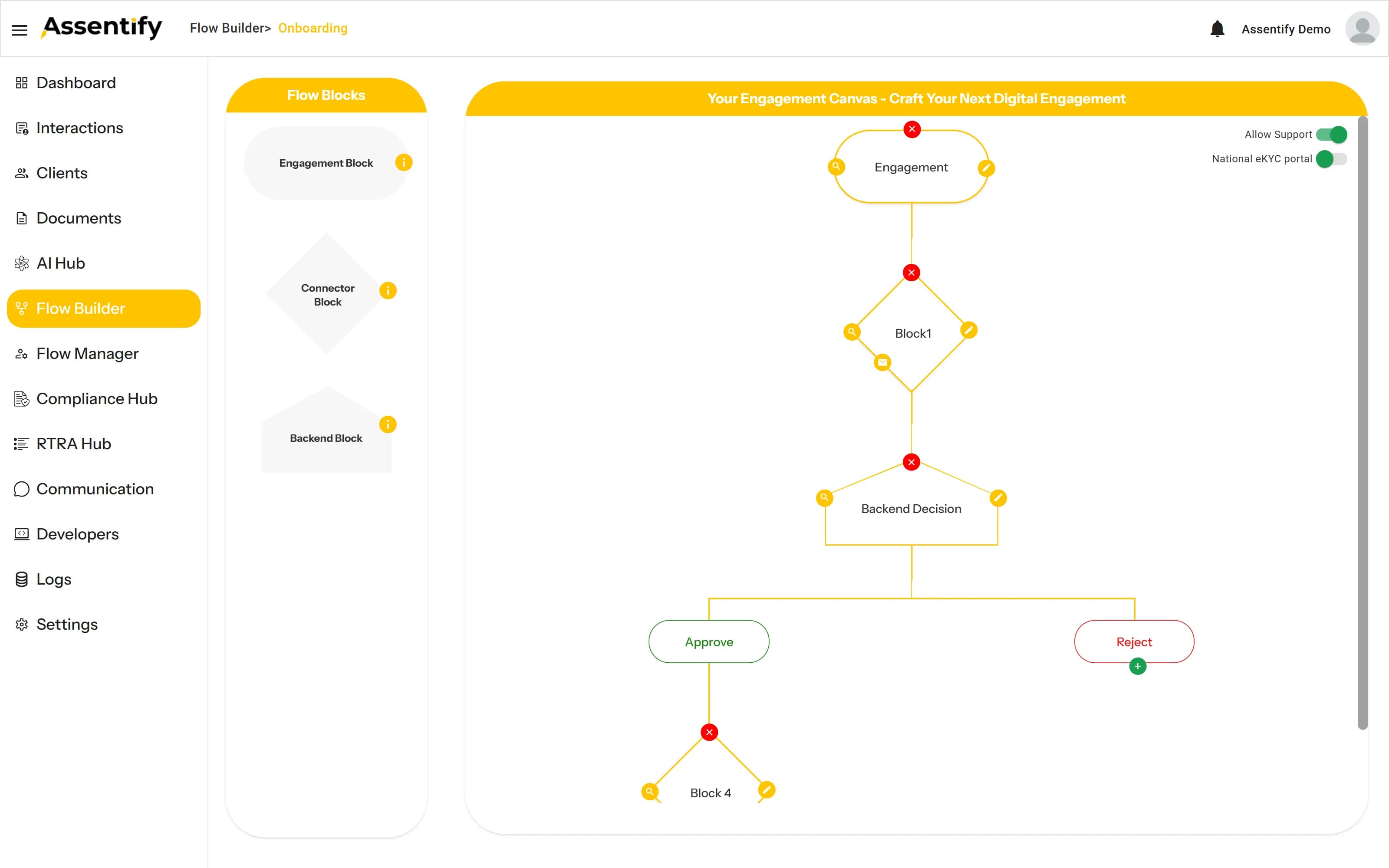
Flow, block and step
The platform words, on the screen they name.
A flow is drawn on the Flows Hub canvas. Its blocks come from the palette on the left, and each block holds the steps the client or the backend runs.
- Engagement Block: what the client sees
- Connector Block: what is sent outward
- Backend Block: where processing and decisions run
One word, two meanings
Half of every procurement argument is two people using one word differently.
A vendor says liveness and means a blink prompt. The bank hears a laboratory certification at a named level. A vendor says audit trail and means a log file. The examiner means an exportable record of who decided what, and when, that still makes sense a year later.
Where a term has a level, the level is named. Where the local meaning in Lebanon differs from the global one, the entry says so.
KYC is the regulatory obligation to identify and verify a customer; eKYC is one method of discharging it remotely and electronically. A branch clerk photocopying an identity card is performing KYC. A client photographing the same card on a phone, passing a liveness check and being screened automatically is performing eKYC. The obligation does not change with the channel, and in several markets, including Lebanon and Qatar, the electronic route requires prior approval from the regulator for the institution.
A digital signature is an electronic signature implemented with public key cryptography, so every digital signature is an electronic signature but not the reverse. An electronic signature is any data in electronic form used by a signatory to sign, which includes a typed name or a drawn mark. A digital signature adds cryptographic proof that a specific key produced the signature and that the document has not changed since.
Liveness detection and presentation attack detection are the same thing under two names: presentation attack detection is the formal term used in the ISO/IEC 30107 standard, and liveness detection is what the market calls it. The distinctions that matter are between passive and active modes, and between a presentation attack, which is held in front of a real camera, and an injection attack, which bypasses the camera entirely.
Transliteration matters in AML screening in this region because the same Arabic name has several accepted Latin spellings, and a screening engine that searches only one of them will miss matches. Whether a clerk learned French or English conventions changes the spelling, the definite article attaches or detaches, and long vowels are rendered inconsistently. Phonetic algorithms designed around English phonology, such as Soundex and Double Metaphone, degrade on these names, which is why Assentify has an AI agent generate candidate variations of the name and then searches those variations, the transliterated forms and the phonetic codes together, comparing them to the index by edit distance. The weighting between traditional algorithms and AI-driven matching is set per client, with forty percent traditional and sixty percent AI recommended.
It tells you which class of attack instruments an independent laboratory tested the product against, under ISO/IEC 30107-3. Level 1 covers low-cost instruments such as printed photographs and screen replays. Level 2 covers more expensive custom-made artefacts such as silicone masks. A liveness claim quoted without a level, a laboratory, a date and the exact product version tested is not verifiable and should be treated as marketing rather than evidence.
Keep reading
Where each of these terms is actually used.
Start
See the words working, in a tenant of your own.
We provision a real tenant on your own subdomain with a sandbox allowance. Build a flow, run your own documents through it, and check the definitions against what the platform actually does.