Digital wallets
Consumer speed.
Regulator evidence.
A wallet signup that takes four minutes loses the user. A signup with no evidence behind it loses the licence. The flow does both, on a phone, in one sitting.
- Interactions a month, average per wallet
- 3,000
- To publish a flow
- Minutes
- To embed the SDK
- Hours
- Watches every transaction after
- RTRA
A phone on a bus, 21:40
Ninety seconds between install and a funded wallet.
Signups happen on the move, one-handed, on whatever network the evening offers.
- 21:40A new user installs the app after seeing a friend pay with it. The wallet’s flow opens inside the app through the Mobile Flow SDK.
- 21:40The identity card is captured against the bus window light. The frame locks onto the card and reads it.
- 21:41The face capture runs with passive liveness. No blinking on command, no countdown. The match is recorded.
- 21:41Screening and de-duplication run inside the flow. A second wallet on the same face would have stopped here.
- 21:42The account exists, inside the ceiling the licence allows. The user tops up before the next stop.
- 21:43The first transfer meets the RTRA Hub, which checks it against the rules the wallet wrote while it is still moving.
Timings are illustrative.

The flows
Six steps, one sitting, on a phone.
Onboarding is where the relationship starts. The client record then lives in the Client Profile, and RTRA assesses that client’s transactions.
Step 1 of 7 · Engagement Block
Informative Onboarding
The flow opens inside your app through the Mobile Flow SDK, on WhatsApp or from a link.
Runs in Flows Hub
Engagement
- Informative Onboarding
- Identification Document Capture
- Facial Image Acquisition
- Compliance
Connector
Backend
- De-duplication
- Decision rule
Profile
- Client Profile
Launch products as configuration
The flow lives on the platform, so a second flow for merchants, a third for a remittance corridor and a fourth for a savings feature are configuration. Flow Manager holds them all, each with its own link, QR code and publish state.
Rules without a release
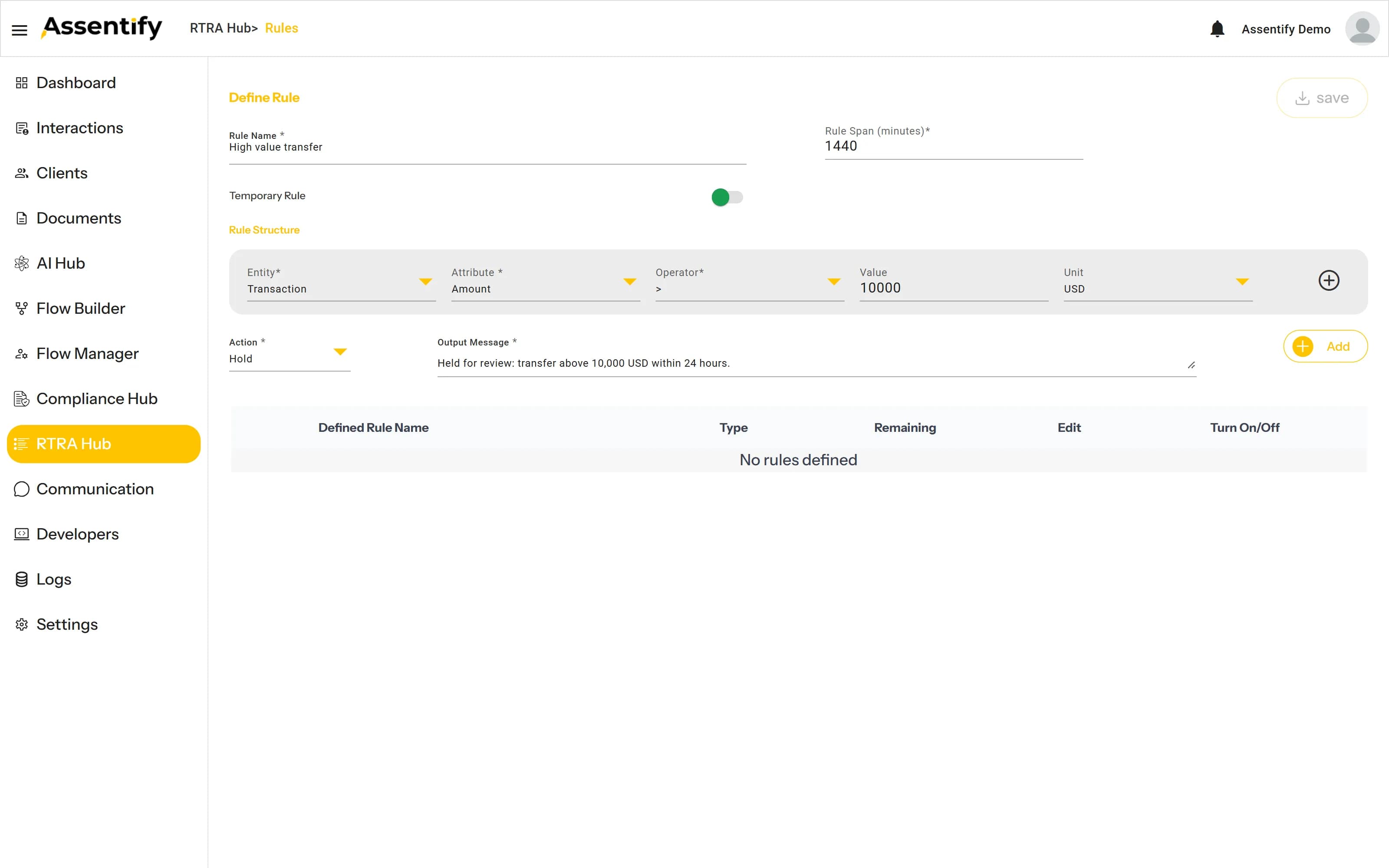
RTRA rules are written in the admin interface: a name, a span, conditions over entity, attribute, operator and value, an action and a message. A rule that only needs a fortnight can expire on its own.
See the RTRA HubThe obligation
Wallets got their own rulebook in January 2026.
Basic Circular 1 to Electronic Payment Services Providers names facial recognition, local data hosting and the ceilings a wallet works inside.
A licence regime that did not exist before 2026
Basic Decision 13790 of 9 January 2026, issued as Basic Circular 1 to Electronic Payment Services Providers, created a standalone licensing regime for wallet and payment businesses. Institutions that already held approvals under the old route were given six months to adjust their situation.
Facial recognition, written into the rule
Article 26 allows onboarding of natural persons through the E-KYC Form with prior BDL approval, for accounts up to USD 10,000, and requires enhanced due diligence, Digital ID systems meeting the FATF identity proofing and enrolment requirements, and facial recognition systems linked to the photo on the user’s identification document. The face match is named in the instrument.
Local Data Hosting, verbatim
Article 27 carries the same sentence as the banking circular: the institution must store in Lebanon all data and information pertaining to clients and executed operations. A wallet that onboards through an offshore verification API has a problem that no amount of encryption solves.
Ceilings and safeguarding
Article 35 caps Category A e-wallets for natural persons at USD 3,000 of balance and USD 10,000 of funds transferred into the wallet per month, and commercial entities at USD 30,000 and USD 50,000. It caps inflow. The article also requires a 100 percent safeguarding ratio against e-wallet balances.
The outsourcing boundary
Article 31 prohibits outsourcing risk management, compliance and internal audit to a third party. IT security, cyber-risk management and IT internal audit may be outsourced with prior BDL approval and under Banking Control Commission supervision. Assentify sits on the correct side of that line: technology your team operates.
Notification and approvals
Institutions must notify BDL in writing 90 days before starting or promoting a covered electronic operation, or before changing one already declared. New E-Money approvals under the banking decision are suspended until further notice, which shapes how a new wallet gets to market.
The one that pays for itself
One person. One wallet. Enforced by the face.
Duplicate identities defeat screening, inflate your user count and open the way to mule accounts and promotion abuse. Assentify enforces uniqueness on biometric face encoding and on any client profile field you declare must never repeat. Both are toggles on the client profile.
Where a signup fails, measured
- Success on first tryReported
- Success on second tryReported
- Success on third tryReported
- Success after three triesReported
- No auto captureReported
- DroppedReported
- ErrorReported
Performance Insights for identity capture, on the Dashboard. Good image, authentication failed, blurred image and unsupported ID are broken out separately.
What carries the weight
Three things a wallet team asks about first.
The SDK, WhatsApp, and drop-off you can see.
The SDK is the product surface
For most wallets the flow lives inside their own app, which means the verification has to feel native and the drop-off has to be measurable. The Mobile Flow SDK embeds the same flow you built on the canvas, and the interaction record captures device name and user agent so you can see which handsets fail capture.
WhatsApp as an onboarding channel
In markets where app installs are the bottleneck, a conversational flow on WhatsApp removes the install from the funnel entirely. It is the same flow definition, published to a different channel, with the same screening and the same audit trail behind it.
Drop-off you can actually see
Engagement Insights reports Completed, In Progress and Dropped, filterable to a single flow by day, week or month. Block Loader and Wrap Up cards give average time and the 95th percentile. WANDA adds a widget to the dashboard from a sentence you type.
Client voices
A payment provider, in its own words.
BOB Finance embedded the flow through the SDK.

“The SDK provided by Assentify was easy to integrate, enabling us to achieve rapid deployment with minimal technical overhead.”
Questions
Digital wallets, answered.
Assentify runs the whole onboarding flow for a digital wallet and then keeps watching the account afterwards. Identity document capture with liveness and tampering detection, a live face matched against the photo on the document, AML and PEP screening inside the flow, de-duplication so one person cannot hold several wallets, and real-time transaction risk rules once the wallet is funded. The flow ships to your app through the Mobile Flow SDK, to WhatsApp as a conversational flow, or to the web as a link or QR code.
Yes, Article 26 of BDL Basic Decision 13790 requires facial recognition systems linked to the photo on the user’s identification document. Assentify extracts the face from the captured document, captures the live face, runs liveness detection against presentation attacks, and writes a Match Percentage onto the interaction record. Liveness is iBeta certified for the passive mode, with active and configurable modes available, and depth estimation adds a signal that two-dimensional texture analysis misses.
Yes, and for a Lebanese electronic payment services provider it has to. Article 27 of Basic Decision 13790 requires the institution to store in Lebanon all data and information pertaining to clients and executed operations. Assentify runs a local cloud with GPU servers inside Lebanon, so document reading and biometric matching happen in country. Data Persistence is also configurable per tenant as on cloud or on premise.
A web or WhatsApp flow can be built and published in minutes, and an SDK integration takes hours rather than weeks. Flow Manager gives you Edit Engagement, Publish Flow, a QR code, a link with a short URL, and email sharing on the same panel. Changing a step later does not require an app release, because the flow definition lives on the platform.
After the wallet is opened, the RTRA Hub takes over. It watches Sender, Receiver and Transaction entities, applies rules you define with conditions, an action and an output message, and can include real-time AML screening checks alongside the rule evaluation. Meanwhile continuous screening keeps re-checking the client profile on a cycle, three days by default, and any hit lands in Client Clear with a risk level and an RBA Score for an analyst to work.
Flows Hub starts at $1,450/month and Compliance Hub at $449/month, on an annual commitment, each in three tiers. RTRA Hub starts at $859/month if you want transaction monitoring as well. Volumes, seats, active flows and deployment shape the final figure, so contact sales to complete. There is no checkout for enterprise deployment.
Start
Open one wallet end to end, in your own tenant.
We provision a tenant on your own subdomain, embed the flow in a test build of your app, and let your team watch a real signup reach the RTRA Hub.