Exchange offices
Compliance at the counter, in under a minute.
An exchange office carries a bank’s reporting duty with a fraction of a bank’s compliance team. So the identification and the screening run inside the transaction itself.
- Form threshold per cash transaction
- USD 1,000
- To report to the central bank
- 2 days
- Arabic and Latin on every search
- AR + LA
- Flow for counter and app
- 1
An exchange counter, mid-morning
A queue of three, and the check still happens.
Counters lose compliance to speed unless the identification is part of the transaction.
- 10:41A client asks to send a transfer. The teller opens the counter flow in Branch Assisted Mode.
- 10:41The client hands over an identity card. The camera reads it and Document Liveness confirms a real card is present.
- 10:42The name is screened before the cash moves, in Arabic and in Latin script, against the lists the office selected.
- 10:42The RF1 form fields fill from what the flow already captured. Nothing is retyped.
- 10:43The transaction proceeds. The record, the document and the screening result sit on one client profile.
- 10:47The same client returns next week. The profile already exists, so the counter moves even faster.
Timings are illustrative.

The flows
What runs while the client is still at the counter.
Nothing here is a nightly batch or a task somebody catches up on at the weekend.
Step 1 of 7 · Engagement Block
Branch Assisted Mode
The teller drives the flow on the counter device while the client presents the document. No app, no email address.
Runs in Flows Hub
Engagement
- Branch Assisted Mode
- Identification Document Capture
- Document Liveness
Connector
- RF1 form
- Daily report
Backend
- Screening
Profile
- Client Profile
The form and the document always agree
The identification and the form come from the same captured record, so they cannot disagree. A paper form beside a separate scan ends with two spellings of one name, and that difference is the first thing an examiner finds.
RF1, built in
RF1 BDL Circular is a built, Lebanon-specific surface inside Settings, and an RF1 Automation Package is available as an add-on from $549/month.
See Branch Assisted ModeThe obligation
The rules caught up with the counter.
Since late 2025, exchange institutions file structured forms, verify identity per transaction, and report to the central bank on a two-day clock.
A reporting entity, by name
Article 4 of Law 44 of 2015 names exchange institutions alongside banks, financial institutions and money transfer businesses as entities that report suspicion to the Special Investigation Commission. The duty is the same one a bank carries, on a business with a fraction of a bank’s compliance headcount.
The RF1 cash-transaction forms
BDL Basic Decision 13769 of 14 November 2025 is addressed to exchange institutions among others. Form RF1-A is completed once per client for cash transactions at or above USD 1,000 and updated by risk category, at least once every five years. Form RF1-B is completed per transaction at or above USD 1,000, excluding cash withdrawals.
Daily reporting to BDL
The same decision requires reporting to BDL within two business days, by email, in a spreadsheet. Identity is verified per cash transaction with a copy of a valid photo identity document retained, and both the forms and the copy are held at least five years.
Named high-risk typologies
SIC Circular 25 of 18 September 2019 designates terrorist financing, corruption-linked money laundering, tax evasion, drug trafficking and cybercrime as high-risk crimes, and requires specific controls on cash, on hawala, on offshore and legal-entity accounts, and on non-face-to-face or third-party dealings. That is a fair description of a busy exchange counter on a Friday.
The grey-list effect
Lebanon has been under FATF increased monitoring since October 2024. Two of the ten action-plan items ask for better risk understanding and effective sanctions at non-bank institutions, and for targeted financial sanctions implemented without delay at those entities. Exchange offices are exactly who that language means.
Correspondent pressure
The commercial consequence arrives before the supervisory one. Banks providing accounts to exchange institutions apply enhanced due diligence and de-risk when the file is thin. Being able to show a clean, dated, exportable record for every transaction above the threshold is now part of keeping a bank account.
The point
Capture once. Screen once. Report from the same record.
The identity copy lives in one place, the form in another, the screening result in a third, and the report is assembled by hand every second day. Put them in one record and the deadline stops being a crisis.
One client record, at the counter
- Identity document
- Copy retained, five years
- Document Liveness
- Real card, not a screen
- Tampering check
- Face and data fields
- Screening
- Each list, pass or match
- Scripts searched
- Arabic and Latin
- RF1-A and RF1-B
- Filled from the capture
- Daily report
- Within two business days
What carries the weight
Three things that decide whether this works at a counter.
Speed and script decide it. A control that adds two minutes gets bypassed, and a screening engine that cannot read Arabic names misses real matches.
Branch Assisted Mode, because the counter is the channel
Exchange offices do not have an app funnel to optimise. They have a queue. Branch Assisted Mode runs the assisted flow over the same steps, screening and audit trail as the self-service version, so the counter and the website produce the same evidence.
Arabic names, screened properly
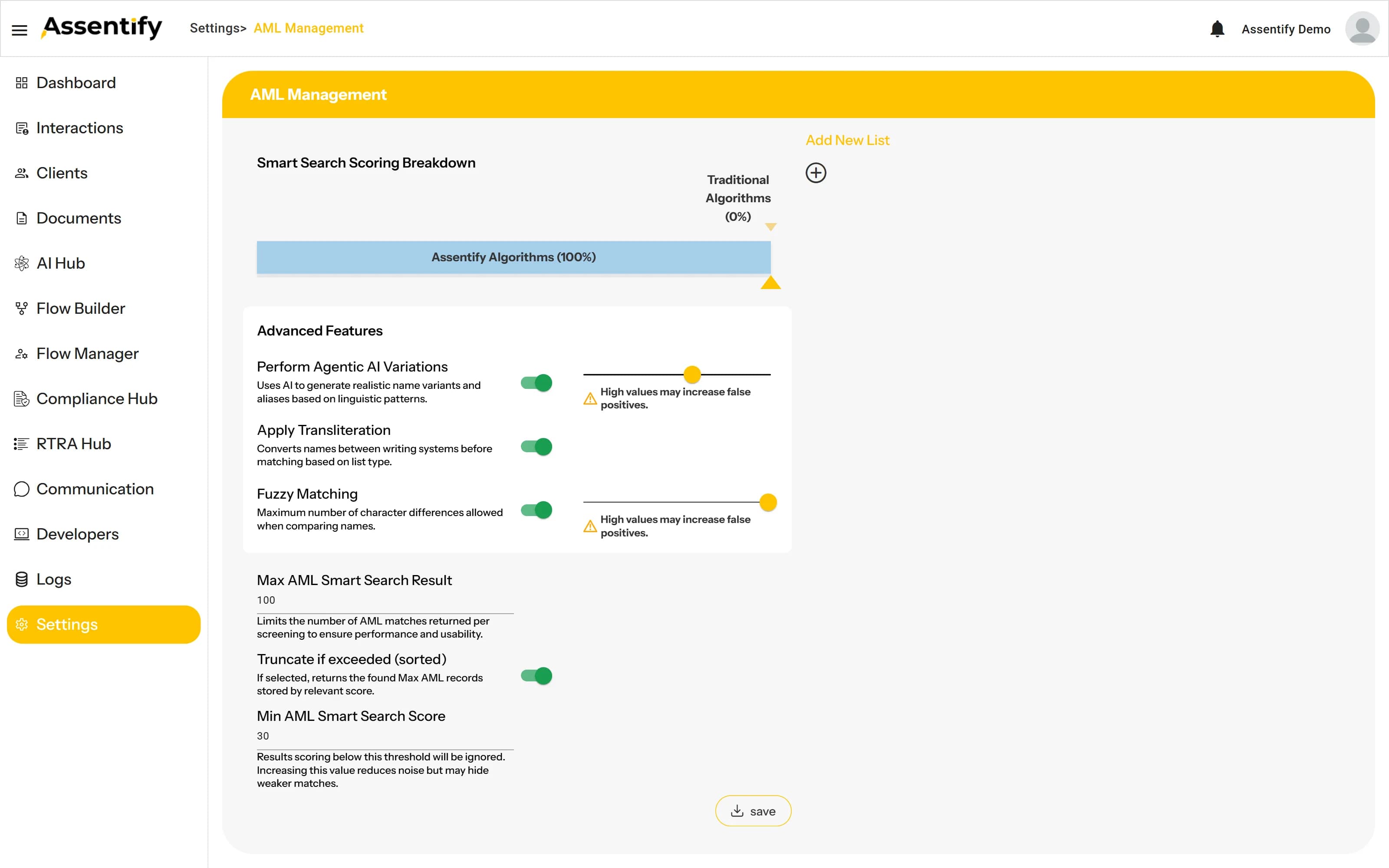
Apply Transliteration To lets a search cross scripts in either direction. An AI agent generates candidate spellings first, and the engine matches them with phonetic codes and edit distance, so a walk-in whose name reaches you spelled three ways is still one search.
Custom lists for your own refusals
Under AML Management you add your own list, it appears as a pill beside the sanctions lists, and from that point it is screened, matched and audited the same way. Previously refused clients, correspondent bank instructions and internal blacklists stop living in somebody’s memory.
Questions
Exchange offices, answered.
Assentify runs identification, screening, the cash-transaction forms and the reporting for an exchange institution from one platform. The teller captures the client’s identity document at the counter in Branch Assisted Mode, the platform reads it, checks it is genuine, screens the name against sanctions and PEP lists with Arabic transliteration, produces the RF1 form from the data already captured, and exports the daily report the central bank expects. Records are retained against the client profile for the required period.
Three rules matter most for exchange institutions in Lebanon: Law 44 of 2015, BDL Basic Decision 13769 and SIC Circular 25 of 2019. Law 44 of 2015 Article 4 names exchange institutions as reporting entities to the Special Investigation Commission. BDL Basic Decision 13769 of 14 November 2025 requires Form RF1-A once per client and Form RF1-B per transaction from USD 1,000, with identity verification, five-year retention and reporting to BDL within two business days. SIC Circular 25 of 2019 designates cash, hawala and non-face-to-face dealings as areas requiring specific controls.
No, Branch Assisted Mode is an assisted mode where your own staff drive the flow on the counter device while the client presents the document. The client does not need an app, an email address or a smartphone. If you also want a self-service option, the same flow publishes to the web as a link, a short URL or a QR code, and to WhatsApp as a conversational flow, with no rebuild.
Names are transliterated in both directions and screened across scripts, using the Apply Transliteration To control in the Compliance Hub. An AI agent generates candidate name variations first, covering plausible spellings, common typo patterns and the language equivalent of the same name, and the engine then matches across those variations, the transliterated names and the phonetic codes Double Metaphone, Soundex and Skeleton, which compares characters only. Comparison runs on edit distance with one and two character modifications allowed. A name captured in Arabic is therefore screened against Latin-script sanctions lists rather than quietly missed.
The Compliance Hub starts at $449/month and the Flows Hub at $1,450/month, on annual commitment, in three tiers each. An exchange office that only needs identification, screening and the forms can subscribe to fewer hubs than a bank does. The RF1 Automation Package is a separate add-on from $549/month. Contact sales to complete, because volume and seats shape the final figure.
No, Assentify produces the data and moves it to the destination you configure; the filing and the compliance judgement stay with your institution. Lebanese rules are explicit that compliance monitoring cannot be outsourced, so the correct division is that Assentify is the tooling and your compliance officer is the decision maker. Every action the platform takes is recorded in the Audit Hub with the user, the timestamp and the event.
Start
Run one counter transaction end to end.
We provision a tenant on your own subdomain, load the lists you screen against, and let your tellers run the counter flow in Branch Assisted Mode from capture to report.