Transliteration engine
The same person, spelled twelve ways.
A screening engine that cannot reconcile Arabic and Latin spellings of one name will miss real matches and never tell you. Assentify built the reconciliation, in both directions, into the search itself.
- Arabic to Latin, and back
- Both ways
- Matched in one query
- Two scripts
- Applied on the search itself
- One checkbox
Try it
Type a name in either script.
Pick an Arabic name, or type one in Arabic or Latin, and see the spellings the engine generates and what each scores against the lists.
Transliteration engine
Assentify IP · Stored example
One Arabic name reaches a screening engine a dozen ways in Latin script. An engine that cannot reconcile them misses the match. An AI agent writes the candidate variations first, the way a compliance officer would, then the search runs across all of them at once. Type a name and see it.
Or try a stored example
Variants the agent generates for Abd al-Rahman
- Abdulrahman98
- Abdul Rahman98
- Abdelrahman96
- Abd El Rahman95
- Abderrahmane88
- Abdurrahman92
- Variants
- 6
- Above 85
- 6
- Top score
- 98
Match found in the stored example
UN Consolidated · ABDUL RAHMAN · 96
A Latin-only engine searching the canonical spelling alone would not have returned this.
Stored example, not a live call. Type a name above and submit to call the service.
What the search runs across
- Agent variationsplausible spellings, common typo patterns
- Language equivalentsthe George and Jorge case, by geography
- Transliterated namesthe query name in both scripts
- Phonetic codesDouble Metaphone, Soundex, Skeleton
An AI agent generates the candidate variations first, the way a compliance officer would. The engine then matches across those variations, the transliterated query names and the phonetic codes at once, comparing with edit distance at one and two character modifications. Skeleton compares a name on its characters only. All of it runs together, not in turn, and the engine returns the most relevant names from the combined search. Inside the platform this is Apply Transliteration To in the Compliance Hub Workspace, and every Screening Profile applied to Interactions, Client Clear and Workspace.
In the product
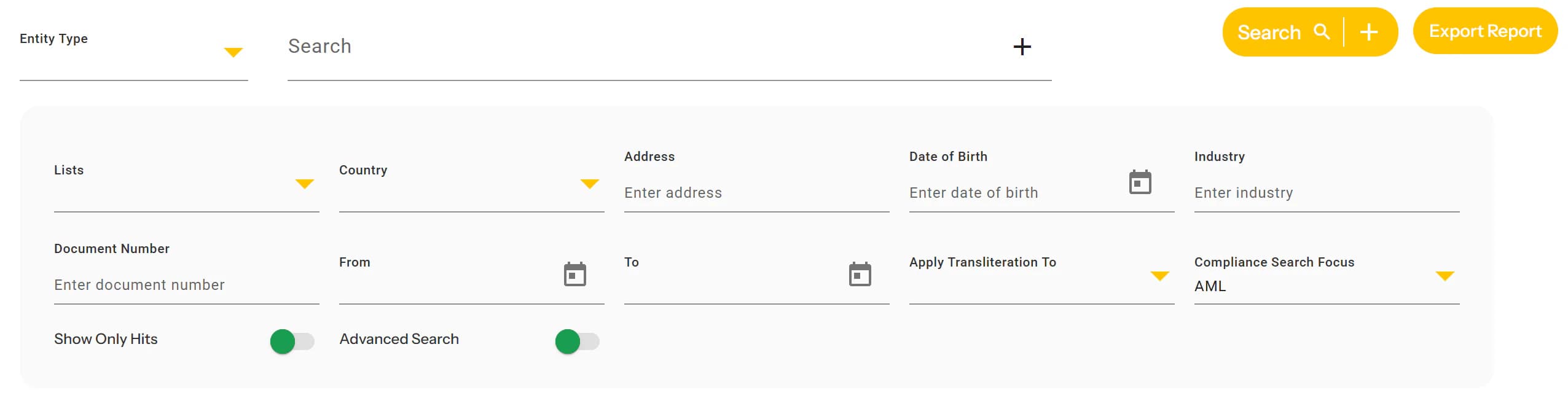
A checkbox on the search.
Turn transliteration on for the search in front of you. There is no separate module to license and no integration to build.
Apply Transliteration To
- Search input
- Arabic or Latin script
- Sources searched
- Both scripts, every configured list
- Variation set
- Written by an AI agent before the query runs
- Variation types
- Spellings, typo patterns, language equivalents
- Matched across
- Variations, transliterations, phonetic codes
- Comparison
- Edit distance, one and two character changes
- Surface
- Workspace, Client Clear, Interactions
- Persistence
- Both forms held on the client record
Concretely
Six names. Twenty-seven spellings. One book of clients.
Six common Lebanese names, written the way real institutions hold them.
محمد
One clientThe doubled consonant may be written once or twice, and the first vowel is o or u depending on the convention in the room.
شربل
One clientFrench orthography writes the sh sound as ch. Lebanese civil records use it constantly, English-language lists do not.
حسين
One clientA long vowel with no exact Latin equivalent, so every transcriber approximates it differently.
عبد الله
One clientA compound name that joins, splits or hyphenates. Word boundaries move, so token counts move with them.
الخوري
One clientThe definite article is sometimes carried, sometimes dropped, sometimes attached to the word.
جبران
One clientOne Arabic consonant is realised as g in one dialect and j in another. Both are written down as heard.
- common Lebanese names
- 6
- spellings, all of them correct
- 27
- scripts on one query
- 2
- book of clients
- 1
Now put those spellings on both sides of a screening query. A sanctions list published in Washington writes the name one way. A civil registry in Beirut writes it another. A core banking record migrated in 2004 writes it a third way, because the migration script stripped the article. Literal comparison finds none of them.
Why it happens
Four causes, none of which are anybody’s mistake.
The mechanism tells you which techniques can help. This is a writing-system problem, and it cannot be cleaned away.
Short vowels are not written
Standard Arabic writing leaves short vowels out. Transcribed into Latin script, those vowels have to be invented, so the same three consonants become Hasan, Hassan, Hassane and Hussan depending on who is typing.
Two colonial orthographies, one country
Lebanon uses French and English conventions, often inside one institution. French writes sh as ch and u as ou, so Chehade and Shehadeh are one family, and Aoun and Awn one name. A list in one convention never matches a record in the other on the string.
Word boundaries move
A compound name can be written as one token, two or three, with or without a hyphen. Abdul Rahman, Abd Al-Rahman and Abdulrahman are one person, and a matcher that tokenises first scores them apart.
The source document is bilingual
A Lebanese identity document carries the name in Arabic and often in Latin script, and the two do not always agree. Extraction has to read both and keep both.
There is no single correct spelling to clean towards. An institution cannot choose how a sanctions body, a correspondent bank or a client wrote a name, so the engine holds every plausible rendering and decides between them at match time.
Read next
Why this is the differentiator
Reading the name is the hard part.
An engine that finds a regional match and one that quietly clears it differ in one thing: whether it can reconcile the way that name is written in Beirut, Dubai and Washington. Assentify built that reconciliation, and it runs on every search.
Questions
Transliteration, answered
The Assentify transliteration engine is Assentify built technology that reconciles Arabic and Latin spellings of the same name so that screening, onboarding and client records line up across scripts. It works in both directions: a name captured in Arabic is screened against Latin-script sources, and a Latin-script name is screened against Arabic ones. In the Compliance Hub Workspace it appears as the Apply Transliteration To setting on a search, and it runs alongside the phonetic and AI matching inside a Screening Profile rather than replacing them.
One Arabic name can carry a dozen Latin spellings because Arabic writing leaves short vowels out and several Arabic sounds have no exact Latin equivalent, so every transcriber approximates differently. In Lebanon the problem doubles, because French and English conventions are both in daily use: the same sound is written ch by one clerk and sh by another, ou by one and u by another. Add compound names whose word boundaries move, and a single person can appear in your systems as a dozen distinct strings, every one of them written in good faith.
No, transliteration and phonetic matching solve different parts of the same problem and the engine runs them at the same time. The engine matches across three things at once: the name variations an AI agent generates, the transliterated query names, and the phonetic codes themselves, which are Double Metaphone, Soundex and Skeleton, the last of these comparing characters only. Candidates are compared to the indexed entries by edit distance, allowing one and two character modifications, and the most relevant names are returned.
Transliteration matters anywhere the same human has to be recognised twice, which includes de-duplication, client search, continuous re-screening and any integration with a core banking system holding legacy records. A client onboarded in Latin script and later searched in Arabic should return the same record, and a duplicate created under a second spelling defeats both de-duplication and sanctions screening at the same time. Keeping both forms on the record is what makes those later checks work.
Yes, the AI Hub pipeline reads Arabic and English, and Assentify supports every Lebanese identity document, so a bilingual card is extracted in both scripts rather than only in the Latin transcription printed on it. That matters upstream of everything else here: if the Arabic form is never captured, no amount of transliteration downstream can recover it, and the institution is screening a transcription somebody else chose.
Yes, it is Assentify intellectual property. Global screening data can be bought from any of the large vendors. Reconciling Arabic and Latin renderings of a Lebanese name, with the local orthographic conventions that market actually uses, is not something available off a shelf, and it is the difference between finding a regional match and quietly missing it.
Start
Search a name in Arabic. Then search it in Latin.
Use your own client book and your own lists. The test takes five minutes and it tells you more about a screening engine than any specification sheet.