Banks
Account opening that survives an examination.
A bank needs the whole file: who was verified, on what document, against which lists, cleared by whom, stored where. Assentify builds that file as the client moves through the flow.
- Interactions a month, per bank
- 100,000
- Processing on local GPU
- In country
- Default re-screening
- 3 days
- Certified
- ISO 27001
A branch counter, Beirut
Nine minutes, one file, nothing to chase.
A client walks in without an account. Everything between the greeting and the approval runs on the platform.
- 09:12The teller opens the account flow in Branch Assisted Mode and greets the client.
- 09:13The client scans a QR code and continues on her own phone. The session carries over.
- 09:15Identification Document Capture reads her Lebanese identity card. The extracted fields appear for her to confirm.
- 09:16Her live face is matched to the document photo. Liveness passes. The Match Percentage is written onto the record.
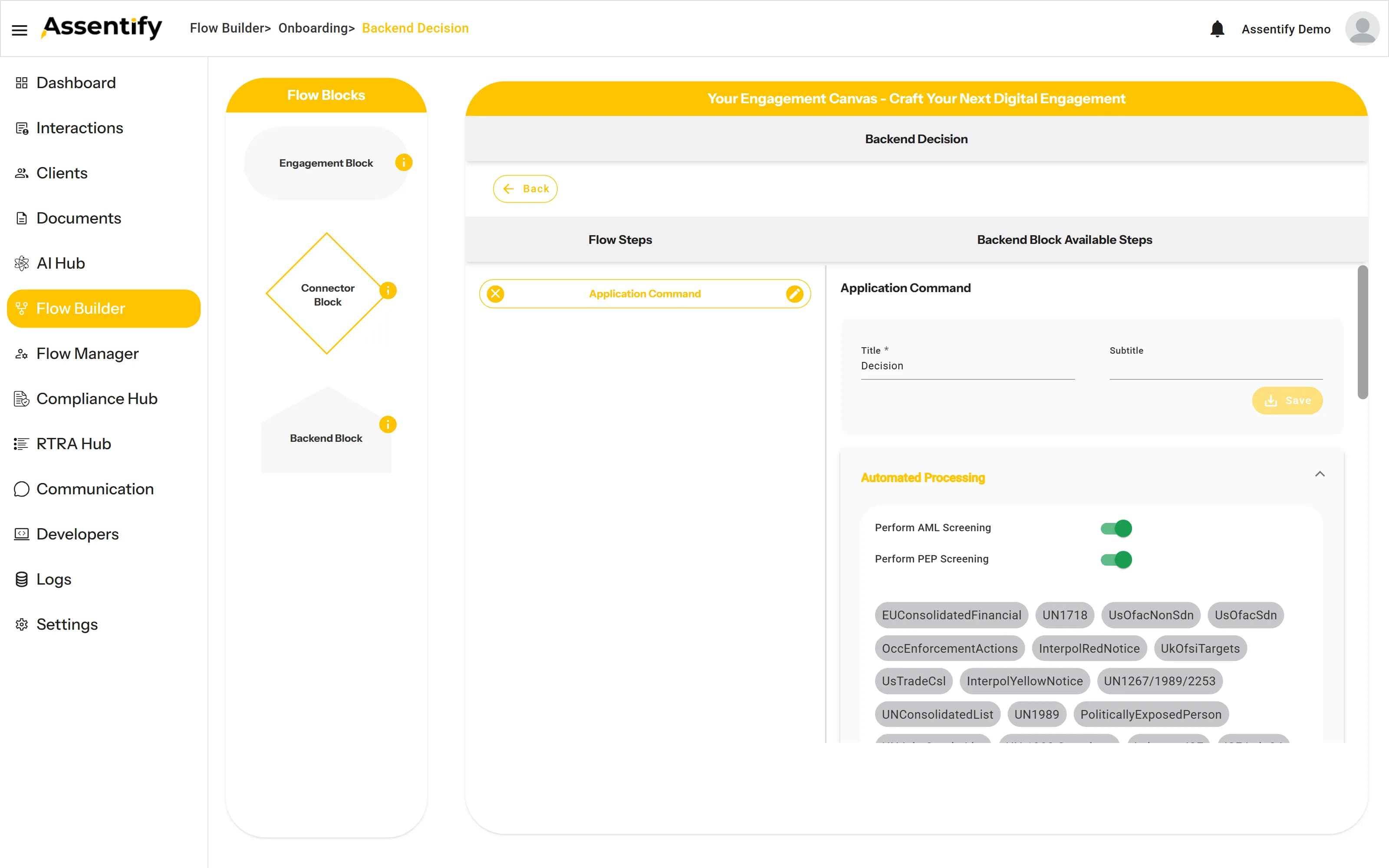
- 09:18The Backend Block screens her name against the lists the bank selected. Every list logs pass or match.
- 09:19She signs the account agreement inside the flow. The signed document lands on her client profile.
- 09:21An operator approves in the Application Processing Command Center. The whole file sits on one record, stored in Lebanon.
Timings are illustrative.
The flows
Three flows a bank runs on one platform.
Step 1 of 9 · Engagement Block
Service selection
The client picks the account they want to open.
Runs in Flows Hub
Engagement
- Service selection
- IDV
- Read the ID
- Data collection
- Contract signing
Connector
- Web Hook
Backend
- Screening
- Decision rule
Profile
- Client Profile
Signed inside the flow
The account agreement is generated from a Word template with tokens bound to the flow’s own data, signed by the client and stored against the client profile. Assentify signing produces advanced, qualified-grade digital signatures. Signed PDFs carry Assentify’s Adobe Approved Trust List (AATL) certificate, so Adobe Acrobat and Reader show them as trusted. Signing keys are held in a hardware security module, and Assentify runs a local certificate authority in country.
One flow, every channel
Publish once and Flow Manager gives you a link, a short URL and a QR code. Point the same flow at WhatsApp for a conversational version, embed it in your own app with the Mobile Flow SDK, or run the assisted version at the counter in Branch Assisted Mode.
See Branch Assisted ModeThe obligation
Six instruments, one file.
Lebanese banking regulation on remote onboarding was rewritten in January 2026. These instruments decide what your onboarding flow has to produce, and where the result may live.
Basic Circular 69, rewritten in 2026
Basic Decision 7548 was repealed and replaced by Intermediate Decision 13791 of 9 January 2026. It governs electronic banking and financial operations for banks and financial institutions registered with Banque du Liban.
The E-KYC Form, and its ceiling
Remote onboarding through the E-KYC Form needs prior BDL approval and opens payment accounts up to USD 10,000. It also requires enhanced due diligence, ongoing transaction monitoring, client risk classification and Digital ID systems built to FATF Guidance on Digital ID.
Electronic signature, seven conditions
Article 5 sets seven cumulative conditions, from informed consent and a signature uniquely linked to the signatory, to tamper-evident linkage to the signed data and the one-time password serving as the client’s electronic signature.
Local Data Hosting
Article 7 requires banks conducting electronic banking to store in Lebanon all data on clients and executed operations. Article 8 restricts sharing it to BDL, the Banking Control Commission, the SIC and the judicial authorities.
Due diligence and retention
Basic Circular 83 sets the acceptable identity documents: a passport, an identity card, a Civil Status Register extract or a residence permit. Beneficial ownership starts at 20 percent. Records are kept at least five years after the relationship ends.
The cash programme
Basic Circular 172 makes a Cash Transaction Slip mandatory for cash deposits of USD 10,000 or more per day, cross-checked against the KYC Form. That is a data-matching problem before it is a paperwork problem.
Behind all of it sits Law 44 of 2015, which makes banks reporting entities to the Special Investigation Commission, and the FATF increased-monitoring status Lebanon has carried since October 2024. Correspondent banks answer that status with enhanced due diligence on Lebanese counterparties, so onboarding evidence is now a correspondent banking issue too.
The architecture
If the data has to stay in Lebanon, so does the inference.
Assentify runs the whole pipeline, document AI and biometrics included, on its own cloud and GPU servers inside Lebanon, so nothing crosses the border to be processed.
Capital Outsourcing runs the Security Operation Center and Network Operation Center for Assentify Cloud, 24/7, under a service level agreement.
Market
Pick a step
Where it runs
The client’s phone or browser
Web link, WhatsApp or your app
- This step
Assentify Cloud, in Lebanon
Own cloud and GPU servers, in country
Data persistence
On cloud or on premise, per tenant
Document read. A vision model reads the document on Assentify’s GPU servers inside Lebanon.
Capital Outsourcing runs the Security Operation Center and Network Operation Center for Assentify Cloud, 24/7, under a service level agreement.
What carries the weight
Four capabilities a bank leans on hardest.
Screening your risk committee already accepts
Global sanctions, enforcement and PEP coverage arrives through plugins to LexisNexis and Refinitiv. On top sit the local Lebanese lists, ISF Leb 24 and SIC 18-26, which a Lebanese bank is still required to screen.
De-duplication before the mule account exists
Client uniqueness is defined per profile type. Turn on biometric face encoding for uniqueness, then name the client profile fields that must not repeat. Duplicate identities are how screening is defeated and loans are doubled.
Corporate onboarding as its own profile
Verified Business is a separate client profile type with its own fields, screening treatment and clearance queue. Registration number, jurisdictions and the ownership chain are captured as client data, not as attachments.
The core banking connection
The Data Sources engine adds your core, your card issuer and your registry lookups from the admin interface. API or SOAP, API key or basic authentication, pull, push or file endpoints. No development and no customisation.
National scale
Sized for a market, examined like a bank.
Assentify also runs national-scale central bank programmes. A national eKYC programme needs document capture, face matching and liveness that hold at population volume, de-duplication across the register, and an audit trail nobody can quietly edit.

Operational surface, as shipped
- Data persistence
- On cloud or on premise, per tenant
- Dual control
- Maker and checker on platform changes
- Session policy
- Length and password policy per tenant
- Audit
- Audit Hub by user, decision and date
- KYC lifecycle
- Expiry alert 30 days, renewal 1000 days
Questions
Banks, answered.
Assentify gives a bank one platform for digital account opening, remote re-KYC of the existing book, AML and PEP screening, electronic and digital signing, and the audit trail behind all of it. The bank designs its own onboarding flow on a drag and drop canvas, publishes it to the web, to WhatsApp and to its own mobile app, and connects its core banking system through the Data Sources engine. Average volume across Assentify bank and Banking-as-a-Service clients is around 100,000 interactions per month each.
No vendor can make a bank compliant, because the approval attaches to the institution. Assentify makes the file passable and the architecture defensible. Remote onboarding through the E-KYC Form requires prior BDL approval, enhanced due diligence, ongoing monitoring, risk classification and a Digital ID system built to FATF Guidance on Digital ID. Assentify supplies the identity proofing, the authentication, the lifecycle management and the evidence, with data kept inside Lebanon as Article 7 requires.
In Lebanon, Assentify processes on its own cloud and GPU servers inside the country, and Data Persistence is a per tenant setting, on cloud or on premise. That matters because Article 7 requires banks conducting electronic banking to store all client and operation data in Lebanon, and Article 8 restricts who may touch it. In the UAE, Kuwait, Qatar, Bahrain and Syria: Assentify processes in its own cloud and keeps zero trace there. The data is stored on premise at the client.
Yes, and the E-KYC Form may be used to renew or amend existing KYC, so remote re-KYC has a legal basis. You publish a re-KYC flow, share it as a short URL or a QR code by SMS, email or WhatsApp, and clients complete it on their own phones. Records update against the existing client profile, screening runs again, and the KYC expiry and renewal alerts reset.
SICILIA is Assentify’s local processing agent for Special Investigation Commission letters. Lebanese banks receive a continuous stream of SIC correspondence: name circulations, information requests, freeze instructions and secrecy-lifting decisions, each searched against the whole client book and answered under confidentiality. The Compliance Hub Workspace supports bulk multi-name search with Arabic and Latin transliteration for the searching itself.
No, and Lebanese regulation would not allow it to. Basic Circular 128 prohibits banks from outsourcing compliance monitoring in whole or in part. Assentify is tooling your own compliance department operates: it runs the screening, presents the matches with a risk level and an RBA Score, records every decision with the user and the timestamp, and exports the evidence. The judgement stays with your officers.
Start
Open one account end to end, in your own tenant.
We provision a tenant on your own subdomain, load the lists you screen against, and let your team run a real account-opening flow from capture to decision.