Financial institutions
The forms became a data pipeline.
Lenders, leasing companies, comptoirs and Banking-as-a-Service providers now file structured cash-transaction forms and report to the central bank within two business days.
- Interactions a month, average loan provider
- 25,000
- RF1 form threshold
- USD 1,000
- BDL reporting window
- 2 days
- Minimum record retention
- 5 years
A loan campaign, on a glass wall
From a poster to a screened borrower, with nobody retyping.
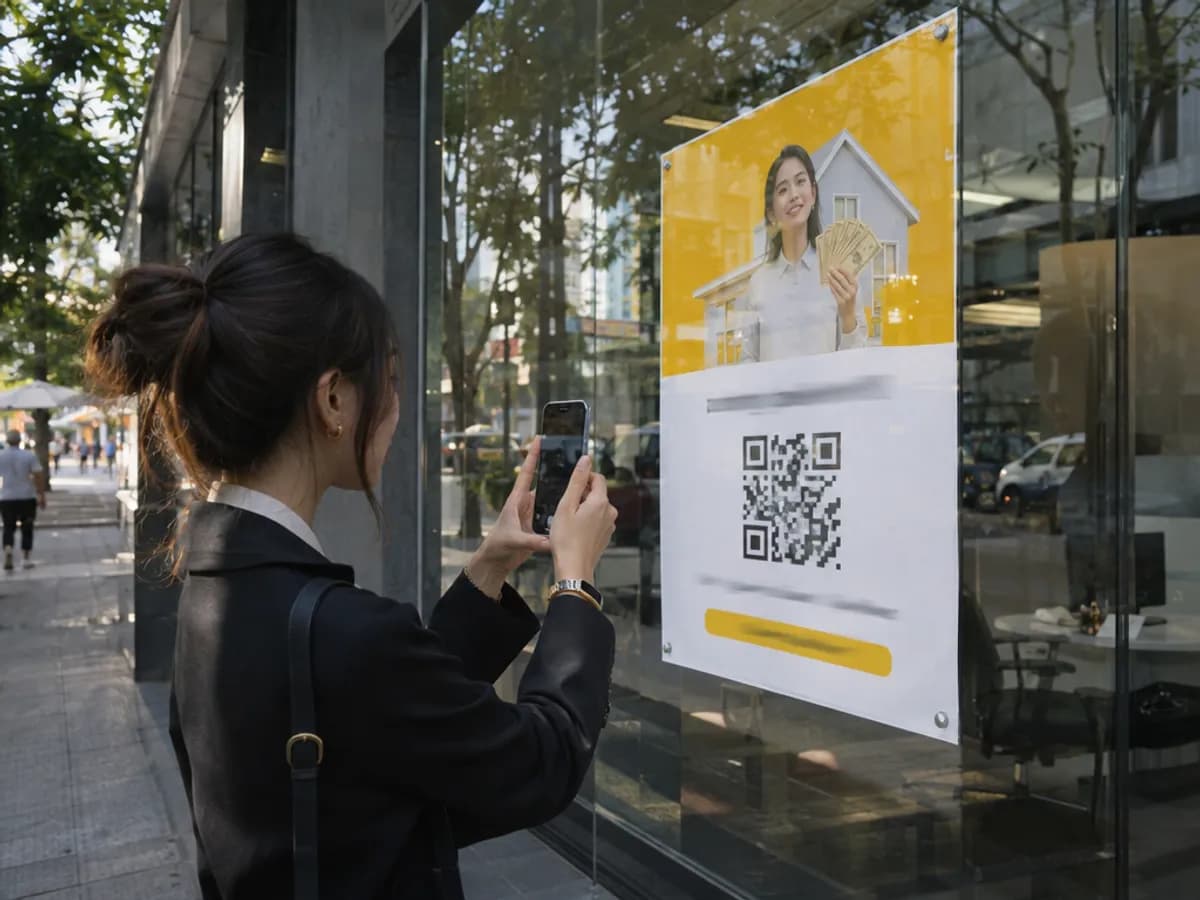
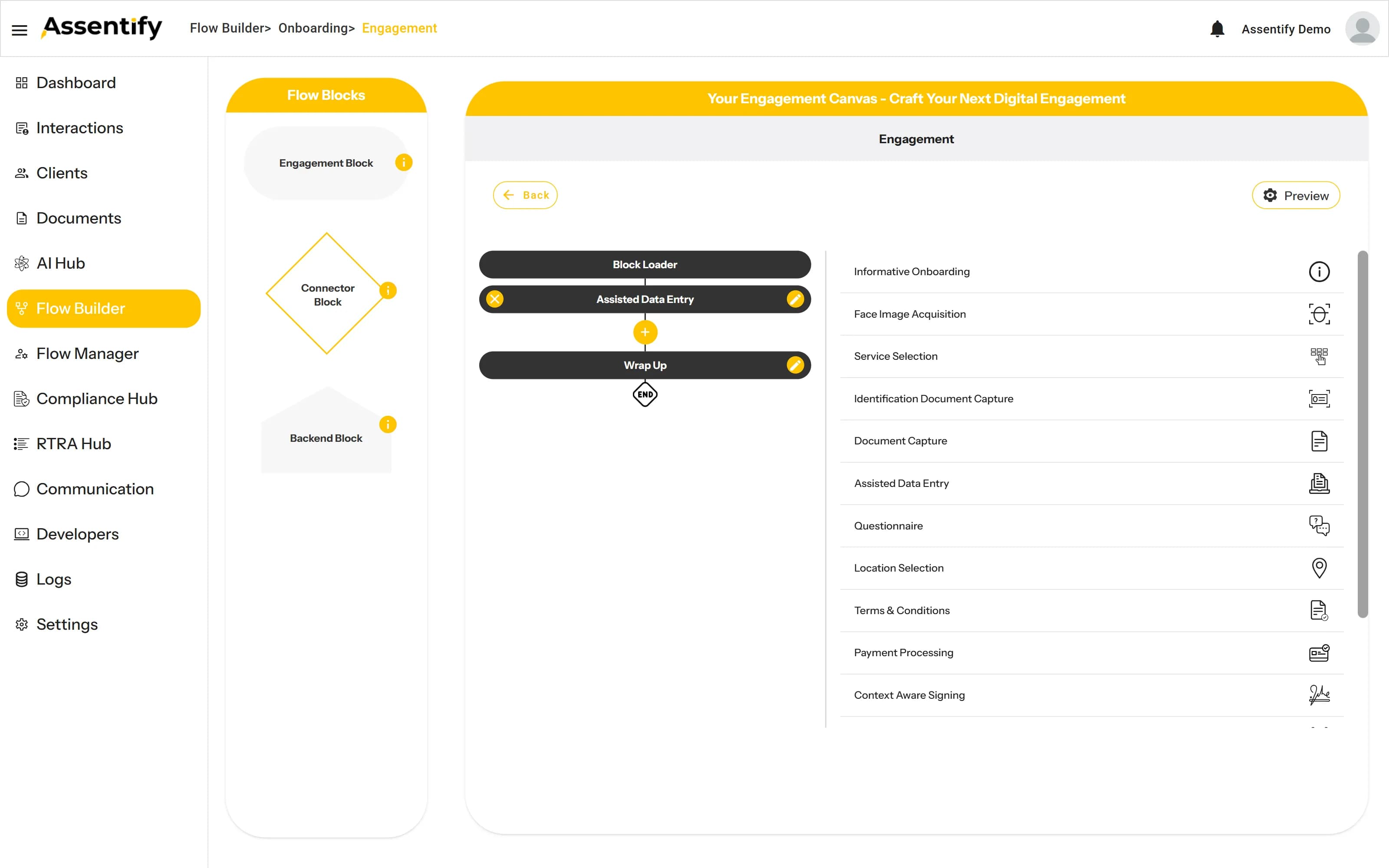
A real client campaign. The poster hangs in an office, and its QR code opens an Assentify flow built from the step library.
- 11:20A visitor scans the Scan to Start code on the poster. The loan flow opens in the browser, with no app to install.
- 11:22Identification Document Capture reads the identity card. The extracted fields appear for confirmation.
- 11:23The live face is matched to the document photo. Liveness passes and the Match Percentage lands on the record.
- 11:24Document Capture collects the supporting documents the credit file needs, in the same sitting.
- 11:25Screening runs against the selected lists, including the local Lebanese lists, with Arabic and Latin transliteration.
- 11:27The application lands in the Application Processing Command Center with the whole file attached, ready for a decision.
Timings are illustrative.
The flows
One flow per product line, one tenant.
Consumer lending, leasing, a comptoir counter and a Banking-as-a-Service partner each get their own flow, link and publish state in Flow Manager, with one audit trail across all of them.
Step 1 of 10 · Engagement Block
Service selection
The client picks the loan they want.
Runs in Flows Hub
Engagement
- Service selection
- IDV
- Read the ID
- Split
- Photo upload
- Contract signing
Connector
- Create client
Backend
- Screening
- Reviewer
Profile
- Client Profile
Decisions by rule
The Automated Decisions rule builder takes a rule name, a condition, a decision and a check value, so a clean low-value file clears itself while everything borderline waits for a person in the Application Processing Command Center.
See the Flow BuilderThe obligation
Non-bank does not mean lightly supervised.
Article 4 of Law 44 of 2015 makes these entities reporting entities to the Special Investigation Commission, including leasing companies and exchange institutions. Several rules below are newer than the banking equivalents.
Basic Circular 3 and the RF1 forms
Basic Decision 13769 of 14 November 2025, the KYC Form for Cash Transactions, is addressed to finance companies, specialised lending entities, exchange institutions and electronic payment providers. Form RF1-A is completed once for any cash transaction at or above USD 1,000 and updated by risk category, at least once every five years. Form RF1-B is completed per transaction at or above USD 1,000, excluding cash withdrawals. Identity is verified per cash transaction, with a copy of a valid photo identity document retained.
Daily machine-readable reporting
The same decision requires reporting to BDL within two business days, by email, in a spreadsheet. It was amended by Intermediate Decision 13815 of 4 May 2026, effective 30 June 2026.
Where the signature stops working
Electronic signature under that decision is permitted for natural persons only, and only where the value of the cash transaction, or the total of recurring transactions by the same client at the institution, does not exceed USD 10,000 a month. Above that, wet signatures of both the client and the institution are required, and so is source-of-funds documentation. Your flow has to know the difference.
The de-risking hold
SIC Circular 20 asks institutions not to close an account, refuse to deal or refuse to open an account for 30 days after filing a report. If no reply arrives within that window, the institution may then act. Knowing which of your clients is inside that window is a records question your system should answer.
The deadline that changes the design
A two-day reporting window is an interface.
A form from USD 1,000 and a report within two business days make compliance a data problem. Capture it once in the flow, hold it in one record, and transform it on the way out with the Data Sources engine.
The cash-transaction obligation, in short
- Form RF1-A
- Once per client, from USD 1,000
- RF1-A update
- By risk, at least once every five years
- Form RF1-B
- Per transaction, from USD 1,000
- Excluded
- Cash withdrawals
- Source of funds
- From USD 10,000 a month
- E-signature
- Natural persons, to USD 10,000 a month
- Reporting
- To BDL within 2 business days
Source: BDL Basic Decision 13769 of 14 November 2025, amended by Intermediate Decision 13815 of 4 May 2026.
What carries the weight
Four capabilities this sector uses most.
A financial institution rarely has a bank’s engineering bench. It needs a platform its own operations team can change without raising a project.
Integration without customisation
Most lenders run a loan management system that predates the current decade. The data sources engine adds it from the admin interface and tests the connection in place before saving. Your team changes a field mapping itself, with no development and no third party.
Screening that keeps running
A loan book is a relationship. Continuous screening re-checks client profiles on a configurable cycle, three days by default, and anything that hits lands in Client Clear with a risk level, an RBA Score, the last hit, the last clearance and the full decision history on that client.
Three client profile types
Person, Verified Person and Verified Business are enabled and configured independently, each with its own title, its own document visibility, its own re-screening cadence and its own KYC expiry and renewal alerts. A leasing subsidiary dealing mostly with companies does not inherit a retail configuration.
Evidence in the shape auditors ask for
Audit Hub filters by system user, by decision and by date range, and exports. Logs record created time, activity type, user name and message, each row expandable. Interactions export from the command centre. Retention obligations run five years, so the exports matter as much as the screens.
Client voices
Lenders, in their own words.
Two financial institutions that run their onboarding, lending and compliance on the platform.

“We highly recommend Assentify as a trusted partner for identity verification, client lifecycle management, and compliance.”

“Assentify delivered far more than onboarding for us. One team built our loan origination system and our mobile super app on the Digital Experience Platform and Compliance Hub, including the BDL eCDR integration.”
Questions
Financial institutions, answered.
Assentify gives a lender, leasing company, comptoir or Banking-as-a-Service provider one platform for client onboarding, cash-transaction forms, AML and PEP screening, electronic signing and the reporting that follows. Each product line gets its own flow on the same canvas, connected to the loan or core system through the data sources engine, with one audit trail across all of them. Loan providers average around 25,000 interactions per month each on the platform.
Yes, RF1 BDL Circular is a built, Lebanon-specific surface inside Settings, and an RF1 Automation Package is available as an add-on from $549/month. The underlying obligation comes from BDL Basic Decision 13769 of 14 November 2025: Form RF1-A once per client for cash transactions at or above USD 1,000 with periodic updates, Form RF1-B per transaction at or above USD 1,000 excluding cash withdrawals, and reporting to BDL within two business days in spreadsheet form.
Under BDL Basic Decision 13769 the electronic signature is permitted for natural persons only, and only where the cash transaction value, or the total of recurring transactions by the same client at that institution, stays at or below USD 10,000 a month. Above that the decision requires wet signatures from both the client and the institution. Assentify handles this with a Split step: the flow branches on the value and routes to Context Aware Signing or to the wet-signature path.
Through the data sources engine, from the admin interface, with no development and no customisation. You add a source with a name, choose API or SOAP, choose API key or basic authentication, then test and save. Each source carries endpoints typed as pull, push or JSON file, with headers, body and an optional XSLT transformation. That covers core banking, loan management, credit bureaus, collections and the reporting destination.
At least five years, and the exact starting point depends on the instrument. BDL Basic Circular 83 requires at least five years after closing the account or ending the business relationship, and at least five years after performing an operation for operation documents. The cash-transaction decision requires the RF1 forms and the retained identity document copy to be held at least five years as well. Assentify retains the interaction record, the captured documents, the signed documents and the audit trail together.
No, Data Persistence is a per-tenant setting with two values, on cloud or on premise, and an on-premise configuration takes a proxy address. The Compliance Hub Engine is also offered as an on-premise package for institutions that cannot let screening data leave their own estate. In Lebanon, Assentify additionally runs a local cloud with in-country GPU servers, and processing stays in the country.
Start
Run one loan application end to end.
We provision a tenant on your own subdomain, load the lists you screen against, and let your team run a real loan flow from the first scan to the decision.