Custom AI models
Train a model, or configure a template?
Most document problems are solved by a good template and an afternoon in the Playground. Some are not. Tell the two apart before you spend a quarter finding out.
- Trained and served on a dedicated GPU
- Enterprise
- Judged against your agreed bar
- Per field
Where a model lands
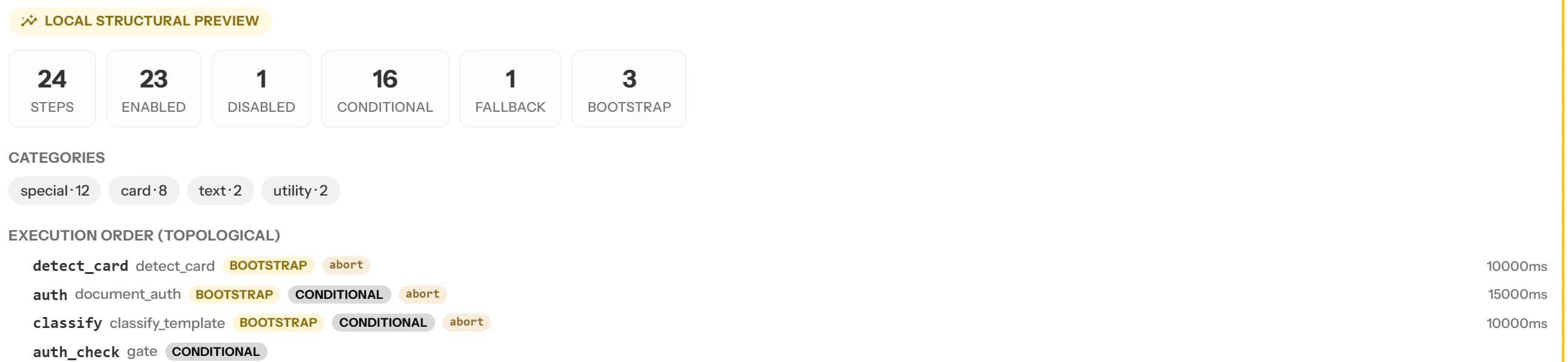
A trained model is one more step in a pipeline.
A custom model joins the same pipeline as the templated steps, so it is validated, versioned and rolled back the same way, with the template still behind it.
Templated pipeline
The answer for most documents
- The document class has a stable layout
- The fields you need sit in predictable places
- Arabic and English are the languages involved
- The volume is normal for an onboarding operation
- You want it working this week, not this quarter
- The Playground already returns what you need
Custom model
Worth it only past a measured ceiling
- The document is unusual and no template holds it
- Layouts vary widely across issuers, years or branches
- Inputs are degraded in a way specific to your operation
- Volumes are high enough that small accuracy gains pay
- Handwriting or stamps carry meaning you must read
- Processing must be isolated for your own risk reasons
If the first card describes your case, you do not need the second.
How training works
Four things decide whether a custom model succeeds.
None of them is the model architecture. Bespoke document AI fails on corpus, evaluation and maintenance far more often than on modelling, and the corpus worth training on is the hard pages.

Start with your real corpus
Hold a set back
Agree the acceptance bar first
Train and serve on dedicated capacity
The shape of the work
Custom model work runs as a loop.
Documents drift: a new card series ships, a form gains a field, a scanner changes its settings. So the engagement runs as a loop.
- 01 MeasureNext: train
Measure on your corpus first
The templated pipeline is run against your own documents, so the baseline is a number, not an impression.
- 02 TrainNext: evaluate
Train on the dedicated GPU instance
The model is fine-tuned on your document set, isolated on Enterprise infrastructure.
- 03 EvaluateNext: deploy
Evaluate against the held-out set
Accuracy is judged per field, against the bar agreed up front, on pages the model has never seen.
- 04 DeployNext: measure again
Deploy, then measure again
The model enters the pipeline, and production pages feed the next measurement.
The position
Often a custom model is not worth building.
The first step is always the same: run your hardest documents through the templated pipeline in the Playground, and read the result. If it clears your bar, that is the project finished.
After deployment
A model is a component with a lifecycle.
Most bespoke AI projects underestimate what has to keep happening after the training run, for as long as the model makes decisions about real clients.
An issuer redesigns a card, a bank changes a statement layout, a ministry adds a security feature. A model trained before that change degrades quietly, and wrong values look exactly like right ones until somebody checks.
Because the templated pipeline stays available behind the custom model, a bad version is a rollback rather than an incident.
Custom work of this kind sits alongside Assentify’s professional services practice, which has delivered full financial institution cores, mobile applications and integrations with central bank systems. The team that builds a model is used to shipping into regulated production.
What comes with a custom model
- Versioning
- A model is a version, not an event. It is replaced, not patched
- Regression testing
- The held-out set is re-run before any version goes live
- Confidence
- Attached per field, so low reads raise a case for a human
- Fallback
- The templated pipeline remains available behind the custom model
- Audit
- Extraction recorded as live audit video, decisions in the Audit Hub
- Residency
- Training and inference on cloud or on premise, per tenant
- Certification
- ISO/IEC 27001:2022, InterCert
Your data
Training on your documents is a data protection question first.
Where the corpus lives, who can reach it, and what happens to it afterwards.
A data processor
Assentify acts as a data processor on behalf of its tenants. Your documents remain your data, and the commercial terms covering a specific model are set in the engagement contract rather than assumed.
Where it runs
Dedicated GPU instance on enterprise, with Data Persistence set per tenant to on cloud or on premise. In Lebanon, local GPU servers keep training data and inference inside the country.
Certified management system
ISO/IEC 27001:2022, registration number IC-IS-2408273, certification body InterCert, certified 31 August 2024, recertification due 30 August 2027.
Questions
Custom models, answered
A custom model is worth training when the templated pipeline has a measured ceiling that costs you money. That usually means one of four things: the document class is unusual enough that no template holds it, layouts vary widely across issuers or years, inputs are degraded in a way particular to your operation, or volumes are high enough that a small accuracy gain repays the work. If none of those apply, the templated pipeline with a well built template is faster to deploy, cheaper to run and easier to change.
Assentify needs a corpus of your own documents that reflects the conditions they actually arrive in, and a portion of it held back for evaluation. The useful pages are the difficult ones: worn cards, glare, angled photographs, unusual issuers, reprints from different years. Clean samples teach a model very little, because clean samples were never the failure case. Assentify also asks for per-field acceptance thresholds up front, so the decision to deploy is made against a bar agreed before anybody saw a result.
A custom model is not automatically better than the templated pipeline. The templated pipeline is fast to build, easy to reason about, and changed in an afternoon by the team that understands the document. A custom model takes a corpus, an evaluation cycle and a maintenance commitment, and it earns its place only where it is measurably better on a held-out set. The right first step for almost every client is a template tested in the Playground against their worst documents.
A custom model runs on a dedicated GPU instance, available on the enterprise tier of the AI Hub. That separates your throughput from other tenants, isolates processing for your own risk purposes, and provides the capacity for training as well as serving. Data Persistence remains a first-class per-tenant setting, on cloud or on premise, and in Lebanon Assentify runs local GPU servers so both training data and inference stay inside the country.
The client’s documents remain the client’s data throughout, and Assentify acts as a data processor on behalf of its tenants. Assentify holds ISO/IEC 27001:2022 certification, registration number IC-IS-2408273, issued by InterCert and certified on 31 August 2024, with recertification due 30 August 2027. The commercial terms covering a specific custom model, including its use and its exclusivity, are set in the engagement contract rather than assumed, so raise them with sales early.
A deployed custom model is versioned, re-evaluated and eventually replaced, because document classes change when an issuer changes a card. The held-out set is re-run before any new version goes live, confidence stays attached per field so weak reads raise a case for a human, and the templated pipeline remains available behind it.
Start
Get the baseline before you buy the project.
Run your hardest documents through the templated pipeline first. The result gives you a number that says whether a custom model is worth training.