NGOs
Every beneficiary counted once.
Aid programmes lose money to the same person collecting twice, on two lists, under two spellings of a name. That is a records problem, and it has a records answer.
- Interactions a month, average per NGO
- 5,000
- Person, one registration
- 1
- As a registration channel
- Audit trail for donor review
- 1
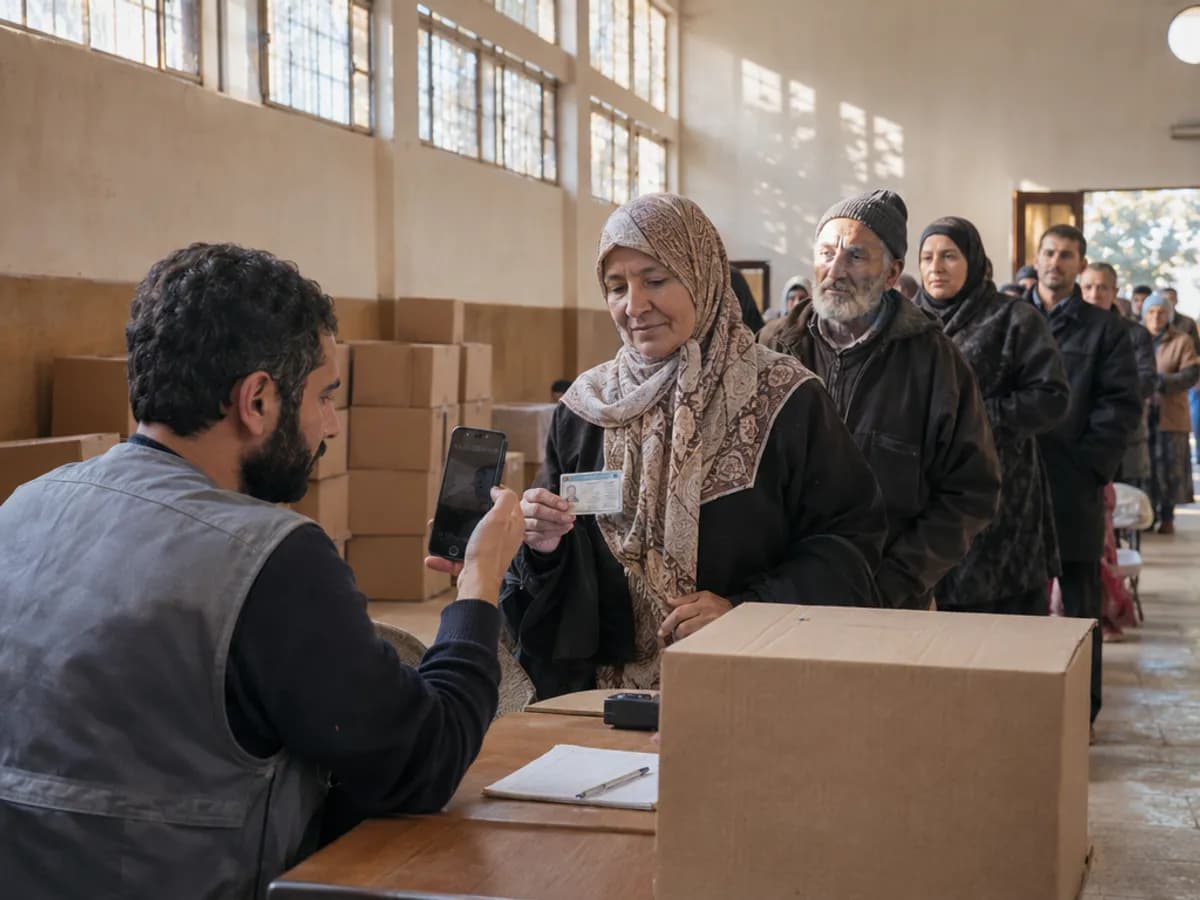
A distribution point, 08:00
A queue, a list of names, and one phone.
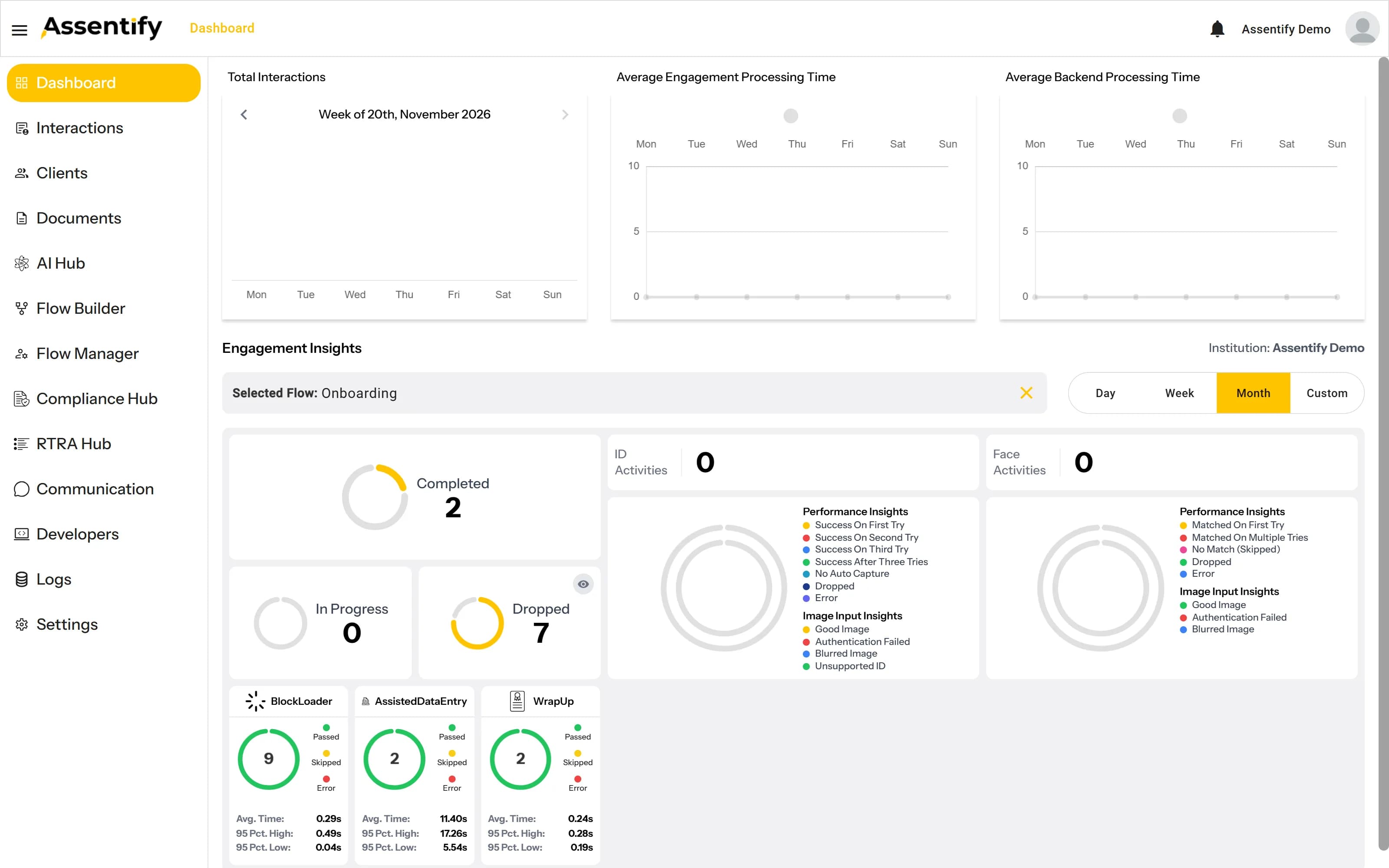
Registration happens where the people are. The whole check runs on a field worker’s phone, and the dashboard counts completed, in progress and dropped registrations per flow.
- 08:04A beneficiary reaches the front of the queue. The field worker opens the registration flow in Branch Assisted Mode.
- 08:05Whatever document exists is captured: an identity card, a passport, a residence permit.
- 08:06The live face is matched to the document. De-duplication runs on biometric face encoding across the whole programme.
- 08:06A second registration under a different spelling of the same name would have stopped here. This one is clean.
- 08:07Consent and terms are recorded. The disbursement is logged against one profile, counted once.
- 08:08The next person steps up. The auditor’s trail is already written.
Timings are illustrative.
The flows
What Assentify runs for an aid programme.
Beneficiaries and the partners who reach them, each on its own flow, feeding one audit trail.
Step 1 of 8 · Engagement Block
Branch Assisted Mode
A field worker opens the flow on their own device at the distribution point. A link, a QR code or WhatsApp work too.
Runs in Flows Hub
Engagement
- Branch Assisted Mode
- Identification Document Capture
- Face Image Acquisition
- Terms & Conditions
Connector
- Web Hook
Backend
- De-duplication
- Screening
Profile
- Client Profile
WhatsApp removes the install
The target population already uses WhatsApp. A conversational flow runs the same steps and produces the same record as the web version, published from the same definition.
See conversational flowsDisburse from the same record
The Data Sources engine connects your payment partner, wallet provider or beneficiary system, so the distribution list and the payment file come from one record.
The pressure
Six reasons this stopped being optional.
Donors, banks and the FATF action plan all ask an NGO the same question: who was paid, and how do you know.
A named item on the FATF action plan
Lebanon’s published FATF action plan includes undertaking targeted and risk-based monitoring of high-risk non-profit organisations, without disrupting or discouraging legitimate NPO activity. That last clause matters. The expectation is proportionate supervision, which means an NGO that can evidence its controls is treated very differently from one that cannot.
NPO classification inside the AML circular
BDL Intermediate Decision 12255 of 2016 brought non-profit organisation classification into the main anti-money-laundering circular alongside the risk-based approach and politically exposed persons. Your banking partner is applying that classification to you whether or not you have thought about it.
The bank account is the real pressure point
Lebanon has been under increased FATF monitoring since October 2024, and correspondent banks respond by applying enhanced due diligence to counterparties in the market. For an NGO the practical consequence is de-risking: an organisation that cannot evidence who it paid, and that it screened them, is the first account a bank chooses to close.
Donors audit harder than regulators
Institutional donors and grant-making bodies require beneficiary-level evidence, sanctions screening on partners and payees, and a trail that shows nobody was paid twice. Those conditions usually arrive in a grant agreement long before any supervisor takes an interest.
Double disbursement is the recurring loss
The single most common failure in aid distribution is one person collecting from two lists, at two sites, on two spellings of a name. It is usually a records problem, and it erodes a programme budget and a donor relationship at the same time.
Screening partners as well as people
Terrorist financing controls in the sector are aimed at the flow of funds through implementing partners, suppliers and local associations. A vendor onboarding flow that screens the counterparty is as important as a beneficiary flow that screens the recipient, and both should feed one audit trail.
The number that decides the budget
Every duplicate is a payment made twice.
A duplicate on a beneficiary register reaches one person twice and another person never. De-duplication on biometric face encoding is a toggle on the client profile, and it works across sites and name spellings because it matches the face.
What a donor asks for, and where it lives
- Who was registered
- Client profile
- Verified how
- Interaction record
- Screened against what
- Inline Compliance Hub
- Any matches
- Client Clear, with history
- Who decided
- Audit Hub, by user
- When
- Time started, time ended
- Paid twice
- Uniqueness rules
- Give me the file
- Export
What carries the weight
Two things an aid programme needs in the field.
Devices in the field, and screening a donor recognises.
A device and a link in the field
Everything runs from a published flow, so a field team needs a device and a link. Branch Assisted Mode gives staff an assisted session, and the interaction record captures the device name, the user agent and the timings, so a supervisor can see which site and which device produced which registration.
Screening without a data contract
Global list coverage arrives through plugins to LexisNexis and Refinitiv, which are the vendors institutional donors already recognise, and the local Lebanese lists are carried natively. An NGO therefore gets screening quality that matches its banking partner without negotiating its own data licence.
Questions
NGOs, answered.
Assentify registers beneficiaries, prevents double disbursement through biometric de-duplication, screens names against sanctions and politically exposed person lists, and keeps an exportable audit trail a donor can inspect. Registration runs on the web, through WhatsApp as a conversational flow, or as an assisted session on a field device. Across Assentify’s NGO clients the average is around 5,000 interactions per month each, mostly for donation disbursement.
Client uniqueness is enforced on biometric face encoding, so the same person cannot be enrolled twice under two names or at two distribution sites. You turn it on per client profile type, and you can add field-level uniqueness on any client profile elements you choose, such as a household identifier or a document number. The check runs at registration, which is the only point at which preventing a duplicate is cheap.
Screening obligations usually arrive through the donor agreement and the banking relationship rather than through a rule aimed at the sector directly, and requirements vary by funder and by jurisdiction. What is clear is the direction of travel: Lebanon’s FATF action plan includes targeted, risk-based monitoring of high-risk non-profit organisations, explicitly without disrupting legitimate activity, and correspondent banking pressure has made evidence of screening a condition of keeping an account.
The flow still runs, and the record shows what was verified. Identification Document Capture has a skip ability and each step is configurable, so a flow can capture the face, the questionnaire data and any document that does exist, then mark the case for a different level of assurance. What Assentify will not do is present an unverified registration as a verified one, because that is precisely what an auditor is looking for.
Assentify flows run on the web, in WhatsApp and inside a mobile application through the Mobile Flow SDK, so the lightest channel available in a location can be used. Where connectivity is a serious constraint, talk to us about the deployment shape before committing to a design, because Data Persistence, hosting and channel choice all affect what is workable at a given site.
Every registration produces one record holding the captured document, the face, the screening results with each list marked pass or match, the consent, the decision and the user who made it. The Audit Hub filters by system user, decision and date range and exports, Logs export separately, and Interactions export from the command centre. Donor reporting becomes a query.
Start
Register one distribution end to end.
We provision a tenant on your own subdomain, switch on de-duplication, and let your field team run a real registration flow from capture to the audit export.