Compare · Jumio
Assentify vs Jumio.
Jumio has been in this category longer than almost anyone, publishes over 300 patents and patent applications, and sells network signal rather than a single check. The question is how much of that network knows your market.
- Dimensions, sourced
- 12
- Jumio patents and applications
- 300+
- Cases where Jumio fits better
- 4
- Every source checked
- 16 Aug 2026
The short version
CHOOSE JUMIO IF
Cross-client network signal is central to your fraud model, throughput is your binding constraint, or your evaluation scores patents and operating history.
CHOOSE ASSENTIFY IF
Your applicants are regional, the data has to stay in the country, screening needs the local lists, and the process ends in a signature rather than a decision.
The question to ask
A network is only as useful as its overlap with your applicants.
Jumio publishes an identity graph holding more than 30 million identities, fed by hundreds of data sources and built on over a billion processed transactions. The mechanism is genuine and well proven: when an identity or a device has already been seen misbehaving somewhere in the network, the next institution to encounter it gets a warning it could not have generated alone. For a global consumer platform, that is a strong reason to buy.
The value of that mechanism scales with overlap. If your applicants are Lebanese nationals presenting Lebanese civil identity documents at a Lebanese institution, the useful question is what share of the graph was built from that population. Jumio does not publish it. Any serious evaluation should ask Jumio directly, because the answer determines whether the network is doing work on your traffic or on somebody else’s.
Assentify builds signal differently, from within your own book. Biometric face encoding enforces uniqueness so one human cannot become two client records. Field-level uniqueness applies the same discipline to any profile element you choose. Continuous re-screening keeps the whole book under watch rather than checking once at onboarding. The RTRA Hub scores transaction risk in real time. That is narrower than a cross-institution graph, and it is entirely relevant to your traffic by construction.
There is also a residency consequence worth stating. Contributing to a shared graph means data about your applicants participates in something outside your jurisdiction. For a supervised institution in a market with data-hosting expectations, that is a question for the compliance function before it is a question for the fraud team.
Side by side
Twelve dimensions, sourced on both sides.
Jumio entries are taken from jumio.com, checked 16 August 2026. Where Jumio publishes nothing, the row says so.
| Dimension | Assentify | Jumio |
|---|---|---|
| What it is | A Digital Experience Platform covering identity verification, AML screening, digital signing, flow orchestration, real-time transaction risk assessment and custom AI processing pipelines on one contract. | Positioned on its own homepage as identity intelligence rather than a point-in-time check, sold under the Jumio Smart banner. |
| Published pricing | Reference starting points on the pricing page, completed by sales. No per-verification list price is published. | Not published. Jumio publishes a total cost of ownership calculator instead of a rate card. |
| Data residency | In-country processing in Lebanon, so identity data does not have to leave the jurisdiction to be verified. | No Lebanon-specific residency offer published. Jumio publishes no Lebanon landing page. |
| Document coverage | Every Lebanese identity document, plus global identity documents by market and passports to ICAO 9303. | Published as 5,000+ identity document types. |
| Network signal | Signal comes from the client’s own record: biometric de-duplication, field-level uniqueness, continuous re-screening and real-time transaction risk assessment through the RTRA Hub. | Published as a Jumio Identity Graph holding 30M+ identities, drawing on hundreds of data sources, over 1B+ transactions processed. |
| Throughput claimed | Over 30 subscribers live, processing hundreds of thousands of transactions daily. Real-time risk decisions under two seconds at load. | Published as 120 transactions per second. |
| Intellectual property | A proprietary bidirectional Arabic and Latin transliteration engine, Context Aware Signing, and the Flow Builder and Data Sources engines. | Published as 300+ patents and patent applications. |
| Screening lists | Global coverage through LexisNexis and Refinitiv plugins, plus the local Lebanese lists, including ISF Leb 24 and SIC 18-26. | Screening and monitoring capability is part of the platform. Local Lebanese list coverage is not published. |
| Signing | Assentify signing produces advanced, qualified-grade digital signatures. Signed PDFs carry Assentify’s Adobe Approved Trust List (AATL) certificate, so Adobe Acrobat and Reader show them as trusted. Signing keys are held in a hardware security module, and Assentify runs a local certificate authority in country. In Lebanon, Banque du Liban recognises the one-time password as the client’s electronic signature. Context Aware Signing combines biometrics, OTP signing and tamper proofing. | No electronic signature product appears in the published solutions navigation. |
| Channels | Web link, short URL or QR, conversational and WhatsApp flows, mobile SDK, and Branch Assisted Mode for onboarding at the counter. | Web and mobile SDK integration paths. No messaging channel is published. |
| Custom AI pipelines | Custom AI processing pipelines pointed at your own documents, plus a professional services division that builds loan origination systems, mobile apps and core integrations on the same platform. | A software platform. Bespoke system build is not part of the published offer. |
| Security certification | ISO/IEC 27001:2022, certified by InterCert, registration IC-IS-2408273, certified 31 August 2024, recertification due 30 August 2027. | No certification badges are surfaced on the Jumio homepage. Certification detail is available through Jumio directly. |
Jumio figures are quoted from jumio.com, checked 16 August 2026. Assentify figures are from the ISO/IEC 27001:2022 certificate and current platform documentation. The certification row records what each vendor publishes on its own site, and is not a statement about what either vendor holds.
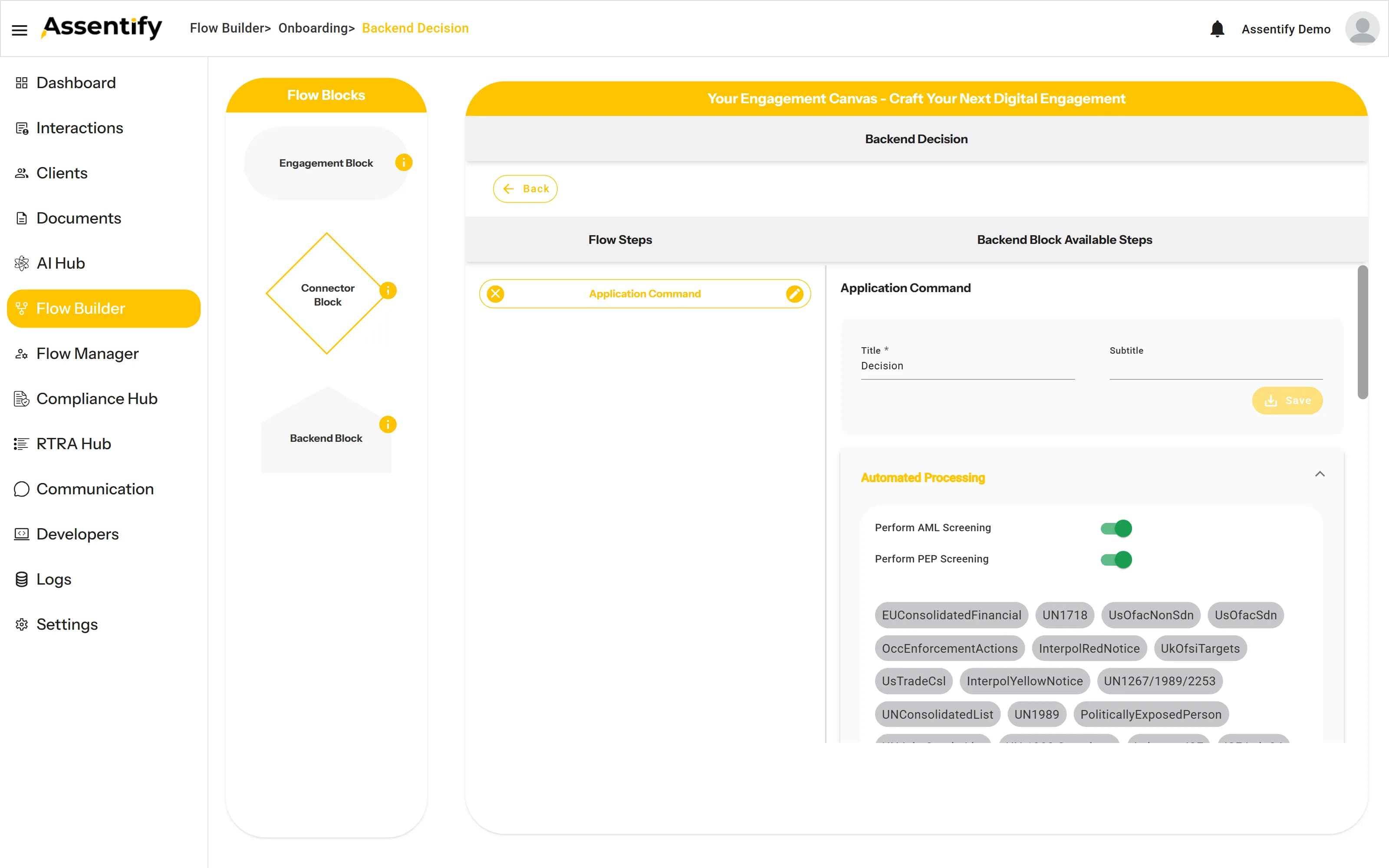
The lists, on screen
Each flow names the lists it screens against.
Screening is configured inside the flow’s Backend Block: switch on AML and PEP screening and choose the lists for that flow, local Lebanese lists included.
- Application Command in the Backend Block
- AML and PEP screening switched on per flow
- The lists chosen for this flow
Scale and depth
Global scale is real. It is just not the same thing as local depth.
Jumio processes more transactions than Assentify and holds more patents. Assentify reads every Lebanese identity document, carries the local Lebanese lists, matches Arabic and Latin renderings of the same name, and keeps the processing inside the country. Decide which of those two your risk actually lives in.

Where Assentify is stronger
Four differences that decide a regional evaluation.
None of these dispute Jumio’s scale. They describe what scale does not buy in a market it was not built from.
1B+
Jumio transactions processed, lifetime
100K+
Assentify transactions daily, in production
5,000+
Jumio document types in the catalogue
Every
Lebanese identity document, MRZ or not
JUMIO LEFT · ASSENTIFY RIGHT
A graph built elsewhere does not know your market
Network signal is real, and its value depends on overlap. An identity graph assembled largely from other markets contributes little when the applicant is a Lebanese national presenting a Lebanese civil identity document at a Lebanese institution. What contributes is reading that document properly, matching the Arabic and Latin renderings of the name, screening against the local lists and de-duplicating against your own book. Assentify is built around those four, and processes them inside the country.
Every Lebanese document, and the local lists
Assentify reads every Lebanese identity document rather than the subset that fits a global catalogue, and screens against local Lebanese lists including ISF Leb 24 and SIC 18-26 alongside global coverage bought from LexisNexis and Refinitiv. Jumio publishes 5,000+ document types, which is a serious catalogue, and publishes nothing about Lebanese list coverage.
The process finishes with a signature
No electronic signature product appears in Jumio’s published solutions navigation, so an institution needing a verified identity followed by a signed agreement is buying two vendors. Advanced, qualified-grade digital signing: an Adobe AATL certificate, keys in a hardware security module and a local certificate authority. Banque du Liban recognises the one-time password as the client’s electronic signature, and Context Aware Signing binds biometrics, OTP signing and tamper proofing to the document itself.
The platform reshapes without a release cycle
When a circular changes what a bank must collect, the flow has to change quickly. Assentify flows are built in the Flow Builder, or drafted with Ashley, and published to web, WhatsApp, mobile SDK or Branch Assisted Mode without an engineering release. Where the requirement goes beyond the platform, the professional services division builds it, as it did at Credit Financier with a custom loan origination system, a mobile super-app and an integration for BDL eCDR credit report requests.
When to choose Jumio instead
Four situations where Jumio is the better buy.
The first one is a capability Assentify does not have.
You want cross-client network signal
Jumio publishes an identity graph holding over 30 million identities and describes hundreds of data sources feeding it, on top of more than a billion transactions processed. A fraud ring that has been seen at another institution can be recognised at yours. Assentify builds signal from your own record through biometric de-duplication, field uniqueness and continuous re-screening, which is a different and narrower mechanism. If cross-institution network effects are central to your fraud model, that is a real advantage.
Your risk committee weighs patents and tenure
Jumio publishes over 300 patents and patent applications and has operated in this category longer than almost anyone in this comparison set. Some institutions treat that as evidence of durability, and it is not an unreasonable proxy. Assentify was founded in 2022. If long operating history is a scoring criterion in your evaluation, Jumio scores higher on it.
Raw throughput is your binding constraint
Jumio publishes 120 transactions per second. If you are launching a campaign that will produce a very large concurrent spike across many markets at once, that is a published number you can plan against. Assentify processes hundreds of thousands of transactions daily across its subscriber base and returns real-time risk decisions in under two seconds at load, but the two figures measure different things and you should ask both vendors for a load profile matching your own peak.
You want research assets to build a business case
Jumio publishes an annual identity study, an iGaming report, a deepfake detection guide, a showcase application and a total cost of ownership calculator. Those are genuinely useful when you are writing an internal business case and need third-party framing rather than vendor claims. Assentify publishes the State of eKYC in Lebanon report and a regulatory hub, which is deeper on one market and much narrower overall.
Jumio’s total cost of ownership calculator deserves a specific mention. Publishing a modelling tool instead of a rate card is a smart answer to a real buyer problem, and it is more useful in a business case than a headline unit price would be. Assentify does not publish an equivalent tool today. If you are building a business case and want the arithmetic, sales builds the model with you.
Sources
Where the Jumio figures come from.
Jumio publishes a great deal about scale and very little about certification or price.
Sources
Competitor facts are taken from each vendor’s own published pages, checked on 16 August 2026. Vendors change their sites, so check the current page before relying on a figure.
- Jumio positioning under the Jumio Smart banner and identity intelligence framinghttps://www.jumio.com/ · checked 16 August 2026
- Jumio scale claims: 120 transactions per second, 5,000+ ID types, 300+ patents and patent applications, 1B+ transactions, 30M+ identities in the Jumio Identity Graphhttps://www.jumio.com/ · checked 16 August 2026
- Jumio resource estate including the TCO calculator, showcase application, deepfake detection guide, 2026 identity study and 2026 iGaming reporthttps://www.jumio.com/ resources navigation · checked 16 August 2026
- Absence of certification badges on the Jumio homepagehttps://www.jumio.com/ · checked 16 August 2026
- Assentify ISO/IEC 27001:2022, InterCert, registration IC-IS-2408273Certificate issued 31 August 2024, recertification due 30 August 2027
Open questions
- Jumio pricing. Nothing is published.
- Jumio’s current certification list. No badges are surfaced on the homepage, which is a publication choice rather than evidence of absence. Ask Jumio directly.
- Jumio’s Lebanese identity document coverage and whether any Lebanon residency option exists under a private contract. Neither is published.
- The composition of the Jumio Identity Graph by market, which determines how much of its signal is relevant to a Levantine applicant pool.
- Any accuracy or false-accept comparison. Neither vendor publishes methodology that would make one meaningful.
Jumio sells identity intelligence built on scale and network signal, while Assentify sells identity verification, AML screening, digital signing, flow orchestration, real-time transaction risk assessment and custom AI processing pipelines as one platform. Jumio is stronger on cross-client network effects, published throughput, patent estate and research assets, with an identity graph of over 30 million identities and more than a billion transactions processed. Assentify is stronger on in-country processing, every Lebanese identity document, local Lebanese screening lists, signing inside the platform, WhatsApp onboarding and pipelines built for the documents that are missing.
Jumio does not publish pricing. It publishes a total cost of ownership calculator instead of a rate card, which is a reasonable substitute for a business case but is not a price. Assentify publishes reference starting points on its pricing page and completes the number with sales. If a published unit price is a hard requirement of your process, both vendors will disappoint you and other vendors in this category publish one.
Jumio publishes no Lebanon landing page and no Lebanon-specific data residency offer, as of 16 August 2026. Lebanese documents may fall inside its 5,000+ document catalogue, but the catalogue count is not a field-level specification and Lebanon is not addressed as a market with its own regulators, lists and hosting requirement. Assentify processes in country in Lebanon, supports every Lebanese identity document, and screens against local Lebanese lists including ISF Leb 24 and SIC 18-26.
Whether a network identity graph beats local depth depends entirely on how much your applicant pool overlaps with the graph. A network graph recognises an identity that has already been seen elsewhere in the network, which is powerful for high-volume consumer businesses spanning many markets. For a Lebanese institution onboarding Lebanese nationals with Lebanese documents, the overlap is thin and the decisive capabilities are document reading, Arabic and Latin name matching, local list coverage and de-duplication against your own book. Ask any vendor claiming network signal what share of its graph comes from your market.
No electronic signature product appears in Jumio’s published solutions navigation, as of 16 August 2026. An institution needing a verified identity followed by a signed agreement is therefore buying two vendors and reconciling two audit trails. Advanced, qualified-grade digital signing: an Adobe AATL certificate, keys in a hardware security module and a local certificate authority. Banque du Liban recognises the one-time password as the client’s electronic signature, and Context Aware Signing binds biometrics, OTP signing and tamper proofing to the signed document.
Jumio does not say, and a homepage without badges is no evidence of what Jumio holds. Certification detail is available from Jumio directly and any serious evaluation should request it. Assentify publishes ISO/IEC 27001:2022 with its certification body, registration number IC-IS-2408273 and recertification date, because a certificate claim without a number cannot be checked.
Start
Ask both vendors what their network knows about your market.
Then run the same documents and the same Arabic names through both. One month free, on your own book, is worth more than either vendor’s statistics page.
See them live before you decide. The demo call shows the platform working on real screens, and the free month puts a tenant of your own behind every claim in the comparison. One form covers both, and no card is taken at any point.
Still comparing? Every comparison, in one place.