Telecoms
Subscriber registration at national scale.
Telecom is the highest-volume work on the platform. Registration in a flagship store, in a dealer outlet and on a client’s own phone all produce the same record.
- Interactions a month, average per operator
- 300,000
- At every activation
- eKYC
- Channels, one flow
- 3
- Processing where required
- In country
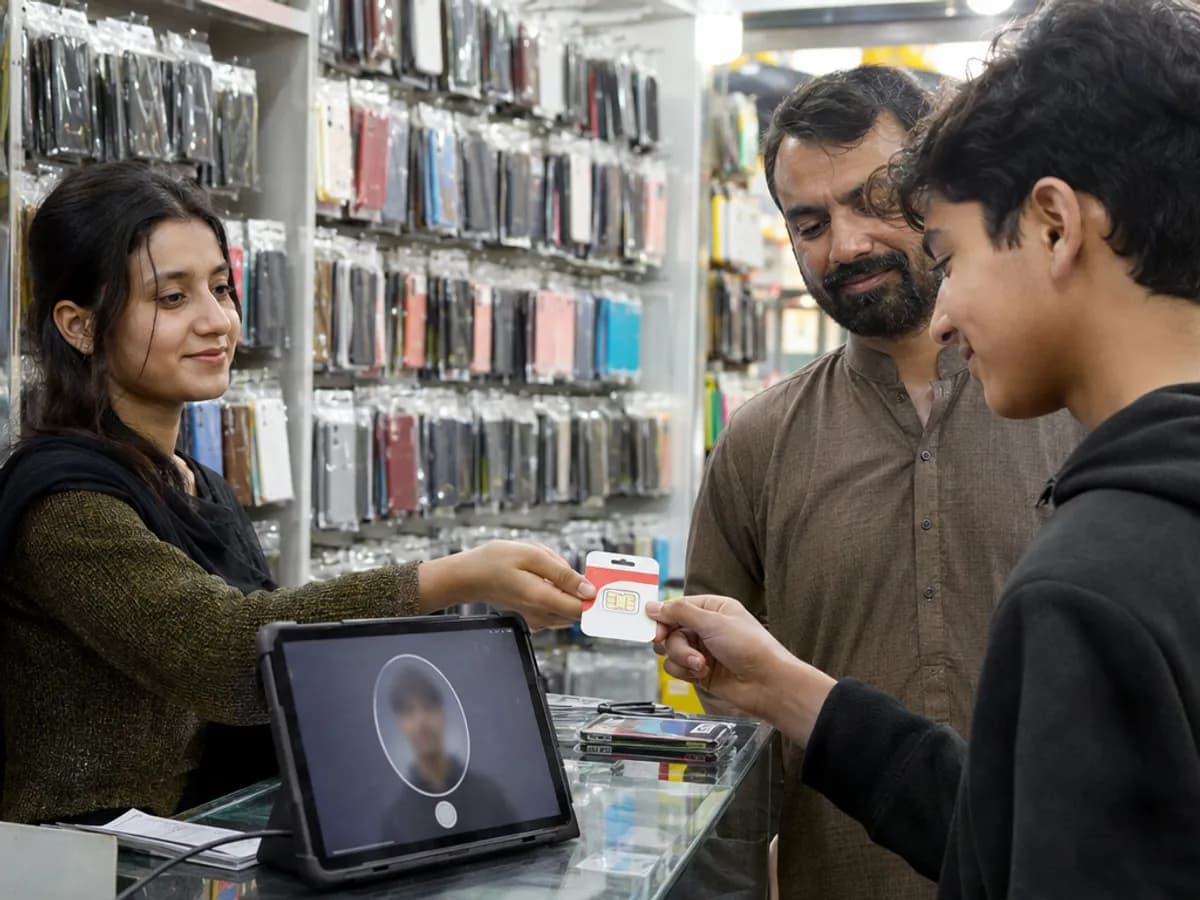
A point of sale, one of hundreds
One activation. Multiply it by three hundred thousand.
The same minute repeats at every dealer, all month.
- 13:02A subscriber buys a SIM. The dealer opens the registration flow on the counter device.
- 13:03The identity document is captured and read by templated OCR built for the market’s documents.
- 13:04The live face is matched to the document photo. Liveness passes and the Match Percentage lands on the record.
- 13:05The subscriber is registered. The document, the match and the timestamps sit on one retrievable record.
- 13:05The same minute is running at hundreds of other points of sale. Average volume per telecom client is 300,000 interactions a month.
- AuditWhen the regulator asks who activated a number, the answer is a record.
Timings are illustrative.
The flows
What Assentify runs for an operator.
Publish once and the same flow runs in a browser, inside your app through the Mobile Flow SDK, and at a store or dealer outlet in Branch Assisted Mode. The steps, the screening and the audit trail do not fork.
Step 1 of 7 · Engagement Block
Branch Assisted Mode
The dealer opens the same flow a self-service client would use, with the same checks.
Runs in Flows Hub
Engagement
- Branch Assisted Mode
- Identification Document Capture
- Document Liveness
- Face Image Acquisition
Connector
- Web Hook
Backend
- De-duplication
Profile
- Client Profile
Screening where financial services run
For operators running mobile money and airtime lending, the Backend Block runs AML and PEP screening in the same flow, and the RTRA Hub watches transactions afterwards with Sender, Receiver and Transaction entities.
See the RTRA HubWired into provisioning
The Data Sources engine connects billing, the subscriber registry and provisioning, tested in place and changed from the admin interface. No development and no customisation, and your team stays in control.
The case
Six reasons an operator runs verified registration.
Fraud in the dealer channel, base quality, drop-off and eSIM all point the same way: verify the person before the SIM is live.
Subscriber registration at volume
At 300,000 interactions a month, a one percent improvement in first-try capture is thousands of avoided retries a month, and a two-second reduction in a step is measured in days of aggregate client time.
The dealer channel
Most subscriber registrations do not happen in an operator’s own store. They happen through dealers and agents whose incentives are volume-based, which is where registration fraud lives.
De-duplication across the base
Duplicate subscriber identities inflate the base, corrupt churn and revenue reporting, and are the standard route to bulk SIM abuse. Assentify enforces uniqueness on biometric face encoding and on any subscriber profile fields you declare must not repeat, so the check runs before the SIM is issued.
Drop-off as a revenue number
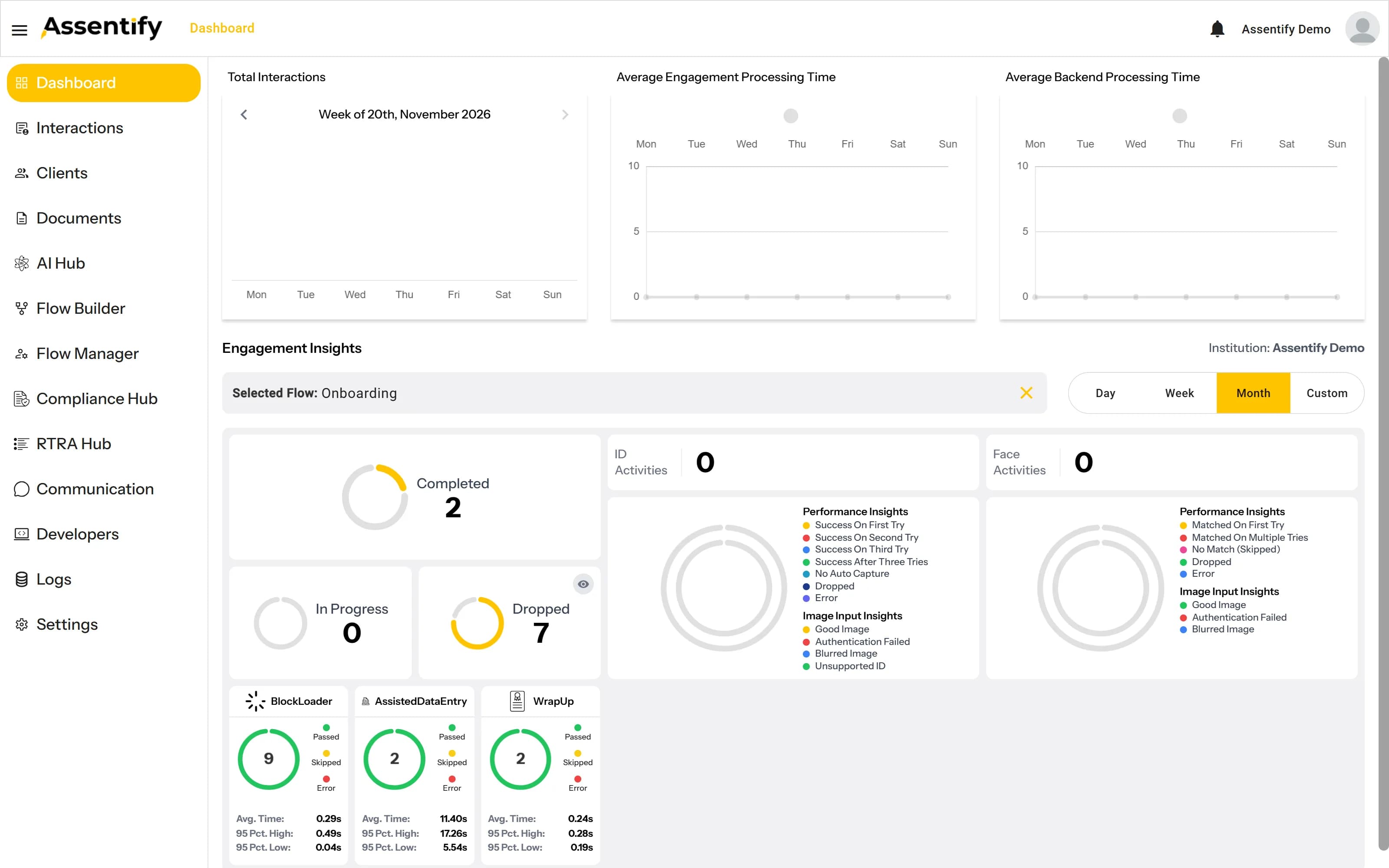
Engagement Insights reports Completed, In Progress and Dropped per flow by day, week or month. Performance Insights for identity capture separates first, second and third try, no auto capture, dropped and error. Image Input Insights separates good image, authentication failed, blurred image and unsupported document. Very few vendors expose any of it. WANDA adds a widget to the dashboard from a sentence you type.
Regulation varies by market
Subscriber registration duties differ sharply between markets, and Assentify does not claim a mandate that a given regulator has not published. Where a market imposes registration rules, the flow is configured to them. Where it does not, the case is operational: fraud, base quality, cost per activation and the speed of getting a client connected.
eSIM changes the shape
An eSIM activation has no counter and no plastic. The entire identity assertion happens remotely, usually on the device being activated, often abroad. That removes the human sanity check a store assistant used to provide and puts the whole weight on document authenticity, liveness and de-duplication.
The control that changes behaviour
The same checks in a dealer’s hand as in the flagship store.
Registration fraud lives where incentives are volume-based. When every outlet runs the same flow, and every record carries the device, the user and a Modified flag on any manual edit, the dealer channel becomes auditable.
What 300,000 a month demands
- First-try capture
- Reported per flow
- Step latency
- 95th percentile, in seconds
- Document mix
- Regional, global, ICAO passports
- Model
- Fine-tuned, English and Arabic
- De-duplication
- Biometric plus field level
- Channels
- Web, SDK, assisted counter
- Processing
- In country where required
- Audit
- Filterable and exportable
What carries the weight
Four things that matter at this volume.
A model Assentify owns, both scripts end to end, processing in country, and latency figures you can write into a contract.
Extraction on a model we own
The AI Hub runs on Assentify’s own fine-tuned vision language model. Enterprise deployments can have a dedicated GPU instance and custom model training. At 300,000 documents a month, owning the model is the difference between tuning for your document mix and filing a support ticket.
Arabic and English, end to end
Documents arrive in both scripts and so do names. Extraction handles English and Arabic, and the Compliance Hub applies transliteration in both directions when screening is part of the flow. The user interface ships English first with right-to-left support in the design system.
In-country processing where required
Data Persistence is set per tenant as on cloud or on premise, and in Lebanon Assentify runs its own cloud with local GPU servers so that document and biometric inference happens inside the country. National-scale programmes are exactly where that architecture stops being a preference and becomes a condition of the contract.
Latency you can hold a supplier to
The Dashboard reports average engagement processing time, average backend processing time, and 95th-percentile high and low step latency in seconds for Block Loader and Wrap Up. Those are the numbers a telecom operations team writes into a service level agreement, and they come straight out of the product.
Questions
Telecoms, answered.
Assentify runs subscriber registration end to end: identity document capture with templated OCR, document liveness and tampering detection, face capture with liveness and a match against the document photo, de-duplication across the subscriber base, and connection into the billing and provisioning stack. Telecom is the highest-volume vertical on the platform, averaging around 300,000 interactions per month per operator, and the same flow serves the web, the operator’s own app and the assisted store or dealer counter.
Whether SIM registration eKYC is mandated depends entirely on the market, and Assentify does not claim a mandate a regulator has not published. Some jurisdictions impose subscriber registration and identity verification duties on operators; others leave it to operator policy. Where a published rule exists, the flow is configured to it. Where it does not, the case for verified registration is operational: registration fraud, base quality, dealer-channel control, and the cost of a fraudulent activation.
Assentify controls the dealer and agent channel by running the same flow, with the same checks, wherever the registration happens. Branch Assisted Mode gives a dealer an assisted session over the same steps a self-service client would use, and every interaction record captures the device name, the user agent, the start and end times, the Match Percentage and the decision with the user who made it. Where a record is edited manually it is flagged as Modified, so a correction is never invisible.
Yes, the AI Hub pipeline runs pre-processing, templated OCR and post-processing on Assentify’s own fine-tuned vision model in English and Arabic, and the identity stack supports every Lebanese identity document, regional documents by market and passports to ICAO 9303. A Playground and a Template Builder let your team add or tune a document template themselves.
Operationally, a national-scale deployment looks like a tenant per environment, in-country processing, published latency figures and an audit surface built for examination. Data Persistence is set per tenant, dual maker and checker control can be required for platform-wide changes, session length and password policy are configurable, and the Audit Hub and Logs both export. Assentify’s National Scale Engagement Services line exists specifically for programmes of this size.
Start
Benchmark us on your own document mix.
Bring the documents your dealers see, the ones that fail today, and your peak volumes. We will show you the extraction, the liveness and the numbers the Dashboard reports.