Insurance
One flow from quote to signed policy.
An insurer’s onboarding, documents and screening are one client interaction. Today it runs across three systems and a scanner. On Assentify it runs as one flow.
- Interactions a month, average per insurer
- 1,500
- Named insurers live
- 4
- Flow from eKYC to issuance
- 1
- Policies generated from templates
- Word
Insurers running on Assentify
- Alig
- Fidelity
- Libano-Suisse
- MedGulf
A live insurer flow
The afternoon the platform said no.
An insurer’s branded flow, in production, refusing a fake identity document. The same flow ends on Payment Processing and Context Aware Signing from the step library.
- 14:02A proposer opens the flow from a shared link. Service Selection asks what the visit is for.
- 14:04Identification Document Capture asks for the identity card and opens the camera.
- 14:04Document Liveness sees a reproduction, not a real card. The screen says Please Use A Real Id.
- 14:05The flow does not move forward. No policy is written, no client profile is created, no claim can follow.
- 14:06A genuine document passes the same check in seconds. Genuine clients never notice it happened.
Timings are illustrative.

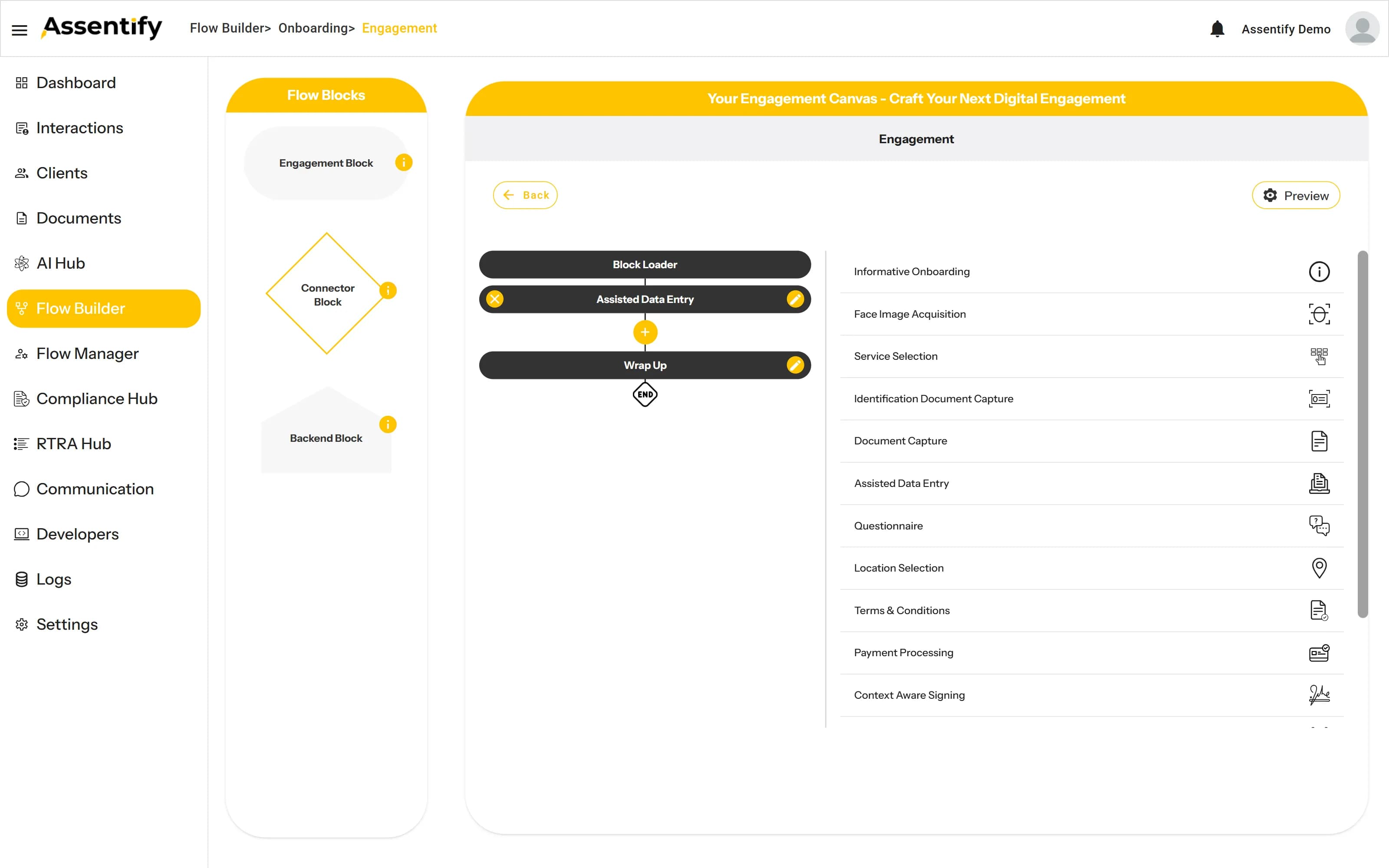
The flows
Quote, policy and claim, on one canvas.
Each flow is published from Flow Manager as a link, a short URL or a QR code.
Step 1 of 9 · Engagement Block
Photo upload
The client uploads photos of the car.
Runs in Flows Hub
Engagement
- Photo upload
- Data collection
- Quotation
- Payment
- Contract signing
Connector
Backend
- Screening
- Decision rule
Profile
- Client Profile
Your policy wording, signed in the flow
The Document Template Processing Engine turns flow inputs into text, date, image and signature tokens in your own Word document. Assentify signing produces advanced, qualified-grade digital signatures. Signed PDFs carry Assentify’s Adobe Approved Trust List (AATL) certificate, so Adobe Acrobat and Reader show them as trusted. Signing keys are held in a hardware security module, and Assentify runs a local certificate authority in country.
Connected to your policy system
The Data Sources engine adds your policy administration, billing or CRM system from the admin interface, with pull, push or file endpoints. No development and no customisation, and your team stays in control.
See the Data Sources engineThe obligation
Insurers are reporting entities, with their own circular.
An insurer answers to a prudential supervisor and to a financial intelligence unit at once, on the same client file.
Article 5 reporting entity
Article 5 of Lebanon Law 44 of 2015 names insurance companies as entities that must report suspicion of money laundering or terrorist financing to the Special Investigation Commission.
SIC Circular 21
SIC Circular 21 of 9 September 2016 is addressed to the parties mentioned in Article 5 of Law 44, particularly insurance companies. A supplement covers know your customer for legal entities. Insurance has a circular written for it.
Insurance Control Commission
The Insurance Control Commission supervises the sector in Lebanon, alongside the anti-money-laundering duties owed to the SIC.
The beneficiary problem
Insurance is unusual because the person paying, the person insured and the person who receives the money can all be different people. Identifying only the first of the three is the classic weakness in an insurance compliance programme, and it is why legal-entity know your customer has its own supplement.
The claim is a second onboarding
Fraud does not only arrive at underwriting. A claim brings a fresh identity assertion, often years after the policy was written, frequently from someone the insurer has never met. The same identity verification and screening that guarded the policy should guard the payment.
Evidence, kept and produced
Reporting entities are expected to retain the file and produce it. That means the identity document, the face match, the lists searched, the decision and the person who made it, all held together and exportable rather than scattered across an underwriting system, a scan folder and an email thread.
The one that matters here
A policy gets printed. The signature has to survive that.
The Context-Aware Visible Signature Verifier is Assentify’s own visual signature verification, built to protect an electronic signature from tampering and copying after the document is printed. In a sector that files paper and produces it years later, that keeps the signature checkable.
On the printed policy
- Signature
- Bound to the verified signer
- Pattern
- Protects the mark from copying
- Identity
- Shown beside the signature
- Flow
- The context it was signed in
- Years later
- Still checkable on paper
What carries the weight
Two things insurers lean on.
A profile per client type, and the people who sell the policies.
Three client profile types
Person, Verified Person and Verified Business are enabled and configured independently, each with its own fields, document visibility, re-screening cadence and expiry alerts. Group medical schemes, corporate fleets and retail motor do not have to share one badly-fitting profile.
Brokers, agents and the branch
Most policies in this market are still sold through people. Branch Assisted Mode runs the assisted version of the flow for an agent or a branch, and Flow Manager can publish a separate flow per channel with its own link and QR code, while screening and audit stay shared underneath.
Questions
Insurance, answered.
Alig, Fidelity, Libano-Suisse and MedGulf run client interactions on Assentify. Across Assentify’s insurance clients the average is around 1,500 interactions per month each, covering eKYC, policy request and policy issuance. Insurance sits alongside banks, wallets, financial institutions and telecoms in a subscriber base of over 30 live organisations processing hundreds of thousands of transactions daily.
Insurance companies are reporting entities under Article 5 of Law 44 of 2015 and must report suspicion of money laundering or terrorist financing to the Special Investigation Commission. SIC Circular 21 of 9 September 2016 is addressed to Article 5 parties and to insurance companies in particular, with a supplement covering know your customer for legal entities. The Insurance Control Commission supervises the sector prudentially at the same time.
Yes, the Document Template Processing Engine takes your own Word document and lets you insert flow inputs as text, date, image and signature tokens. The Context Aware Signing step then consumes those tokens, so the policy schedule is generated from the verified data captured in the flow and signed by the client in the same sitting. The signed document is stored against the client profile with the rest of the file.
A claim runs as its own flow with its own steps, using the same identity verification the policy was written on. The claimant captures an identity document and a live face, the platform matches the face to the document and screens the name, and the result is compared against the existing client profile. Because de-duplication can be enforced on biometric face encoding, a claimant presenting as a new person is far harder to sustain.
No, Assentify connects to it rather than replacing it. The data sources engine adds your policy administration, billing or CRM system as a source from the admin interface, with a type of API or SOAP, an authentication method of API key or basic authentication, and endpoints typed as pull, push or JSON file with headers, body and optional XSLT transformation. You test the connection in place before saving, with no development and no customisation.
A web flow or a WhatsApp conversational flow can be built and published in minutes, and shared as a link, a short URL or a QR code. Most insurers start with one product line, publish it, then add branches for other products on the same canvas. Embedding the flow in your own mobile app through the Mobile Flow SDK takes hours rather than weeks.
Start
Issue one policy end to end, in your own tenant.
We provision a tenant on your own subdomain, load your policy template and the lists you screen against, and let your team run a real quote to signed policy.