Lebanon · electronic signature
In Lebanon, the signature is only as good as the evidence.
Lebanese law gives an electronic signature the same legal effect as a wet one, and leaves the shortcut that would prove reliability unbuilt. The question is what you can put in front of a judge when somebody says they never signed.
- The law
- 81/2018
- Same effect as paper
- Art. 4, 7
- Presumption not live
- Art. 17
- BDL e-signature
- OTP
The law
What Law 81 of 2018 actually says
Law No. 81 of 2018 on Electronic Transactions and Personal Data, enacted 10 October 2018, is short on the signature. It turns on two questions: can you identify the signatory, and can you show the record is intact.
Article 4
Legal effect
Electronic writings and signatures have the same legal effect as the writings and signatures made on paper, provided the producer or signatory is identifiable and the data is safely organised and stored. This is the foundation of every electronic contract in Lebanon.
The platform’s part
Identity proofing at the moment of signing, and integrity sealing on the document itself.
The regime is half built
Article 17 offers a presumption of reliability through an authorised authentication service provider, and Articles 20 to 25 describe how COLIBAC would accredit one. Practitioner analysis in Beirut reports that no provider is yet authorised and that COLIBAC is not operational in determining the accreditation conditions.
So the shortcut is closed. What remains is Article 12, where the judge assesses the organisation of the record, the storage conditions that preserve integrity, and the reliability of the identification mechanism. Read it as the specification for electronic signing in Lebanon.
Banking moved first
While the general regime waited, Banque du Liban wrote its own. Article 5 of Basic Decision 7548 sets seven cumulative conditions for an electronic signature in electronic banking: client consent to the likely risks, adequate measures for utmost security, a signature uniquely linked to the signatory, capable of identifying the signatory, created using data the signatory can use under sole control with a high level of confidence, linked to the signed data so any later change is detectable, and the one-time password serving as the client’s electronic signature.
Article 25 of Basic Decision 13790 repeats all seven for Electronic Payment Services Providers. A Lebanese bank therefore has clearer signature guidance from its regulator than a Lebanese business has from the civil law.
Levels
Which signature levels are recognised in Lebanon
Lebanon has no ladder of simple, advanced and qualified signatures in force today, because the COLIBAC accreditation machinery has not been stood up. Three things are recognised.
A plain electronic signature
Captured in the flow in real time. It carries legal effect under Articles 4 and 7 as long as the signatory is identifiable and the record is intact. Its weakness is that identifiability and integrity are asserted rather than demonstrated, which is exactly what a court examines under Article 12.
Recognised, weakest evidence
A digital signature with public key cryptography
A cryptographic signature binds the signer’s key to the document and makes any later change to the bytes detectable. Integrity stops being a claim and becomes arithmetic. Identifiability still depends on how well the key was bound to a real, verified human at issuance.
Recognised, strong on integrity
The one-time password, in banking
Banque du Liban states that the one-time password serves as the client’s electronic signature, in Article 5(7) of Basic Decision 7548 and Article 25(7) of Basic Decision 13790. It applies to electronic banking and payment operations only, alongside six other cumulative conditions.
Recognised by BDL, sector-specific
How Assentify signs
Assentify signing produces advanced, qualified-grade digital signatures. Signed PDFs carry Assentify’s Adobe Approved Trust List (AATL) certificate, so Adobe Acrobat and Reader show them as trusted. Signing keys are held in a hardware security module, and Assentify runs a local certificate authority in country.
The claim
No presumption. So build the proof instead.
Identity proofing at the moment of signing. A tamper-evident record afterwards. Integrity sealing on the document itself. A full audit trail with the user, the decision and the timestamp. Retained in Lebanon. That is the file that answers Article 12, and it is the file we build by default.
The product
Context Aware Signing
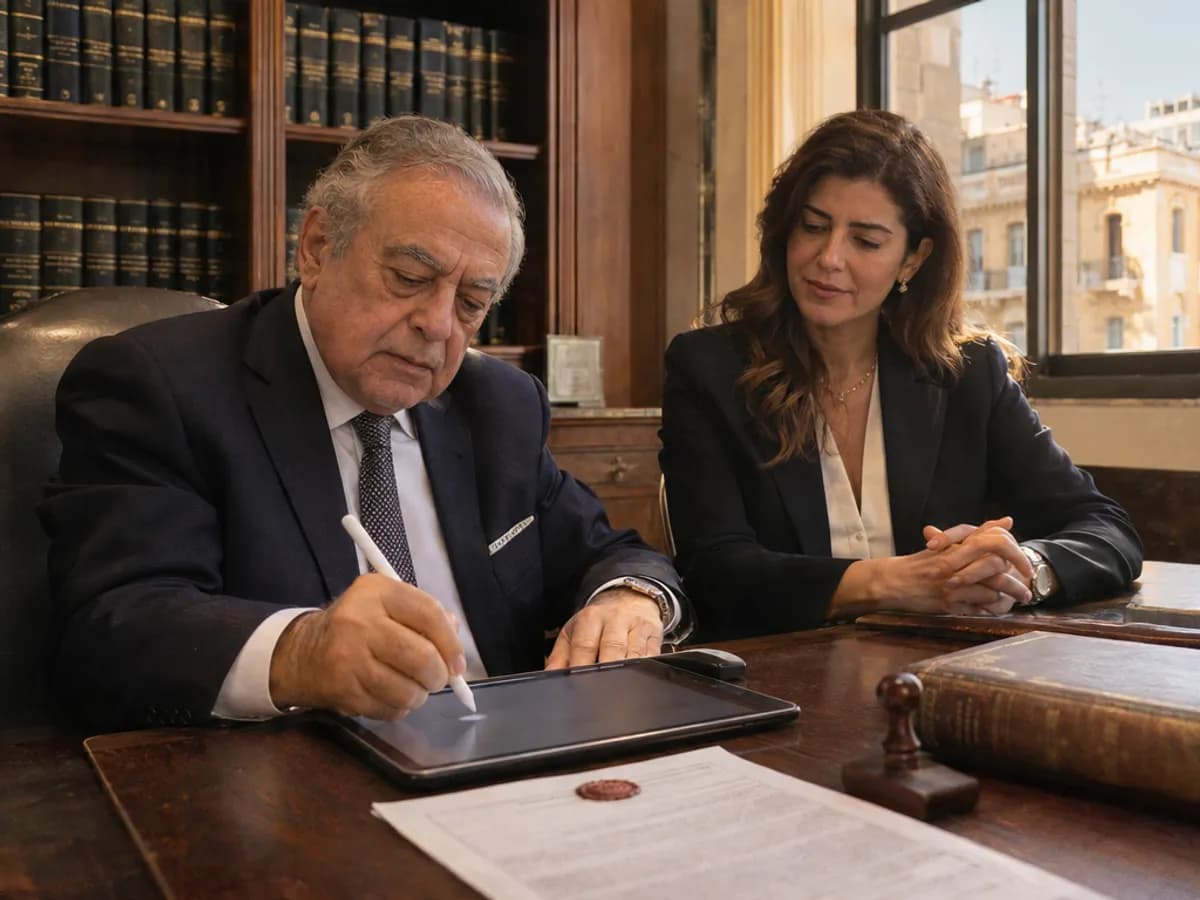
Assentify’s proprietary signing step binds the signature to the verified person and the exact document, on screen and on paper.
01 · The binding
It binds a face to a document
Context Aware Signing combines biometric data, such as the facial verification captured earlier in the same flow, with the metadata of the document being signed. The signature is not a drawing on a page. It is a record of who was present, what they were looking at, and when.
02 · The overlay
It embeds a visible, unique overlay
The signature carries a unique pattern overlay holding the document name and other critical details. Any attempt to lift the signature and reuse it on a different document, or to alter the document underneath it, becomes detectable rather than invisible.
03 · The print
It survives the printer
The overlay is visually verifiable, so the protection holds after the document is printed. In a market where a signed page still ends up in a physical file, a signature that only defends itself inside a PDF viewer is defending the wrong perimeter.
04 · The template
It consumes a real template
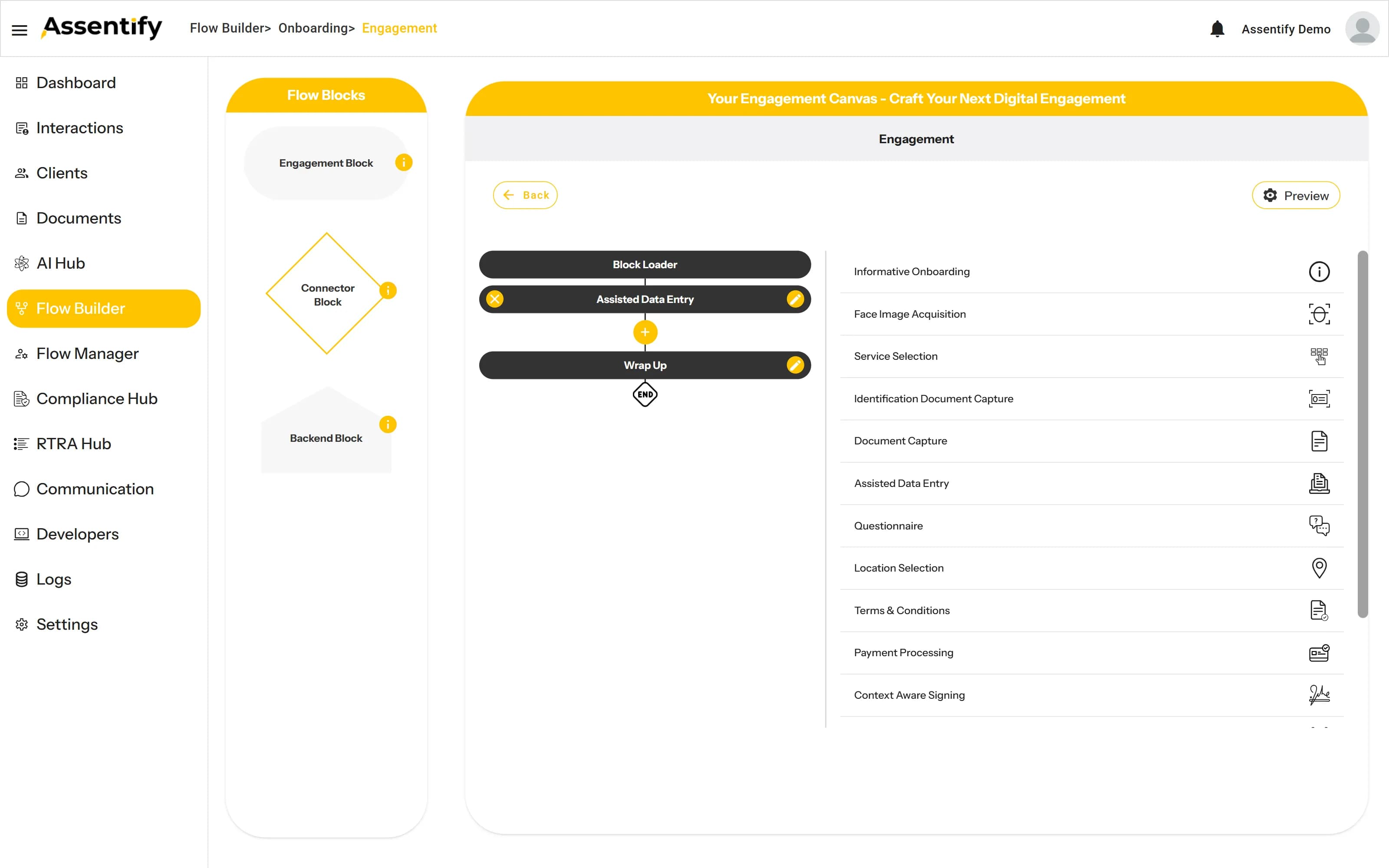
The Document Template Processing Engine takes a Word document and lets you place flow inputs into it as text, date, image and signature tokens. Context Aware Signing consumes that template, so the document a client signs is populated from verified flow data rather than retyped by a person.
Signing capabilities on the platform
- Real-time electronic signature captured in the flow
- Authenticated signature bound to the verified identity
- Digital signature using public key cryptography
- Adobe AATL certificate on every signed PDF
- Signing keys held in a hardware security module
- A local certificate authority run by Assentify in Lebanon
- Context Aware Signing with a visually verifiable overlay
- Document Template Processing Engine with text, date, image and signature tokens
- Signature Integration API for teams embedding it elsewhere
- Every signing event written to the exportable audit trail
What the signature record holds
The identity document that was captured, the face that was matched and its match percentage, the liveness result, the template that produced the document, the document itself, the signature, the user, the device, the user agent and the timestamps. One record, exportable, and readable by somebody who was not there.
Limits
Where an electronic signature will not do
Three limits to know before a project sets its scope.
Cash transactions above a monthly threshold
Basic Decision 13769 of 14 November 2025, Article 4.4, permits an electronic signature for natural persons only, and only where the value of the cash transaction, or the total value of recurring transactions by the same client at that institution, does not exceed USD 10,000 a month. Above that, wet signatures of both the client and the institution are required.
Acts that traditionally need an official form
Law 81/2018 states no explicit exclusions. Acts that have traditionally required an official or notarial form, such as marriage, divorce, wills and transfers of immovable property, remain unresolved pending implementing decrees. Treat them as out of scope for electronic signature in Lebanon until the decrees exist.
Anything where you cannot prove identity
This is not a legal exclusion, it is a practical one. Article 12 puts the judge in charge of assessing the identification mechanism. If a signature was collected without proving who was on the other end of the connection, the strongest cryptography in the world is signing an unknown person’s name.
Basic Decision 13769 also introduced the RF1-A and RF1-B forms for cash transactions at or above USD 1,000, and it was amended by Intermediate Decision 13815 of 4 May 2026, effective 30 June 2026. The signature rule sits inside that reporting obligation.
Go deeper
The rest of the Lebanon cluster
Questions
Digital signature in Lebanon, answered.
Yes, under Law No. 81 of 2018 on Electronic Transactions and Personal Data, enacted on 10 October 2018 and in force three months after publication, electronic writings and signatures have the same legal effect as writings and signatures made on paper. Article 4 sets that rule, provided the producer or signatory is identifiable and the data is safely organised and stored. Article 7 gives electronic documents the same significance and power of proof as a written paper-based document where the issuer is identifiable and integrity is ensured.
No, Lebanon has no qualified or accredited electronic signature in practice. Article 16 of Law 81/2018 says authentication services are not subject to pre-licensing, and allows a qualified authentication service provider to request an accredited certificate from the Lebanese Accreditation Council, COLIBAC. Practitioner analysis in Beirut reports that no authentication service providers are yet authorised in Lebanon and that COLIBAC is not operational in performing its functions, in particular determining the accreditation conditions. The presumption of reliability the law contemplates is therefore unavailable in practice.
The evidence you can produce in court, because Article 12 puts the judge in charge of assessing reliability. The judge looks at how the record was organised, the storage conditions that preserve its integrity, and whether the identification mechanism was reliable. That turns a signature into an evidence problem: who was verified, how, with what document, matched to what face, at what time, and what proves the document has not changed since. Assentify is built to produce exactly that file.
Yes, Article 5(7) of BDL Basic Decision 7548 states that the one-time password serves as the client’s electronic signature, and Article 25(7) of Basic Decision 13790 repeats it for Electronic Payment Services Providers. It is the seventh of seven cumulative conditions: client consent to the risks, utmost security, a signature uniquely linked to the signatory, capable of identifying the signatory, created with data under the signatory’s sole control, and linked to the signed data so that any later change is detectable. Banking is therefore ahead of the general civil regime in Lebanon on this point.
For cash transactions above a monthly threshold, and for acts that traditionally require an official form. Basic Decision 13769 of 14 November 2025, Article 4.4, allows an electronic signature for natural persons only and only where the cash transaction, or the total of recurring transactions by the same client at that institution, stays at or below USD 10,000 a month; above that the wet signatures of both the client and the institution are required. Acts such as marriage, divorce, wills and transfers of immovable property remain unresolved pending implementing decrees, so they should be treated as out of scope.
Context Aware Signing is Assentify’s proprietary signing step, which combines biometric data such as facial verification with document metadata to produce a tamper-resistant signature. It embeds a unique pattern overlay carrying the document name and other critical details, so any attempt to alter the signature or reuse it outside its intended context is detectable, including after the document is printed. It consumes documents built in the Document Template Processing Engine, where a Word template carries text, date, image and signature tokens populated from verified flow data.
Start
Sign something, then read the record.
Upload a Word template, place the tokens, add a Context Aware Signing step to a flow, and sign it yourself. Then open the interaction record and ask whether it would satisfy a judge who was not in the room.