Trust centre
What we hold.
How to check it.
Assentify Ltd. is certified to ISO/IEC 27001:2022 under registration number IC-IS-2408273, GDPR compliant, and iBeta certified on passive liveness. Each comes with the number, the body or the date a reviewer needs.
- IC-IS-2408273
- ISO 27001
- Passive liveness
- iBeta
- Processor role
- GDPR
- Processing, Lebanon
- In country
Certifications
Four things we hold, each with its evidence.
ISO/IEC 27001:2022
Certified · IC-IS-2408273
Assentify Ltd holds ISO/IEC 27001:2022 certification, registration number IC-IS-2408273, issued by InterCert on 31 August 2024 with recertification due 30 August 2027. It is verifiable with the certification body.
iBeta passive liveness
iBeta certified, ISO/IEC 30107-3 Level 1
Presentation attack detection is tested by an independent laboratory under ISO/IEC 30107-3. Active and configurable liveness ship alongside it. The confirmation letter is supplied on request.
Digital signing, Adobe AATL
Qualified-grade digital signing
Assentify signing produces advanced, qualified-grade digital signatures. Signed PDFs carry Assentify’s Adobe Approved Trust List (AATL) certificate, so Adobe Acrobat and Reader show them as trusted. Signing keys are held in a hardware security module, and Assentify runs a local certificate authority in country.
GDPR
Compliant
Assentify is GDPR compliant and acts as a data processor for its tenants: a data processing agreement, defined purposes, retention and deletion controls in the product, and support for data subject requests raised by the controller.
Capital Outsourcing runs the Security Operation Center and Network Operation Center for Assentify Cloud, 24/7, under a service level agreement.
The certificate
ISO/IEC 27001:2022, registration number IC-IS-2408273.
The certificate
- Standard
- ISO/IEC 27001:2022
- Registration number
- IC-IS-2408273
- Certification body
- InterCert
- Certified entity
- Assentify Ltd, Larnaca, Cyprus
- Initial certification
- 31 August 2024
- Certificate issue
- 31 August 2024
- Recertification due
- 30 August 2027
- Statement of Applicability
- Version 1.0
Scope, verbatim
“The Information Security Management System at Assentify, applies to the Software Operations and Software Engineering/AI Applications hosted as SaaS platform for their clients on Azure with the Support Function of IT Infrastructure, Human Resources, Physical Security, Legal and Administration.”
The certified entity
- Legal entity
- Assentify Ltd.
- Registered office
- 59 Archiepiskopou Makariou III, Mouyias Tower, 3rd Floor, Office 301, 6017 Larnaca, Cyprus
- TIC number
- 10433452M
- Founded
- 2022
- Research and development
- Canada and Lebanon
Platform controls
Six controls a reviewer asks about by name.
Each is a setting in the product that an administrator can show on screen.
Platform-wide changes
Dual maker and checker control
One administrator proposes a platform-wide change and a second approves it before it takes effect. A single compromised or careless account cannot quietly change a screening threshold, a decision rule or a retention setting.
On the screen
- Proposed by
- One administrator
- Approved by
- A second administrator
- Takes effect
- After approval
Session Management
Session and password policy
Session length and the password policy are set per tenant in Session Management.
On the screen
- Session length
- Default 15 minutes, configurable
- Required length
- Set per tenant
- Required unique characters
- Set per tenant
- Digit, lowercase, uppercase
- Required or not, per tenant
- Non-alphanumeric character
- Required or not, per tenant
Compliance Hub, Audit Hub and Logs
Full audit trail
Every action carries a user, a timestamp and an event type. The Audit Hub filters by system user, decision and date range and exports; the platform logs expand row by row and export as a set.
On the screen
- Every action
- User, timestamp, event type
- Audit Hub filters
- System user, decision, dates
- Logs
- Created time, activity, user, message
- Export
- Audit Hub and logs
User Management
Roles and user management
Access is managed per tenant, with roles that set which surfaces and which decisions a user can reach. The boundary between the person who can clear an AML match and the person who cannot is a role.
On the screen
- Access
- Per tenant
- Roles
- Surfaces and decisions a user can reach
- Clearing an AML match
- Granted by role
Interactions table
Marked and reviewable records
A record is marked when a person edits an extracted value, a face match falls below the threshold, an authenticity check needs manual review, or tampering is detected on the card. The mark is carried into the audit record.
On the screen
- Extracted value edited
- Marked modified
- Face match below threshold
- Marked for review
- Authenticity needs review
- Marked for review
- Tampering on the card
- Marked for review
Tenant settings
Retention and re-screening
Screening cycle, alerts before KYC expiry and renewal, and which captured documents are stored are tenant settings. The controller decides the data lifecycle.
On the screen
- Screening cycle
- Configurable, default 3 days
- KYC expiry alert
- Default 30 days
- KYC renewal alert
- Default 1000 days
- Stored captured documents
- Per step, toggled
Audit Hub
Every decision, filtered and exported.
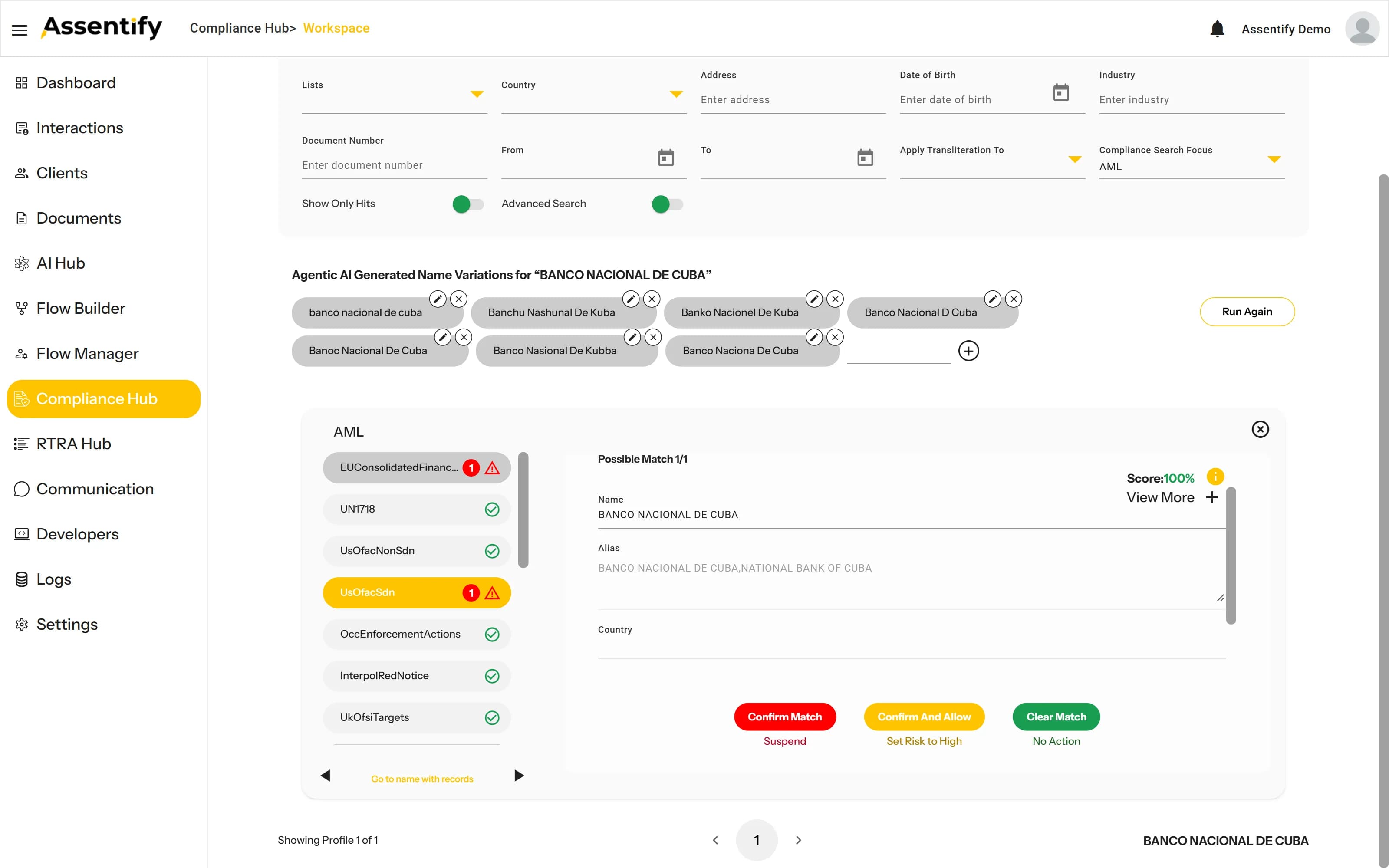
A named user confirms or clears each possible match. The Compliance Hub’s Audit Hub records the source, the system user, the names screened, the decision and the time. Filter by user, decision and dates, then export.
Residency and deployment
Where the data sits is a tenant setting.
Data persistence is set per tenant, on cloud or on premise. Processing follows the market.
Lebanon, in country
Data Persistence is set per tenant, on cloud or on premise. In Lebanon, Assentify runs its own cloud and GPU servers inside the country.
Lebanese banks, wallets, insurers
Zero trace, stored at the client
Assentify processes in its own cloud and keeps zero trace there. The data is stored on premise at the client. This is the model for the UAE, Kuwait, Qatar, Bahrain and Syria.
UAE, Kuwait, Qatar, Bahrain, Syria
On premise
Data persistence is a tenant setting with an on-premise option, configured with a proxy address. The Compliance Hub engine is also offered as a one-time on-premise package.
Institutions with a hard residency rule
Where the image is processed
Storing a record in a region is common. Processing there is rarer, because a document read by a vision model, a face matched and a liveness decision all need GPU capacity beside the data. Assentify runs GPU servers inside Lebanon so the image is understood without leaving the country.
Ask every vendor two questions: where the record is stored, and where the image is processed.
Residency, country by countryEvidence
A badge you cannot verify is a picture.
Check the ISO registration number and scope with InterCert. Ask for the iBeta confirmation letter. Open a signed PDF in Adobe Acrobat or Reader and Assentify’s AATL certificate shows as trusted.

Documents available
- ISO/IEC 27001 certificate
- On request
- iBeta confirmation letter
- On request
- Data processing agreement
- On request
- Security overview and architecture
- Under NDA
- Deployment and residency design
- Under NDA
- Completed security questionnaire
- On request
Sent to a named contact at your institution.
Roles
Assentify processes. You remain the controller.
That decides who answers a regulator, who answers a data subject, and who sets a retention period.
A tenant decides why personal data is processed, how long it is kept, which documents are stored, how often re-screening runs and who can clear what. Assentify processes on documented instructions under a data processing agreement. With on-premise persistence, the data does not sit in Assentify infrastructure at all.
If your supervisor requires a right to inspect a material outsourced processor, say so during procurement and it is written into the agreement.
Who does what
- Assentify
- Processor
- Your institution
- Controller
- Purpose and retention
- Set by the controller
- Data subject requests
- Answered by the controller
- Audit rights
- Granted in the contract
Questions
Trust and security, answered.
Yes, Assentify Ltd is certified to ISO/IEC 27001:2022 under registration number IC-IS-2408273, issued by InterCert on 31 August 2024, with recertification due 30 August 2027. The Statement of Applicability is version 1.0. The scope reads: "The Information Security Management System at Assentify, applies to the Software Operations and Software Engineering/AI Applications hosted as SaaS platform for their clients on Azure with the Support Function of IT Infrastructure, Human Resources, Physical Security, Legal and Administration." The certificate is verifiable with the certification body and available on request.
Assentify signing produces advanced, qualified-grade digital signatures. Signed PDFs carry Assentify’s Adobe Approved Trust List (AATL) certificate, so Adobe Acrobat and Reader show them as trusted. Signing keys are held in a hardware security module, and Assentify runs a local certificate authority in country. Context-Aware Signing adds facial verification and document metadata, and embeds a pattern overlay carrying the document name, so reuse of a signature outside its context is detectable, including on paper.
Assentify is a data processor acting for its tenants, who are the controllers. The tenant decides the purpose, the retention period, the screening cycle, which documents are stored and who can see what. Assentify processes on documented instructions under a data processing agreement.
Data persistence is a tenant setting, on cloud or on premise. Data Persistence is set per tenant, on cloud or on premise. In Lebanon, Assentify runs its own cloud and GPU servers inside the country. For the UAE, Kuwait, Qatar, Bahrain and Syria: Assentify processes in its own cloud and keeps zero trace there. The data is stored on premise at the client. Capital Outsourcing runs the Security Operation Center and Network Operation Center for Assentify Cloud, 24/7, under a service level agreement.
Yes. Assentify passive liveness is iBeta certified, ISO/IEC 30107-3 Level 1. The confirmation letter, with its date and the tested product version, is sent on request. Active and configurable liveness ship alongside it, so the mode can match the risk of the flow.
Dual maker and checker control requires a second administrator to approve a platform-wide change before it takes effect. Sessions default to 15 minutes, the password policy is set per tenant, roles bound access, and every action is recorded with a user, a timestamp and an event type in an exportable audit trail.
Next
Send us your security questionnaire.
Add the residency rule and the supervisor requirement. We come back with answers and the documents behind them.