Custom AI pipelines and models
Your documents.
Your model.
Assentify builds the extraction pipeline for your document class and, where the evidence supports it, fine-tunes a model on your own corpus. Measured against a held-out set, delivered on the AI Hub, handed over to your team.
- Extraction, on our own model
- AR + EN
- Evaluation set, agreed first
- Held out
- Accuracy, never averaged
- Per field
- Where it runs, in your tenant
- AI Hub
The line
One document, watched all the way through.
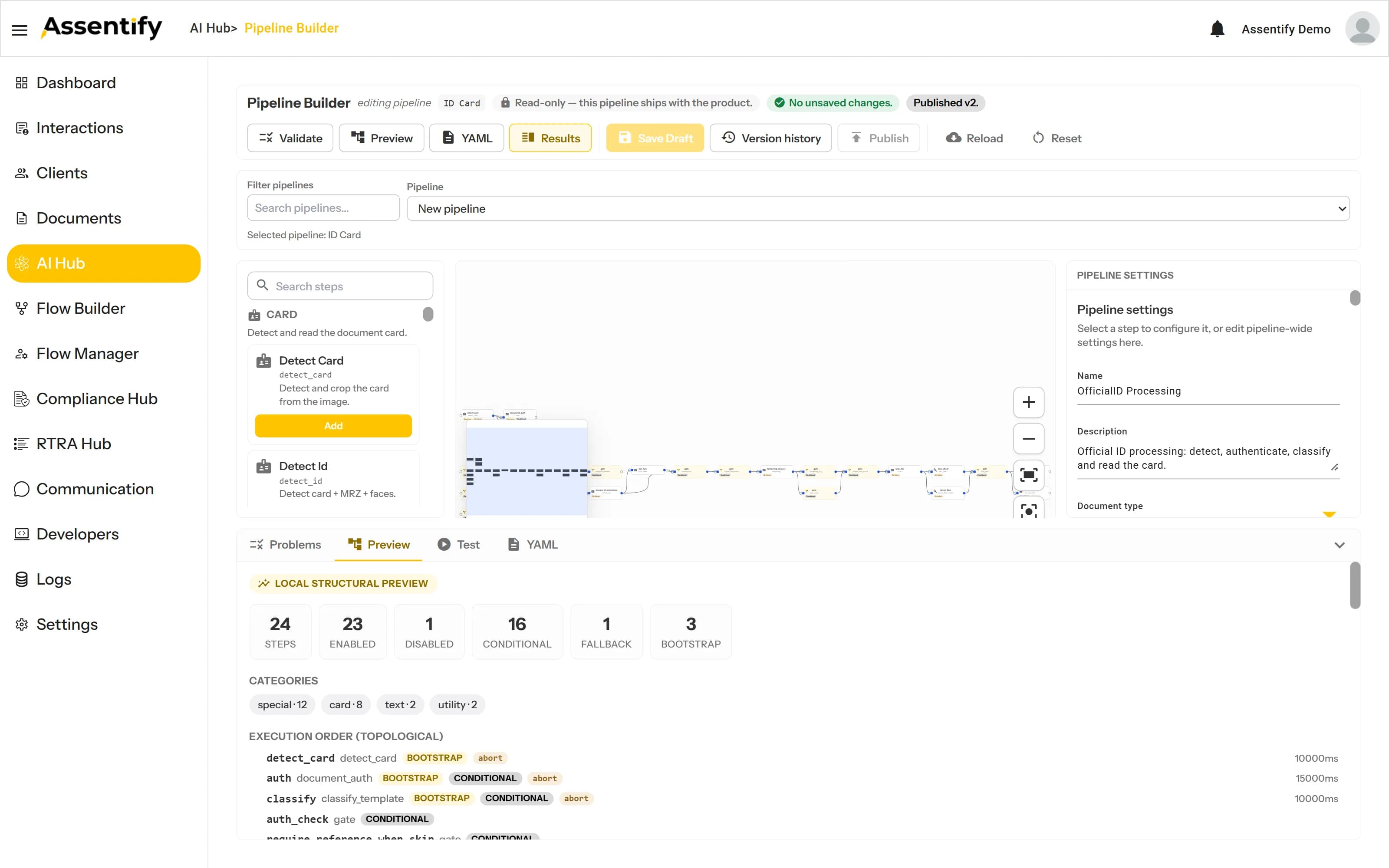
Every pipeline this service delivers has the same shape. A page enters at one end, checked fields leave at the other, and every step between is open in the Pipeline Builder. Identity documents are the common case; proof of address, payslips, commercial register extracts, statements and claim files run through the same line.
01
Pre-processing
The input is prepared before anything tries to read it.
02
Templated OCR
Extraction runs against a description of the document you expect.
03
Post-processing
Values are cleaned, checked and shaped into your structure.
- Running on Assentify’s own fine-tuned vision model, Arabic and English.
01
Your pages
The real corpus, including the worn cards, the glare and the bad scans.
02
Pre-processing
The input is prepared before anything tries to read it.
03
Templated OCR
Extraction runs against a description of the document you expect.
04
Post-processing
Every value is cleaned, checked and shaped into your structure.
05
The flow step
Fields land in the interaction, with confidence attached per field.
The engagement
Six steps, in this order, every time.
Failed document AI projects usually trained before anyone measured the baseline, or agreed what good looked like too late. This order avoids both.
Phase 1 of 6 · About a week
Scope the document
One document class and the decision it feeds: which fields the process needs, who acts on them, and what happens today when a value is wrong.
What you hold at the end
- A written field list
- An owner for each field
The decision
Template, or trained model?
The first question of every engagement. We confirm the answer against your own data before anyone commits budget.
| Your situation | What we would build | Typical time |
|---|---|---|
| Layout is stable across issuers | Templated pipeline | Days to weeks |
| Layouts vary widely by issuer or year | Fine-tuned model | Weeks to a quarter |
| Arabic and English printed text | Templated pipeline | Days to weeks |
| Handwriting or stamps carry meaning | Fine-tuned model | Weeks to a quarter |
| Inputs degraded in ways specific to you | Fine-tuned model | Weeks to a quarter |
| Volume normal for an onboarding team | Templated pipeline | Days to weeks |
| Volume high enough that small gains pay | Fine-tuned model | Weeks to a quarter |
| Processing must be isolated on your own GPU | Dedicated instance | Set up in days |
Extraction runs on Assentify’s own fine-tuned model; your documents are never sent to a third-party model provider.
The rule this practice is built on
A model you cannot measure is a model you cannot deploy.
Every document AI project in a regulated business ends at a risk committee asking how often the thing is wrong, and in which field. Assentify starts from the held-out set, the per-field bar and the baseline, because those three turn a demonstration into something an institution runs on real clients.

Where it runs
On the platform, inside your tenant.
This work leaves behind objects in a product your team already logs into: a pipeline, a template and a test surface they can change.
On the AI Hub
Everything we build for you is a first-class object in the AI Hub: a pipeline in the Pipeline Builder, a document description in the Template Builder, and a test surface in the Playground. There is no separate console and no consultant-only tooling to maintain.
On dedicated capacity where it matters
Custom model training and dedicated GPU capacity sit on the enterprise tier. Dedicated capacity gives throughput that does not move when another tenant has a busy morning, and it gives an isolation story a risk committee can accept. In Lebanon it can run on local GPU servers, so training data and inference both stay inside the country.
Beside the rest of the platform
What comes out of post-processing populates the Assisted Data Entry step for the client to confirm, feeds the client record in Clients, and provides the identity fields the Compliance Hub screens. One extraction, one record, one audit trail.
A bespoke pipeline, shipped as a product
SICILIA
SICILIA is Assentify’s processing agent for Special Investigation Commission letters in Lebanon. It exists because one document class, in one country, mattered enough to institutions to deserve its own pipeline and its own review surface. It is the clearest evidence that this service produces working systems.
Pipelines inside a larger engagement
Credit Financier, brand RISE
A leading Lebanese financial institution where Assentify delivered the Digital Experience Platform, the Compliance Hub, the SDK, a custom loan origination system, a mobile super-app and an integration for Banque du Liban eCDR credit report requests. Custom AI work sits inside programmes of this shape more often than it sits alone.
Questions
Custom AI, answered.
The custom AI pipelines and models service is an engagement in which Assentify builds a document extraction pipeline for your own document class, and where the evidence supports it, fine-tunes a model on your own document set. The work runs on the AI Hub, which means the pipeline, the document template and the test playground all live in your tenant and stay editable by your team after hand-over. A typical engagement scopes the fields, collects a real corpus, measures a baseline on the templated pipeline, agrees a per-field acceptance bar, trains, evaluates against a held-out set, and hands over.
Most institutions need a templated pipeline. A template is the right answer when the layout is stable, the fields sit in predictable places, the languages are Arabic and English, and the volume is normal for an onboarding operation. A fine-tuned model earns its cost when layouts vary widely across issuers or years, when inputs are degraded in ways specific to your operation, when handwriting or stamps carry meaning, or when volumes are high enough that a small accuracy gain pays for the training. We measure the baseline before recommending training, so the decision is made on your data.
What matters is coverage of conditions. A few hundred pages that include the worn cards, the glare, the angled phone photographs, the unusual issuers and the reprints from other years will beat several thousand clean scans. We work through the collection with your operations team, because the difficult pages are usually the ones already being re-keyed by hand and are therefore easy to find. A portion of whatever is collected is held back and never used for training.
Accuracy is measured per field on a held-out set the model has never seen, against an acceptance bar agreed in writing before training begins. Averaged accuracy figures are not accepted here, because a document number read wrong and a middle name read wrong are not the same failure. The evaluation compares the custom model to the templated pipeline it would replace, and if it does not beat the pipeline on your own data we say so and you keep the pipeline. The held-out set is re-run before any later version goes live.
Training data stays inside your tenant under the data persistence setting you choose, which is on cloud or on premise per tenant. In Lebanon, training and inference can both run on local Assentify GPU servers, so the corpus never leaves the country. Assentify holds ISO/IEC 27001:2022 certification with registration number IC-IS-2408273, certified 31 August 2024 by InterCert, and acts as a data processor on behalf of the institution that operates the tenant. Custom training on a dedicated GPU instance keeps your processing isolated from other tenants.
The pipeline and the document templates live in your tenant and your team edits them in the Pipeline Builder and the Template Builder without needing Assentify. Templates can be revised, pipelines re-pointed, and any change tested in the Playground before it touches a live flow. Commercial terms for a trained model are agreed in the engagement contract, and the templated pipeline remains available behind a custom model as a fallback.
Start
Send us twenty of your worst pages.
The glare, the worn cards, the angled phone photographs. Twenty difficult pages tell us in an afternoon whether this needs a template or a trained model.