Compliance Hub
Loaded from source.
Every day.
We go to the publisher of each list and load it into the platform daily, and we carry the local Lebanese lists, ISF Leb 24 and SIC 18-26. Then we give your compliance team somewhere to work.
- Lists loaded from source
- Daily
- Lebanese lists carried
- Local
- Default re-screening
- 3 days
- Arabic and Latin
- AR + LA
Workspace
One search. Every list. The match in front of you.
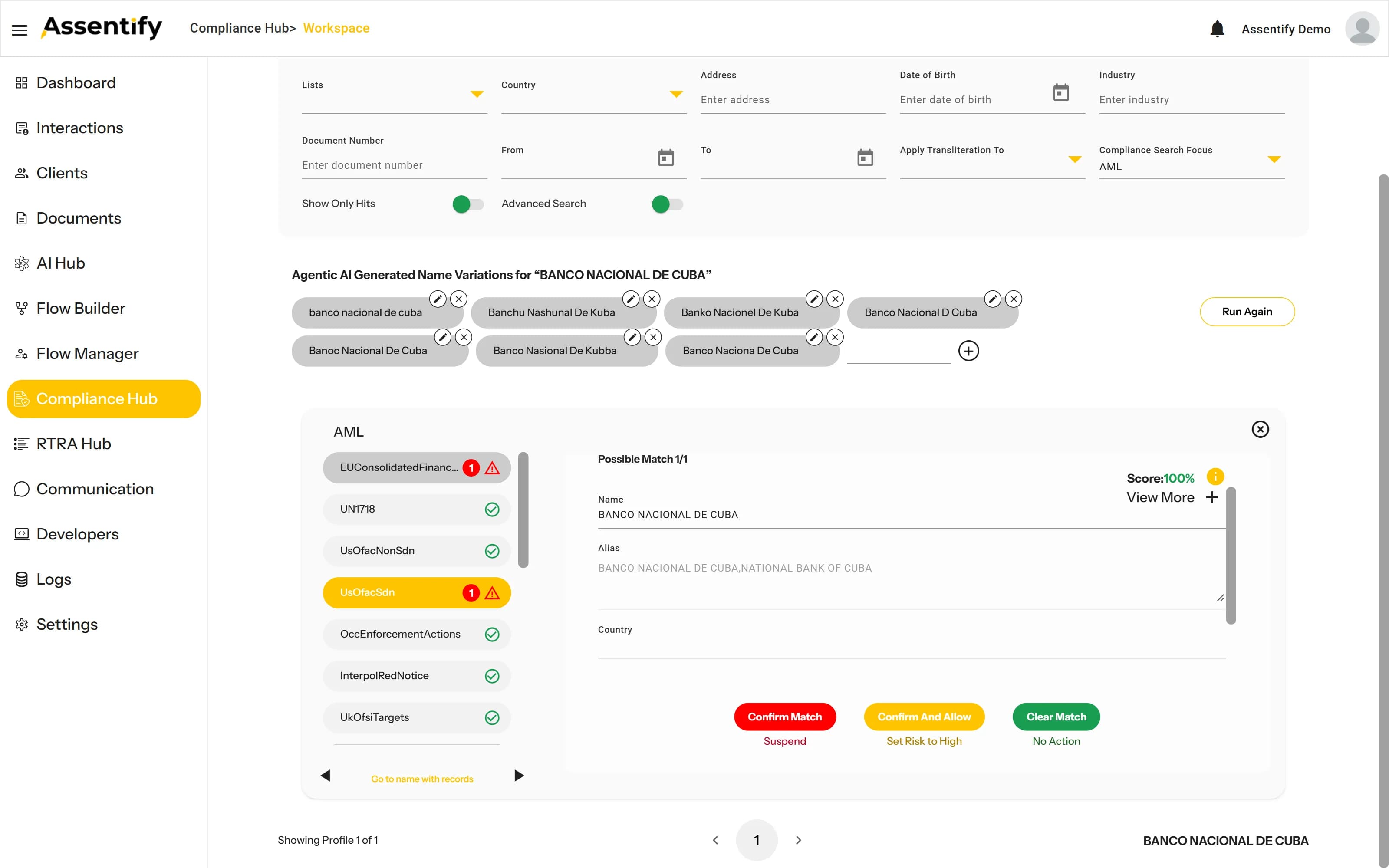
A search on the Workspace runs the name, its variations and its transliterations against every selected list, then puts the possible match and its score beside the list that raised it.
Inline Compliance Hub, inside an interaction
- US OFAC SDNPass
- UK OFSI TargetsPass
- EU ConsolidatedPass
- UNSC ConsolidatedPass
- PEPsMatch
- ISF Leb 24Pass
- SIC 18-26Pass
Every list searched is on the case itself, so the reviewer never opens a second system to see what was checked.
Four sub-modules
Working the hits is the daily job. Here are its four surfaces.
The Compliance Hub ships the queue, the clearance, the evidence and the engine health as working surfaces, beside the search itself.
Workspace
Ad hoc and bulk screening, on demand.
The standalone screening surface. An analyst searches one name or many, narrows by the filters that matter, and exports a report at the end. It is the surface a compliance officer lives in when a correspondent bank asks a question and the answer is needed today.
- Entity Type, plus multi-name search
- Lists, Country, Address, Date of Birth, Industry
- Document Number and a From / To date range
- Apply Transliteration To, for Arabic and Latin script
- Compliance Search For, Show Only Hits, Advanced Search
- Export Report
Client Clear
Where continuous screening hits get resolved.
Every client flagged by the continuous screening cycle arrives here, split by profile type: Person, Verified Person and Verified Business, each with its own count. The analyst sees the face, the risk level and the score before deciding, and the history of every prior decision on that client sits in the same row.
- Client ID, Face, Name
- Risk Level and RBA Score
- Client Status, Last Cleared, Last Hit
- Full decision History per client
- Search by name, clear, and work the queue
Audit Hub
The trail, filtered the way an auditor asks for it.
Regulators ask who cleared this client, when, and on what basis. The Audit Hub answers that in the shape the question is asked: by system user, by decision, and by date range, exportable as evidence.
- Filter by System User
- Filter by Decision
- From / To date range
- Export the resolved audit entries
Status
Proof that the lists you screened against were current.
A screening result is only as good as the freshness of the data behind it. Status reports engine refresh, list freshness and integration health, so the engine’s state is on record when an examiner is in the room.
- Engine refresh status
- List freshness
- Integration health
Coverage
We go to the source. Then we load it, daily.
Your names are matched against data we hold, by an engine we built, inside your own tenant.

International lists, loaded from source
Refreshed daily
| List | Who publishes it |
|---|---|
| US OFAC SDN | US Treasury, Office of Foreign Assets Control. Specially Designated Nationals. |
| US OFAC Non-SDN | The other OFAC designation lists published beside the SDN file. |
| US Trade CSL | The United States consolidated screening list for trade restrictions. |
| UK OFSI Targets | UK Treasury, Office of Financial Sanctions Implementation. Consolidated targets. |
| EU Consolidated | The European Union consolidated financial sanctions list. |
| UNSC Consolidated | The United Nations Security Council consolidated list. |
| UNSC 1267 / 1989 | The Security Council regime behind the ISIL and Al-Qaida designations. |
| UNSC 1718 | The Security Council regime covering North Korea. |
| UNSC 1988 | The Security Council regime covering Taliban designations. |
| UN ISIS Al-Qaeda | The United Nations ISIL and Al-Qaida designations. |
| UN 1988 Sanctions | The United Nations 1988 sanctions designations. |
| Interpol Red | Interpol Red Notices. |
| Interpol Yellow | Interpol Yellow Notices. |
| PEPs | Politically exposed persons. |
| OCC Enforcement | US Office of the Comptroller of the Currency enforcement actions. |
Local Lebanese lists
- ISF Leb 24
- Published by the Internal Security Forces.
- SIC 18-26
- Published by the Special Investigation Commission, Lebanon’s financial intelligence unit.
- Custom lists you define
- Uploaded by you, indexed and audited on the same terms.
Matched by the same profile and audited the same way as the international lists. A Lebanese institution is required to screen against them.
If you need more coverage
Some institutions screen against far more than the set above, usually because a correspondent bank asks them to. For those, Assentify offers a LexisNexis plugin and a Refinitiv plugin. A client licenses the vendor, and the data runs through the Assentify compliance engine, the same matching profile and the same AI matching as everything else.
That route puts the vendor’s coverage behind the same search. The lists Assentify loads from source, and the local Lebanese lists, are the part that is ours.
The differentiator
The global lists and the local ones, in one index.
A Lebanese bank is judged on whether it screened the lists its own regulator publishes, in the script the names arrive in, with evidence it can hand over. The Compliance Hub carries those lists beside the international ones.
One index, loaded today
- US OFAC SDN
- InternationalDaily
- EU Consolidated
- InternationalDaily
- UNSC Consolidated
- InternationalDaily
- ISF Leb 24
- LebaneseDaily
- SIC 18-26
- LebaneseDaily
- Your own lists
- CustomDaily
The matching engine
Traditional and AI, at the split you set.
A screening profile that only does phonetics floods your team with noise. A profile that only does AI cannot be explained to an examiner. Assentify blends the two, recommends 40 and 60, and lets each client set the split to its own risk appetite.
Traditional matching, 40% recommended
Double Metaphone matches names by how they sound rather than how they are spelled. Soundex sits beside it with an older, coarser encoding, and Skeleton compares a name on its characters only. Each code carries its own weight slider inside the traditional share, so you can tune the profile to the names you actually screen.
AI-driven matching, 60% recommended
An AI agent generates candidate name variations first, the way a compliance officer would: plausible spellings, common typo patterns, and the geographic or language equivalent of the same name, George and Jorge for example. The engine then matches across those variations, the transliterated query names and the phonetic codes at once, comparing candidates to the indexed entries by edit distance with one and two character modifications allowed. It returns the most relevant names from that combined search, which is how one Arabic name arriving from a dozen systems still reaches the list entry.
Transliteration, both directions
Apply Transliteration To lets a search cross scripts. A name captured in Arabic is screened against Latin-script lists and the reverse, which is the single most common reason a regional screening engine misses a real match.
Profiles, applied where you choose
A Screening Profile is named and then applied to Interactions, Client Clear and Workspace independently. Onboarding can run a tighter profile than an analyst investigation, without maintaining two engines.
The engine widens the name before it searches, then searches the widened set, the transliterations and the phonetic codes together, and tolerates one and two character differences on the way. That is why a client who reaches you as Mohamad from the core banking system, Mohammed from the correspondent bank file and محمد on the identity document is screened as one person rather than missed three times.
Risk based, and scored
A risk based approach is a regulatory expectation. Turn it on, define your risk levels, and set the thresholds on a 0 to 10 strip. The result is the RBA Score that appears on every row in Client Clear, so an analyst triages by risk. Dynamic RBA lets the client define rules so that transactions evaluated in the RTRA Hub move the RBA Score.
The same settings drive the ongoing lifecycle. Re-screening cadence, KYC expiry alerts and renewal alerts are per client profile type, so a Verified Business is configured separately from a retail Person.
Defaults, as shipped
- Risk levels
- Low, Medium and High out of the box, extensible
- Thresholds
- Set on a 0 to 10 strip, per tenant
- Output
- RBA Score, shown on every row in Client Clear
- Dynamic RBA
- Client-defined rules let RTRA Hub transactions move the score
- Re-screening
- Run AML screening every X days, three by default
- KYC expiry alert
- Default 30 days before expiry
- KYC renewal alert
- Default 1000 days before renewal
Screening inside the flow
The screen, the decision and the evidence in one record.
The Compliance step screens while the client is still in the flow, and the Backend Block screens the finished case before a decision.
Screening and decisions on the case
On the Backend Block you turn on AML and PEP screening, pick the lists and the filters, and write decision rules so clean cases clear themselves. The Compliance step does the same during the flow; see the step library.
Every setting, in Flow BuilderEvidence by default
AML Management can flag the client application on any match, and can run a background check on all clients. Every action lands in the Audit Hub and in Logs, with the user, the timestamp and the event.
Custom lists work the same way. Under AML Management you add your own list, it appears as a pill beside the rest, and from that moment it is screened, matched and audited exactly like a sanctions list. Internal blacklists, previously declined applicants and correspondent bank instructions all become first-class screening data.
Pricing
Starts at $449/month
Published so you can size a budget before you speak to anyone. The Compliance Hub is sold in three tiers on an annual commitment. Screening volume, profile types and deployment shape the final number, so contact sales to complete.
Tiers and options
- Starter
- Screening, Workspace, Client Clear and the audit trail.
- Business
- Higher volume, more profile types, more analysts.
- Enterprise
- Contracted volume, support and deployment options.
- On premise
- Compliance Hub Engine delivered as a one-time package.
Questions
Compliance Hub, answered.
The Compliance Hub is the AML, PEP and sanctions screening product inside the Assentify Digital Experience Platform, made of four sub-modules: Workspace for ad hoc and bulk screening, Client Clear for resolving hits raised by continuous screening, Audit Hub for the full audit trail, and Status for engine and list health. It screens at onboarding through the Backend Block of a flow, and it keeps screening client profiles on a cycle after onboarding. It is subscribed to on its own or alongside the other hubs.
Assentify goes to the body that publishes each list and loads it into the platform daily. The set loaded from source covers US OFAC SDN and Non-SDN, US Trade CSL, UK OFSI Targets, EU Consolidated, UNSC Consolidated, UNSC 1267 / 1989, UNSC 1718, UNSC 1988, UN ISIS Al-Qaeda, UN 1988 Sanctions, Interpol Red, Interpol Yellow, PEPs and OCC Enforcement. Beside those sit the local Lebanese lists, ISF Leb 24 from the Internal Security Forces and SIC 18-26 from the Special Investigation Commission, plus any custom list you define. Institutions that need wider coverage can add a LexisNexis or Refinitiv plugin and run that data through the same engine.
An AI agent generates candidate name variations, and the engine then matches across those variations, the transliterated query names and the phonetic codes at once. The agent produces plausible spelling variations, common typo patterns and the geographic or language equivalent of the same name, George and Jorge for example. The phonetic codes are Double Metaphone, Soundex and Skeleton, which compares characters only, and each carries its own weight slider. Comparison runs on edit distance, allowing one and two character modifications between a candidate and the indexed entries, and the most relevant names come back scored. Each client sets the split between traditional and AI-driven matching on its Screening Profile; Assentify recommends 40 percent traditional and 60 percent AI-driven.
Continuous screening runs on a cycle you configure per client profile type, set to every three days by default. Any client that raises a hit lands in Client Clear with a risk level, an RBA Score and the full history of prior decisions on that client. Client profiles also carry alerts before KYC expiry, 30 days by default, and before KYC renewal, 1000 days by default, so the file does not quietly go stale.
The Compliance Hub starts at $449/month, on an annual commitment, in three tiers: Starter, Business and Enterprise. On-premise deployment of the Compliance Hub Engine is available as a one-time package for institutions that cannot send screening data outside their own estate. Volumes, tiers and deployment shape the final figure, so contact sales to complete.
Yes, the Compliance Hub runs inside your own infrastructure: Data Persistence is set per tenant to on cloud or on premise, and the Compliance Hub Engine is offered as an on-premise package. In Lebanon, Assentify runs its own cloud and GPU servers inside the country.
Start
Screen a real name against your real lists.
We provision a tenant, load the lists you screen against, and let your compliance team run the searches they run every day. Then compare the queue with the one they have now.