Compare · Sumsub
Assentify vs Sumsub.
Sumsub publishes its prices, ships an enormous catalogue and sells to over 4,000 clients. Assentify processes inside the country, reads every Lebanese document and signs at the end of the flow. Here is where each one is genuinely better.
- Dimensions, sourced
- 12
- Sumsub, published per check
- $1.35
- Cases where Sumsub fits better
- 4
- Every source checked
- 16 Aug 2026
The short version
CHOOSE SUMSUB IF
You want a published unit price, a large ready-made catalogue and a broad multi-market footprint with no local residency requirement.
CHOOSE ASSENTIFY IF
You are regulated in Lebanon or elsewhere in MENA, you need local documents and local lists, you want signing bound to the verified identity, and you would rather carry one contract than six.
Credit where it is due
Sumsub built the category’s biggest catalogue, and keeps building.
Sumsub publishes its prices on a public page: $1.35 per verification with a $149 monthly minimum on Basic, $1.85 with a $299 minimum on Compliance, and a 14-day trial with 50 free checks. It states over 4,000 clients on its homepage. Its catalogue spans user and business verification, non-doc verification, address verification, reusable KYC, video identification, travel rule, crypto monitoring and transaction monitoring. For a buyer whose requirement list maps onto that menu, it is a serious, complete offer.
It also runs an Academy with courses on AML fundamentals, verification and the Travel Rule. For a compliance function that is still forming, that library has value independent of the software.
And Sumsub did something in June 2026 worth crediting on its own line. It exposed its configuration layer to AI agents through an MCP integration and a skills suite, so a compliance policy can be handed to an agent and turned into a working environment. That is a serious piece of engineering, and it is the same instinct behind Ashley on the Assentify side.
None of that decides a regional deal, though. What decides a regional deal is where the data sits, which documents are read, which lists are searched and what happens after the check.
Side by side
Twelve dimensions, sourced on both sides.
Sumsub entries are taken from sumsub.com and its pricing page, checked 16 August 2026. Where Sumsub publishes nothing, the row says so.
| Dimension | Assentify | Sumsub |
|---|---|---|
| What it is | A Digital Experience Platform covering identity verification, AML screening, digital signing, flow orchestration, real-time transaction risk assessment and custom AI processing pipelines on one contract. | Positioned on its own homepage as AI-powered trust infrastructure for compliance operations at scale, with a very large catalogue of verification, screening and monitoring products. |
| Published pricing | Reference starting points on the pricing page, completed by sales. No per-verification list price is published. | Published. Basic at $1.35 per verification with a $149 monthly minimum, Compliance at $1.85 with a $299 monthly minimum, Enterprise on request, plus a 14-day trial with 50 free checks. |
| Data residency | In-country processing in Lebanon, so identity data does not have to leave the jurisdiction to be verified. | No Lebanon-specific residency offer published. Sumsub publishes no Lebanon landing page. |
| Lebanese documents | Every Lebanese identity document, plus global identity documents by market and passports to ICAO 9303. | Global document coverage across a very large catalogue. Lebanese document coverage is not itemised on a public page. |
| Screening lists | Global coverage through LexisNexis and Refinitiv plugins, plus the local Lebanese lists, including ISF Leb 24 and SIC 18-26. | A full screening and monitoring product line, sold as its own catalogue section. Local Lebanese list coverage is not published. |
| Signing | Assentify signing produces advanced, qualified-grade digital signatures. Signed PDFs carry Assentify’s Adobe Approved Trust List (AATL) certificate, so Adobe Acrobat and Reader show them as trusted. Signing keys are held in a hardware security module, and Assentify runs a local certificate authority in country. In Lebanon, Banque du Liban recognises the one-time password as the client’s electronic signature. Context Aware Signing combines biometrics, OTP signing and tamper proofing. | QES is listed as a product in the Sumsub product menu. Assentify has not evaluated its scope or jurisdictions. |
| Channels | Web link, short URL or QR, conversational and WhatsApp flows, mobile SDK, and Branch Assisted Mode for onboarding at the counter. | Web and mobile SDK integration paths. The workflow builder page names no messaging channel. |
| Building the flow | Flow Builder for drag and drop construction, Ashley for AI-assisted build, and the Data Sources engine for wiring core systems into the flow. | A no-code workflow builder, plus an MCP integration and AI agent skills suite announced in June 2026 for building configuration through an AI agent. |
| Liveness certification | iBeta certified passive liveness, plus active and configurable modes, so the security bar is set per flow. | iBeta and ISO/IEC 30107-3 Level 1 presentation attack detection are listed on the Sumsub site. |
| Custom AI pipelines | Custom AI processing pipelines pointed at your own documents, plus a professional services division that builds loan origination systems, mobile apps and core integrations on the same platform. | A software platform with an integration and partner ecosystem. Bespoke system build is not part of the published offer. |
| Security certification | ISO/IEC 27001:2022, certified by InterCert, registration IC-IS-2408273, certified 31 August 2024, recertification due 30 August 2027. | ISO 27001 and CCPA are listed among the certifications on the Sumsub site. |
| Scale claimed | Over 30 subscribers live, processing hundreds of thousands of transactions daily, across banks, wallets, insurers and national-scale deployments. | Over 4,000 clients, stated on the Sumsub homepage. |
Sumsub figures are quoted from sumsub.com and sumsub.com/pricing, checked 16 August 2026. Assentify figures are from the ISO/IEC 27001:2022 certificate and current platform documentation. Neither column carries an accuracy or false-accept comparison, because neither vendor publishes methodology that would make one meaningful.
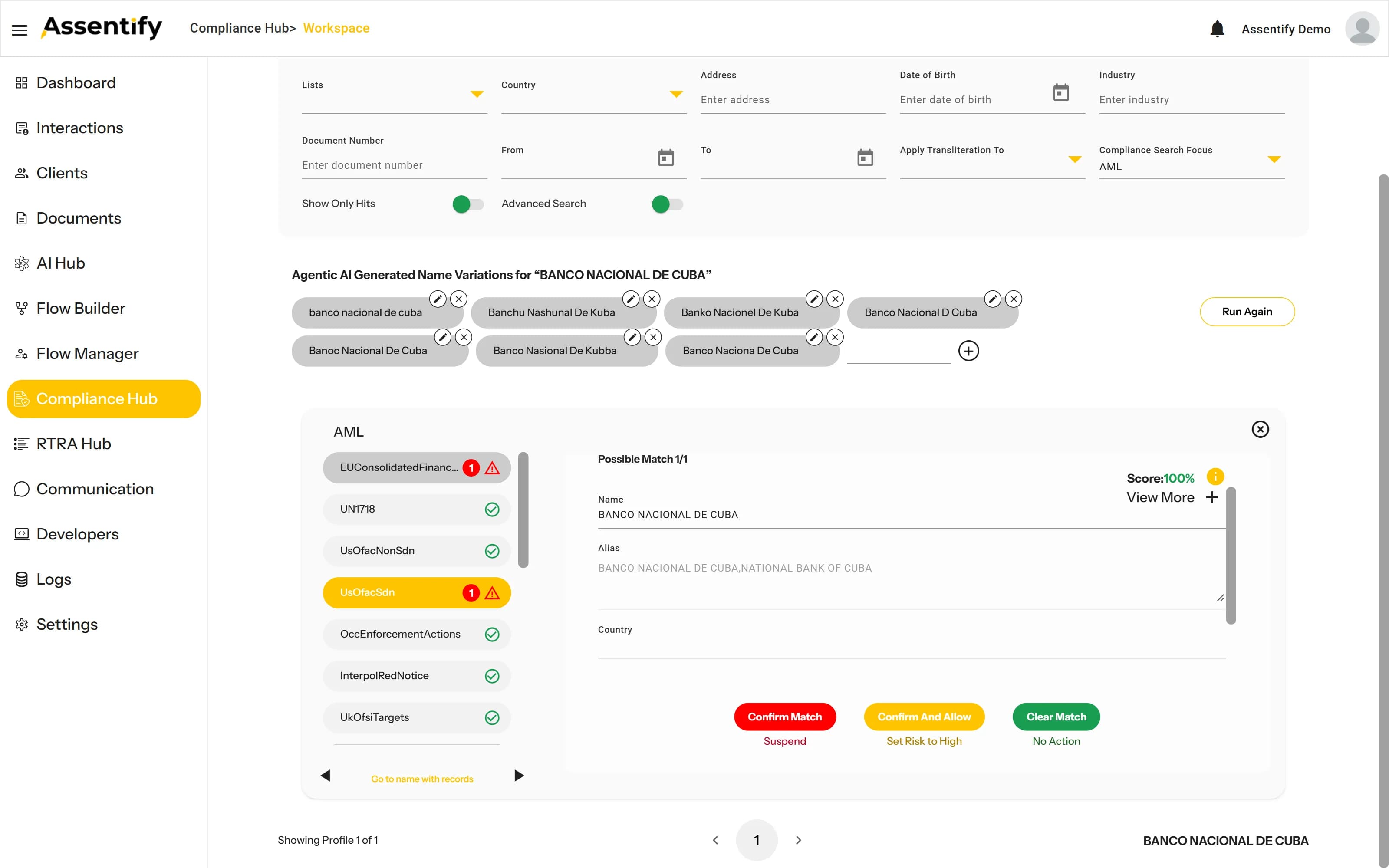
The local lists, on screen
Global lists and the Lebanese ones, in one search.
The Compliance Hub searches the global vendor lists and the local Lebanese lists together, with AI name variations for Arabic names.
- LexisNexis and Refinitiv plugins
- ISF Leb 24 and SIC 18-26
- Confirm, allow or clear each possible match
The comparison nobody runs
Count the contracts, not the features.
An institution that buys verification from one vendor, screening from a second, signing from a third, a workflow engine from a fourth, transaction risk scoring from a fifth and document AI from a sixth is running six contracts, six integrations, six audit trails and six renewal conversations. Assentify is one of each.

Where Assentify is stronger
Four differences that decide regional deals.
$1.35
Sumsub, published per verification on Basic
30+
Assentify subscribers live, regulated institutions
4,000+
Sumsub clients, stated on their homepage
Every
Lebanese identity document, read in country
SUMSUB LEFT · ASSENTIFY RIGHT
The data does not leave the country
Lebanon’s supervisory expectations around client data make where processing happens a live procurement question. Assentify runs in-country processing in Lebanon, so faces, documents and extracted fields are handled inside the jurisdiction. Sumsub publishes no Lebanon residency offer and no Lebanon page. For a BDL-supervised institution, that difference is usually decided before any feature comparison begins.
Every Lebanese document, and the local lists
Assentify reads every Lebanese identity document rather than the two or three that fit a global template, and screens against the local Lebanese lists including ISF Leb 24 and SIC 18-26 alongside the global coverage bought from LexisNexis and Refinitiv. Global list volume is a commodity every serious vendor licenses. Local list coverage is not on sale, and its absence is invisible until a match is quietly missed.
The whole onboarding runs inside WhatsApp
In most of Assentify’s markets, WhatsApp is where clients already are. Assentify ships conversational flows as a first-class channel next to web and mobile SDK, so a client can complete capture, liveness, screening and signing without installing anything. The Sumsub workflow builder page names no messaging channel at all. In markets where app installs are the drop-off point, that changes completion rates.
What is missing gets built, not queued
Assentify runs a professional services division alongside the platform. The Rise engagement at Credit Financier delivered the DXP and Compliance Hub together with a custom loan origination system, a mobile super-app and integrations with a card issuer, a finance house and BDL eCDR credit report requests.
There is a structural point underneath all four. Sumsub is built to be the same product everywhere, which is exactly the right architecture for a company selling into fifty markets at once. The cost of that architecture is that no single market gets its own document set, its own list coverage, its own hosting and its own signing regime. Lebanon needs all four, and so do several of its neighbours.
Assentify supports global identity documents by market and passports to ICAO 9303, which covers the international side of a regional institution’s book. It does not have a five-figure document catalogue.
When to choose Sumsub instead
Four situations where Sumsub is the better buy.
You want the number before you talk to anyone
Sumsub publishes its per-verification price and its monthly minimum on a public page, with a free trial attached. That is a real advantage in a mid-market evaluation, where a procurement team may shortlist on published numbers before a first call ever happens. Assentify publishes reference starting points and completes the number in a conversation, which is slower for the buyer who wants to compare four vendors on a spreadsheet this afternoon.
Your footprint is broad and shallow rather than deep
If you are onboarding users across dozens of countries where no single market is dominant, and you need no local residency, no local list coverage and no local signing, then breadth is what you are buying. Sumsub has been built for that shape, states over 4,000 clients, and publishes regional KYC guidance across many markets. Assentify is built for the opposite shape: fewer markets, much deeper in each.
You want a large ready-made product catalogue
The Sumsub product menu spans user and business verification, non-doc verification, address verification, reusable KYC, video identification, travel rule, crypto monitoring and transaction monitoring, among others. If your requirement list maps neatly onto items already in that catalogue, buying them assembled is faster than building them. Assentify covers a different set, deeply, and builds the rest.
Your compliance team wants structured training
Sumsub runs an Academy with courses on AML fundamentals, verification and the Travel Rule, alongside a large blog and newsroom. For a compliance function that is still forming, that library has value independent of the software. Assentify runs training under the R.O.A.D. framework, but it is delivered as engagements rather than published as a self-serve course catalogue.
If two or more of these describe your evaluation, run the Sumsub trial and hold them to the published numbers. If none of them do, the comparison turns on residency, documents, lists and signing rather than on catalogue size.
Sources
Where the Sumsub figures come from.
Sources
Competitor facts are taken from each vendor’s own published pages, checked on 16 August 2026. Vendors change their sites, so check the current page before relying on a figure.
- Sumsub positioning, client count and certification listhttps://sumsub.com/ · checked 16 August 2026
- Sumsub pricing: $1.35 and $1.85 per verification, $149 and $299 monthly minimums, 14-day trial with 50 free checkshttps://sumsub.com/pricing/ · checked 16 August 2026
- Sumsub no-code workflow builder, and the absence of a named messaging channel on that pagehttps://sumsub.com/workflow-builder/ · checked 16 August 2026
- Sumsub MCP integration and AI agent skills suite, announced June 2026Sumsub press release via PR Newswire, 18 June 2026
- Sumsub liveness certifications (iBeta, ISO/IEC 30107-3 Level 1) and security certifications (ISO 27001, CCPA), as listed among the certifications on the Sumsub sitehttps://sumsub.com/ · checked 16 August 2026
- Assentify ISO/IEC 27001:2022, InterCert, registration IC-IS-2408273Certificate issued 31 August 2024, recertification due 30 August 2027
Open questions
- The scope, jurisdictions and trust-service status of the QES product listed in the Sumsub catalogue.
- Whether Sumsub offers Lebanon-specific data residency under a private contract. No such offer is published, which is not the same as it not existing.
- Sumsub’s Lebanese identity document coverage. It is not itemised on a public page.
- Any comparison of accuracy, false-accept or false-reject rates. Neither vendor publishes methodology that would make such a comparison meaningful.
Sumsub is an identity verification and compliance platform sold with a published per-verification price and a very large product catalogue, while Assentify is a platform that packages identity verification, AML screening, digital signing, flow orchestration, real-time transaction risk assessment and custom AI processing pipelines on one contract. Sumsub is stronger on breadth, published pricing and self-serve purchase. Assentify is stronger on in-country processing, coverage of every Lebanese identity document, local Lebanese screening lists, WhatsApp onboarding and pipelines that read the documents no catalogue covers. The right answer depends on whether your requirement is wide and shallow or narrow and deep.
Sumsub publishes its pricing and Assentify does not publish a per-verification list price. On the Sumsub pricing page, checked on 16 August 2026, the Basic tier is $1.35 per verification with a $149 monthly minimum and the Compliance tier is $1.85 per verification with a $299 monthly minimum, with Enterprise on request. Assentify publishes reference starting points and completes the number with sales, because a deployment that includes screening, signing and orchestration prices differently from a single document check. If a published unit price is a requirement of your process, that is a genuine point in Sumsub’s favour.
Sumsub publishes no Lebanon landing page and no Lebanon-specific data residency offer, as of 16 August 2026. That does not mean Lebanese users cannot be verified on the platform; it means Lebanon is not addressed as a market with its own documents, regulators, lists and hosting requirements. Assentify processes in country in Lebanon, supports every Lebanese identity document, and screens against local Lebanese lists including ISF Leb 24 and SIC 18-26. For an institution supervised by Banque du Liban, those are usually decision criteria rather than nice to have.
No, and the catalogues do not map onto each other one for one. Sumsub publishes products Assentify does not sell, including crypto transaction monitoring and travel rule tooling, and it addresses many more markets with published guidance. Assentify covers identity verification, screening, signing, orchestration, transaction risk scoring and custom AI processing pipelines, and covers them deeply in its markets. If your requirement list is mostly items already sitting in the Sumsub catalogue, buying them assembled is the faster route.
For a regulated institution in Lebanon, Assentify is the stronger fit, because of how it is built. Identity data is processed inside the country, every Lebanese identity document is supported, the local Lebanese screening lists are covered, signing runs in the same platform with the one-time password Banque du Liban recognises as the client’s electronic signature, and the onboarding can run inside WhatsApp where clients already are. For a business with no Lebanese exposure and a broad multi-market footprint, that advantage does not apply and Sumsub’s breadth may matter more.
Start
Run both. On your documents, against your lists.
Sumsub gives you 50 free checks. Assentify gives you one month free. Put the same Lebanese identity documents and the same Arabic names through both, then decide.
See them live before you decide. The demo call shows the platform working on real screens, and the free month puts a tenant of your own behind every claim in the comparison. One form covers both, and no card is taken at any point.
Still comparing? Every comparison, in one place.