Saudi Arabia · eKYC
eKYC in Saudi Arabia, Nafath and what sits around it.
Saudi Arabia has the most heavily used national identity broker in the region and the highest localisation expectations. Onboarding here works alongside Nafath, under SAMA, with in-kingdom hosting as the working assumption.
- Nafath launched
- 2021
- Nafath users
- 23.5M+
- Services behind it
- 6,000+
- SIM biometrics
- 2016
The instruments
Who writes the rules in Saudi Arabia.
A national identity broker under SDAIA, a financial regulator with a rulebook, a telecom regulator with biometric SIM rules, and a privacy law with transfer regulations.
The instruments
- National identity rail
- Nafath
- Rail operator
- National Information Center
- Supervising authority
- SDAIA
- Financial regulator
- SAMA
- Digital ID also accepted
- Absher, Tawakkalna
- Telecom regulator
- CST
- SIM biometrics since
- January 2016
- Privacy law
- PDPL, enforced by SDAIA
- Nafath launched by the National Information Center
- 2021
- Nafath launched by the National Information Center
- Nafath users reported by SDAIA, November 2024
- 23.5M+
- Nafath users reported by SDAIA, November 2024
- Verification operations reported at the same date
- 3bn+
- Verification operations reported at the same date
- Government and private services behind Nafath
- 6,000+
- Government and private services behind Nafath
Nafath figures as reported by SDAIA, November 2024.

The rail
Nafath is the deepest national identity rail in the region
Saudi Arabia’s state identity scheme has the largest published usage numbers in the region. A verification vendor works around it.
ON THE RAIL · NATIONALS AND RESIDENTS
Nafath authenticates against the National ID record
- App push with number matching
- One-time password
- QR code
- Face and fingerprint biometrics
A federated assertion returns: this is the person the national record describes.
OFF THE RAIL · THE EDGE CASES
Pilgrims, visitors, new arrivals, signatories abroad
No national record answers for them, so the institution keeps its own evidence: a captured document, ICAO 9303 passport reading, a face match and a liveness score, produced by Assentify inside the deployment.
The live verification runs here, and its evidence is the institution’s own.
ONE INTERACTION RECORD
Both paths land on the same record, so the file reads the same way to a supervisor whichever lane the client arrived by.
What Nafath does
Nafath, the unified national access service, is operated by the National Information Center under SDAIA and launched in 2021. It authenticates by mobile app push approval with number matching, by one-time password, by QR code, and by AI-based face and fingerprint biometrics. Registration is anchored on an Absher-linked mobile number and the National ID record.
SDAIA reported more than 23.5 million users and more than three billion verification operations in November 2024, with Nafath acting as the central identity broker across more than 6,000 government and private services, including banking onboarding and KYC work. The Digital Government Authority mandates it as the single sign-on for online government services.
What it does not do
A broker answers one question well: is this the person the national record describes. Onboarding asks more. Which document was captured and was it genuine. Was a live human present. What is this client’s risk classification. Which lists were searched, when, and with which spelling. When does the file expire and who is told. What did the client sign, and can that signature still be checked in three years. None of that is federated to you by an authentication call.
And who it does not reach
A national scheme covers nationals and residents. Saudi Arabia hosts an enormous transient population: pilgrims, business visitors, new arrivals waiting on residence formalities, and corporate signatories sitting in other countries. Those clients are onboarded with a document, a face and a liveness check, and the institution keeps its own evidence because there is no national record to lean on.
Sequencing
Saudi Arabia has the deepest budgets in the region and the highest local-presence expectations, shaped by the Regional Headquarters programme and by national cloud and cybersecurity controls. Assentify treats it as a market entered after the UAE and Qatar.
The checklist
Saudi requirements, instrument by instrument
Eight items, each tied to the instrument or the source behind it.
Nafath
Authenticate through the national broker
Nafath is the unified national access service operated by the National Information Center under SDAIA, launched in 2021. It acts as the central identity broker across more than 6,000 government and private services, including banking onboarding and KYC work. The Digital Government Authority mandates it as the single sign-on for online government services.
Who acts
The institution. This one sits with you and your regulator, whichever platform you choose.
The claim
Nafath answers who. Onboarding needs the rest.
Consume the rail where it applies, verify directly where it does not, and put both paths on one interaction record so the file reads the same way to a supervisor either way.
The rail answers
- Who the person is
- By push approval, one-time password, QR code or biometrics
- For nationals and residents
The platform adds
- Risk classification
- Sanctions and politically exposed person screening
- Re-screening on a cycle you set
- Expiry and renewal alerts
- A signature bound to the identity
- The audit trail behind every decision
Data Persistence is set per tenant, on cloud or on premise. In Lebanon, Assentify runs its own cloud and GPU servers inside the country.
Signing and SIM
Signature law and SIM biometrics
Signing sits under the Electronic Transactions Law. SIM registration has run on biometrics since January 2016.
Signature: the Electronic Transactions Law
Saudi electronic signature is governed by the Electronic Transactions Law, with the National Center for Digital Certification acting as root certification authority.
Assentify signing produces advanced, qualified-grade digital signatures. Signed PDFs carry Assentify’s Adobe Approved Trust List (AATL) certificate, so Adobe Acrobat and Reader show them as trusted. Signing keys are held in a hardware security module, and Assentify runs a local certificate authority in country.
SIM: biometric since 2016
Biometric registration for SIM cards began in Saudi Arabia in January 2016, which makes it one of the earliest markets anywhere to bind a mobile line to a biometric identity. The Communications, Space and Technology Commission operates a SIM authentication code service, and issued a measure on SIM services with the Ministry of Interior in May 2025.
Saudi Arabia also operates a fingerprint biometric requirement for expatriates, so biometric verification is a national norm for telecom and bank flows alike.
The fit
Which Assentify capabilities matter most in Saudi Arabia
The rail is strong, so the value is at the edges and in everything after the authentication call returns.
01
Everything the broker does not cover
Nafath is a mature, mandated national rail and no vendor improves on it for the people it covers. The work is at the edges: pilgrims and visitors, new arrivals waiting on residence formalities, corporate signatories abroad, and any flow where the institution needs its own evidence. Assentify reads global identity documents by market and parses the machine readable zone on ICAO 9303 passports, which is what those edges require.
02
The compliance work that sits after authentication
Authenticating a person is not the same as onboarding a client. Risk classification, sanctions and politically exposed person screening, re-screening on a configurable cycle, expiry and renewal alerts, and the audit trail behind every decision are all separate obligations that survive a perfect national rail. That is the Compliance Hub.
03
Deployment shaped to a localisation conversation
Data Persistence is a first-class per-tenant setting with two values, On Cloud or On Premise, and the on-premise value runs through a proxy address the institution controls. In Lebanon, Assentify runs its own cloud and GPU servers inside the country under Banque du Liban’s Local Data Hosting rule, which is the reference a Saudi procurement team should ask about.
04
Signing with the evidence bound to the identity
Context Aware Signing combines biometrics, one-time password signing and tamper proofing on the same record, and the Context Aware Visible Signature Verifier keeps a signature checkable after a document has been printed. The Document Template Processing Engine turns a Word file into a live template so the contract is generated fully populated at the moment the client is ready to sign.
Licences in Saudi Arabia
Assentify holds no Saudi authorisation, no SAMA registration and no listing under the National Center for Digital Certification. The approvals in this market attach to the licensed institution and to trust service providers. Assentify brings the platform and the deployment flexibility.
Assentify Ltd. is registered in Cyprus, with research and development in Canada and Lebanon. Over thirty subscribers are live, processing hundreds of thousands of transactions daily.
Certified and supported
- ISO/IEC 27001:2022
- IC-IS-2408273
- Passive liveness
- iBeta certified
- Active liveness
- Configurable
- ICAO 9303 passports
- MRZ parsed
- Global IDs
- By market
- Arabic and Latin
- Transliterated
- Data Persistence
- Per tenant
- Subscribers live
- 30+
Certified 31 August 2024 · recertification due 30 August 2027 · InterCert
In Riyadh
On stage at LEAP 2024, in the SDAIA session
Assentify's CEO spoke at the Saudi Data and AI Authority session at LEAP 2024 in Riyadh, the region's biggest technology event.
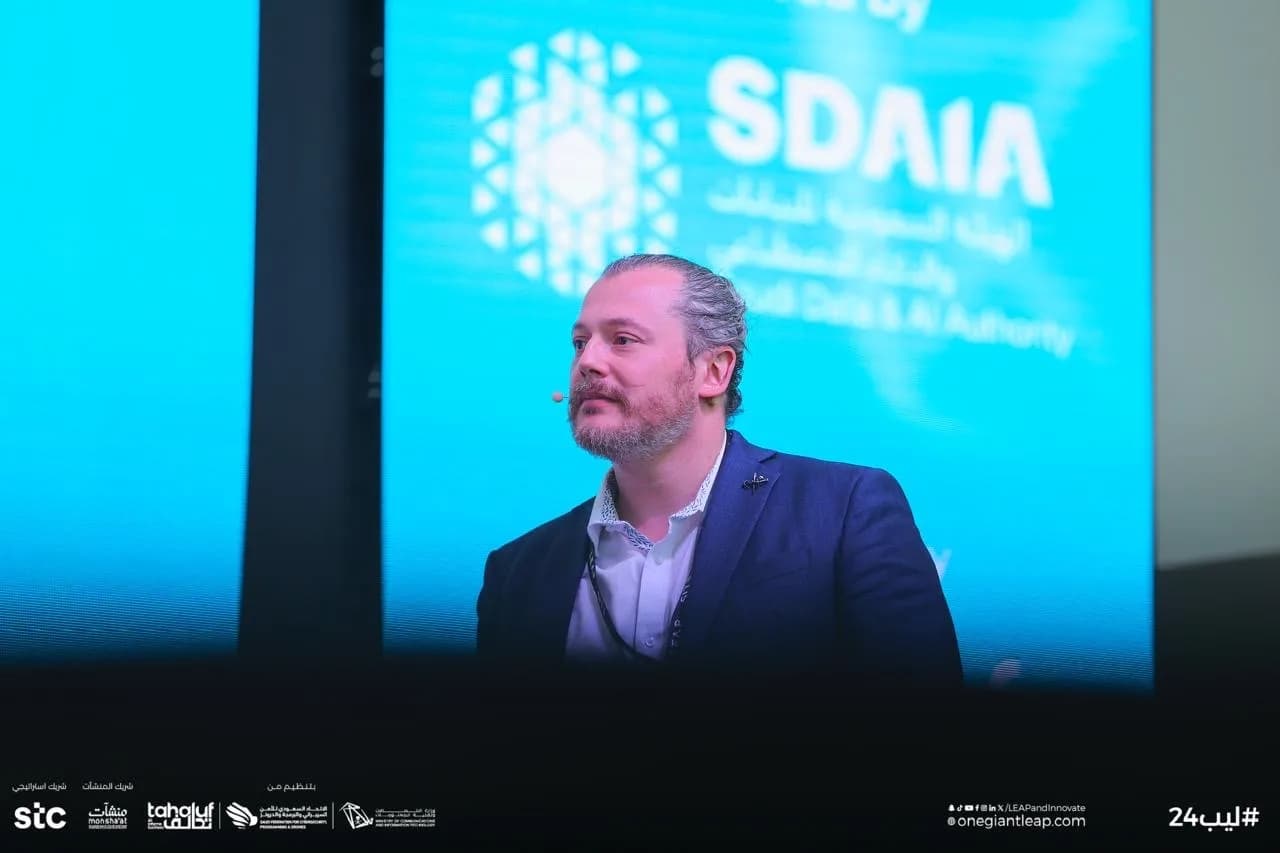
LEAP is where the kingdom announces its digital agenda, and SDAIA is the authority that supervises the identity rail. Nafath’s 23.5 million users are the scale any vendor claim is measured against. Assentify brings a platform already carrying national-scale work elsewhere and an architecture shaped for the localisation conversation this market starts with.
Go deeper
The rest of the country cluster
Each guide covers one market: the identity scheme, the regulator, signing and data residency.
Questions
eKYC in Saudi Arabia, answered.
Nafath, meaning unified national access, is the Saudi national identity broker, operated by the National Information Center under SDAIA and launched in 2021. It authenticates users by mobile app push approval with number matching, by one-time password, by QR code, and by AI-based face and fingerprint biometrics, and it acts as the central identity rail across more than 6,000 government and private services, including banking onboarding and KYC work. SDAIA reported more than 23.5 million users and more than three billion verification operations in November 2024. Registration is anchored on an Absher-linked mobile number and the National ID record.
The SAMA Rulebook carries an entry on acceptance of the digital ID on the Absher platform and the Tawakkalna application, so digital identity acceptance is established in the rulebook. Any institution relying on it should read the rulebook entry directly and confirm the current position with its supervisor.
Yes, biometric registration for SIM cards began in Saudi Arabia in January 2016. The Communications, Space and Technology Commission operates a SIM authentication code service, and in May 2025 it published a measure on SIM services in collaboration with the Ministry of Interior. Saudi Arabia also operates a fingerprint biometric requirement for expatriates, which reinforces biometric identity assurance as a national baseline.
Expect in-kingdom hosting to be the working assumption, even where a narrow reading of the law might allow otherwise. Saudi Arabia has a Personal Data Protection Law enforced by SDAIA with regulations covering data transfers, and national cloud and cybersecurity controls that shape what regulated institutions will accept. Confirm the transfer conditions before designing a cross-border architecture. Assentify deploys with Data Persistence set per tenant, on cloud or on premise.
Saudi electronic signature is governed by the Electronic Transactions Law, with the National Center for Digital Certification acting as root certification authority. Read the law for the recognised levels, the conditions and the excluded document types before choosing a signature level for a signing flow.
No. Assentify holds no Saudi authorisation, no SAMA registration and no listing under the National Center for Digital Certification. It treats Saudi Arabia as a market entered after the UAE and Qatar, because local-presence and localisation expectations are the highest in the region. What it offers is the platform and a choice of deployment shape. Assentify Ltd. is registered in Cyprus, with research and development in Canada and Lebanon. The platform is certified to ISO/IEC 27001:2022 under certificate IC-IS-2408273 and holds iBeta certification on its passive liveness. Over thirty subscribers run on it today, processing hundreds of thousands of transactions daily. Talk to sales about the deployment shape before assuming an architecture.
Start
Bring us the constraint.
Saudi projects are decided by hosting, local presence and evidence. Tell us where the data has to sit and who has to be able to read the audit trail, and we will scope what is workable before anyone writes a requirement document.