AI pipeline processing
A document is not a picture.
A pipeline chains AI components into one automated ingestion process: detection, classification, authenticity and tampering checks, DocScan, extraction and transliteration. Images and PDFs, Arabic and English, one page or a whole file.
- Images and PDFs, a page or a file
- Any file
- Arabic and English on every document
- Both
- Fine-tuned vision language model
- Our own
One file, end to end
A car insurance file, read in one run.
The application arrives as one PDF of five pages. The pipeline takes each page in turn, finds every document on it, and reads each one with the step that suits it, with no one splitting pages by hand.
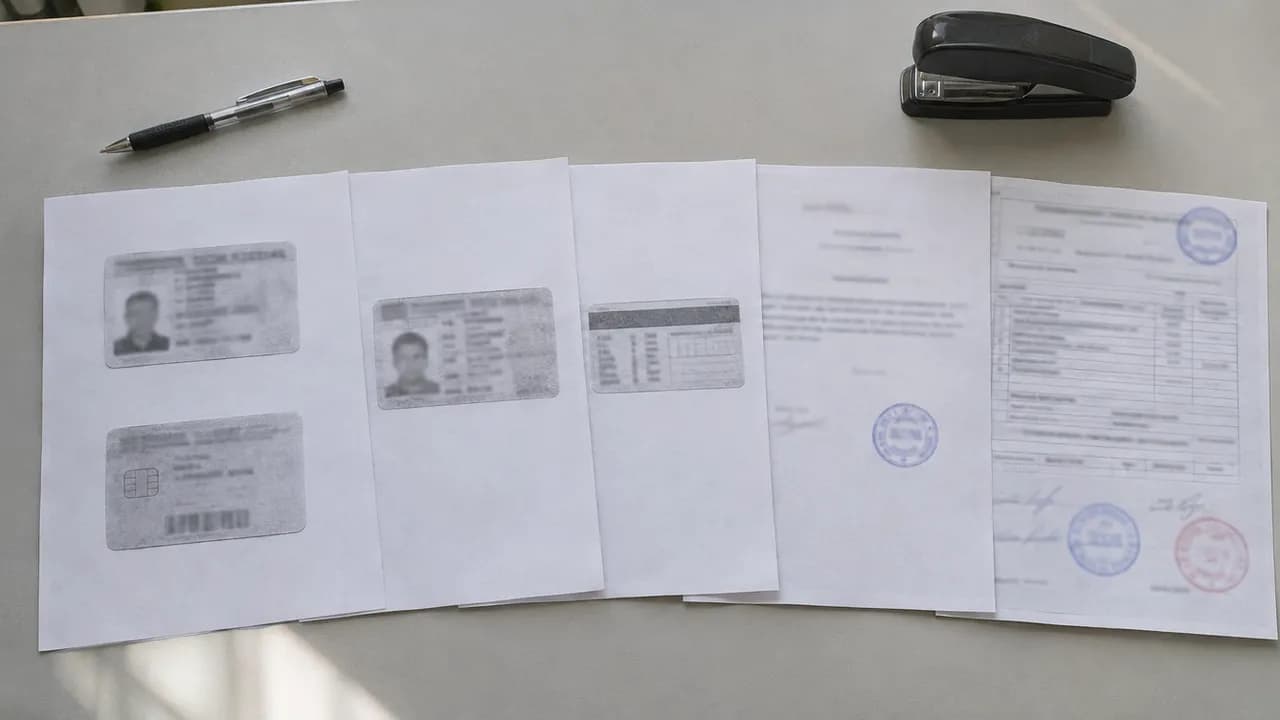
The civil ID, front and back, on one page
- Detection
- Two cards on one page
- Classification
- Civil ID, front and back
- Extraction
- Templated OCR
The front of the driving licence
- Detection
- One card
- Classification
- Driving licence, front
- Extraction
- Templated OCR
The back of the driving licence
- Detection
- One card
- Classification
- Driving licence, back
- Extraction
- Templated OCR
The alarm certificate
- Detection
- Paper document
- Classification
- Paper document
- Extraction
- Key-based or best effort
The customs paper
- Detection
- Paper document
- Classification
- Customs paper
- Result
- The whole file, structured
In the AI Hub
Every stage, a block on one canvas.
Pipelines are composed in the AI Hub, validated, and published as versions, so the run a client meets is the run the institution approved.
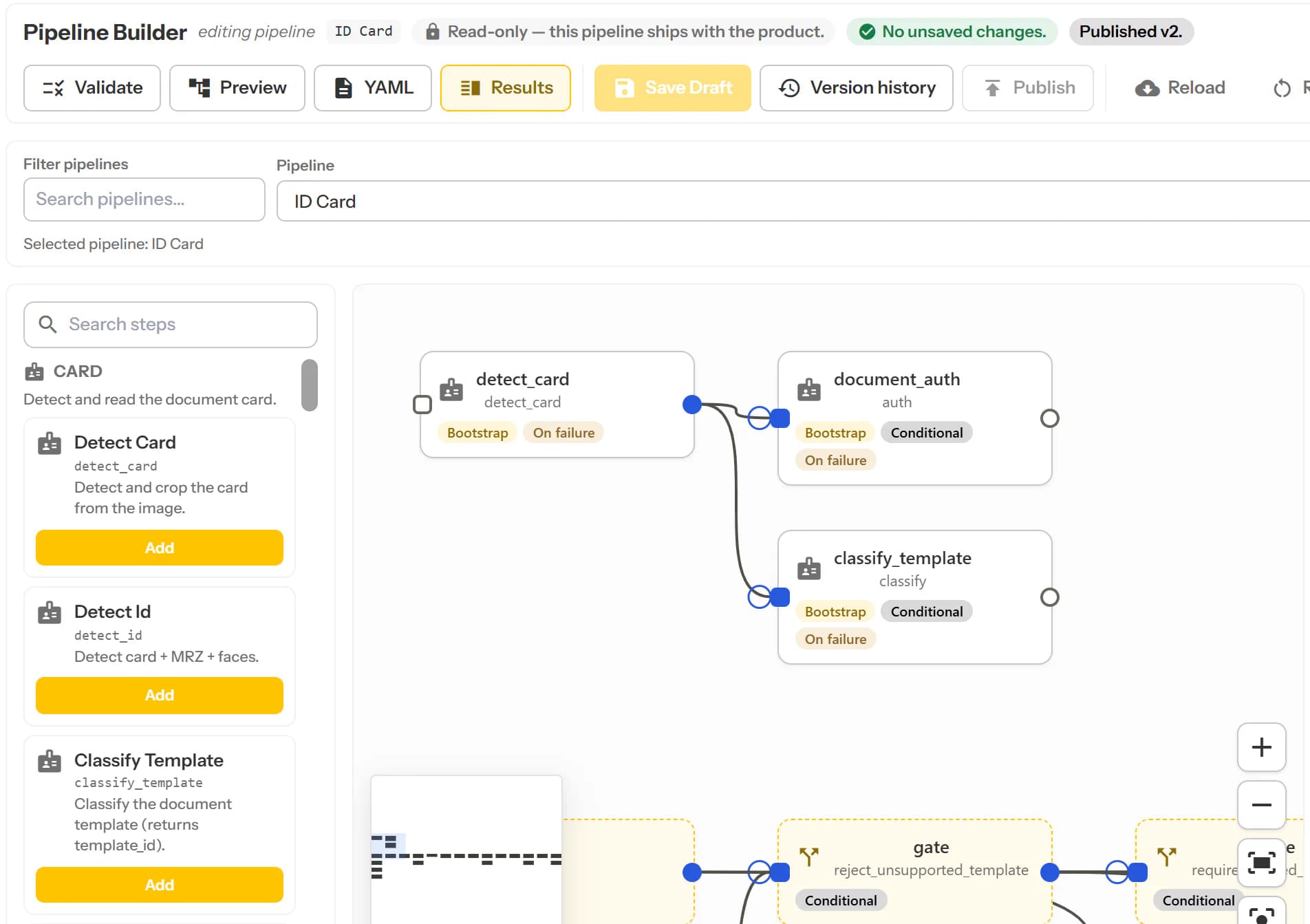
The pipeline
Every AI component, as a step you can chain.
Pick a family to see what it holds. The playground builds any pipeline from these components, and new models can be added, such as vehicle image detection.
Detection
- Identity
- ID, face, MRZ
- Paper
- Paper and card
- Codes
- QR code, and more
Classification
- Prebuilt models
- All IDs in Lebanon and Syria
- Vehicles
- The Lebanon vehicle package
- Other approaches
- Similarity check, homography with LightGlue
Authenticity check
- Screen attack
- A replay from a screen
- Paper attack
- A printed copy
- Cropped paper attack
- A copy cut to size
Tampering check
- Face replace
- Another portrait laid over
- Data replace
- A printed value changed
Extraction
- Templated OCR
- Assentify templates
- Key-based
- Assentify fine-tuned approach
- Best effort
- Assentify fine-tuned vLLM model
DocScan and transliteration
- DocScan
- Skew, orientation, exact crop
- Transliteration
- Arabic and Latin
Pipeline control
- Looping
- The next card, the next page
- Fork
- Different documents, different branches
- And more
- Other pipeline components
The pipeline, as specified
- Inputs
- Images and PDFs
- Languages
- Arabic and English
- Model
- Assentify’s own fine-tuned vision language model
- Serving
- vLLM
- Structure
- Chained components, with looping and fork
- Standards
- ICAO 9303 machine readable zones
- Coverage
- Every Lebanese identity document, global IDs by market
- Enterprise
- Dedicated GPU instance and custom model training
- Residency
- On cloud or on premise, with local GPU servers in Lebanon
Why it is built this way
Read only the Latin side of a bilingual card and you are guessing.
The documents in this region carry the name in Arabic and in Latin script, and the two do not always agree. Assentify reads both and keeps both, which is what allows screening, transliteration and de-duplication to work later. A pipeline that drops the Arabic form at capture has thrown away the evidence before anyone needed it.
Infrastructure
Shared capacity, or a GPU of your own.
Document AI is the most compute-hungry thing in the platform, so where it runs is a commercial and a regulatory question at the same time.
Enterprise clients can take a dedicated GPU instance instead of shared capacity. Throughput stops depending on anybody else’s traffic, processing is isolated for risk purposes, and custom model training runs on the same instance.
Data Persistence is set per tenant, on cloud or on premise, and in Lebanon local GPU servers keep document AI and eKYC processing inside the country. Inference is synchronous and in memory, and produces no model artefacts that retain client data.
The AI Hub starts at $449/month, on an annual commitment, in three tiers. Page volume, document classes, dedicated GPU capacity and any custom training shape the final figure.
- Starts at, a month
- $449
- Pricing tiers
- 3
- Dedicated GPU instance, Enterprise
- 1
- GPU servers in Lebanon
- In-country
Where it runs
- Shared capacity
- Every tier
- Dedicated GPU instance
- Enterprise tier
- Custom model training
- Enterprise tier
- On cloud persistence
- Per tenant setting
- On premise persistence
- Per tenant, proxy address supplied
- Local GPU servers
- Lebanon, in-country processing
- Certification
- ISO/IEC 27001:2022
Beyond identity documents
Any page your operation reads by hand is a candidate.
If a person reads a page and types what it says into a system, a pipeline can be built for it.
- 01
Identity documents
Civil IDs, driving licences, residency cards, passports.
- 02
Proof of address
Utility bills and statements, where a name and address must be read.
- 03
Financial statements
Pages processed by hand today in lending and underwriting.
- 04
Commercial registers
Corporate documents behind a Verified Business profile.
- 05
Forms and applications
Paper that arrives scanned and leaves as a spreadsheet.
- 06
Regulatory letters
Structured correspondence that has to be read, logged and actioned.
Questions
AI pipelines, answered
An AI pipeline turns AI components into one automated ingestion process. In it, a pipeline chains detection, classification, authenticity and tampering checks, DocScan, extraction and transliteration. Looping and fork let one run take every card and every page of a file. Pipelines are built in the AI Hub’s playground, and best effort extraction runs on Assentify’s fine-tuned vLLM model.
Assentify uses templated extraction because a regulated business needs fields, not text. Generic OCR returns a page of characters and leaves somebody to work out which of them is the document number, which is the expiry date, and what to do when the layout shifts. A template describes the document class once, so every page of that class returns the same named fields in the same shapes, which is what makes downstream automation, screening and audit possible at volume.
Yes, the pipeline reads Arabic and English, which matters because the source documents in this region are bilingual and the two sides of a card do not always agree. Reading only the Latin transcription printed on a document means accepting a transliteration somebody else chose, and losing the Arabic form before screening ever sees it. Assentify supports every Lebanese identity document, along with global identity documents by market and passports read to ICAO 9303.
The Playground lets you run a template against a real document and see the output before the template goes anywhere near a live flow. Test it on the hard inputs: a worn card, glare across the laminate, a scan at an angle, a photograph of a screen.
Yes, dedicated GPU capacity is available on the enterprise tier of the AI Hub. A dedicated instance gives throughput, isolation and predictability that shared capacity cannot. In Lebanon, local GPU servers keep document AI inside the country, and Data Persistence is set per tenant to on cloud or on premise.
Low confidence becomes a case for a human instead of a silent write into a client record. Extracted values carry confidence, and an interaction is flagged Modified when an extracted value is edited, when a check requires manual review, or when tampering is detected on the document. The extraction itself is recorded as a live audit video, so a reviewer replays what the camera saw rather than arguing from one stored still image.
Start
Bring your worst scan. Not your best one.
Build a template in the Playground against the documents that actually give your team trouble, and read the output yourself before anything reaches a client.