Compare · uqudo
Assentify vs uqudo.
uqudo is a genuinely MEA-native platform with real regional partners and a Lebanon page that names the right regulators. The differences come down to three things, and they are specific.
- Dimensions, sourced
- 12
- Where uqudo is native
- MEA
- Cases where uqudo fits better
- 4
- Every source checked
- 16 Aug 2026
The short version
CHOOSE UQUDO IF
Your programme spans the GCC and East Africa at once, you want a large systems integrator partner network, or device intelligence sits at the centre of your fraud model.
CHOOSE ASSENTIFY IF
You need residency operating today rather than available on request, signing in the same platform as verification, and onboarding that completes inside WhatsApp.
Credit where it is due
uqudo is the most serious regional competitor in this set.
uqudo built the position most global vendors ignored. Its homepage leads with identity, fraud and compliance for enterprises in MEA, not with a generic global claim, and its information architecture reflects a truth about the region that most product companies miss: buyers here purchase delivery, not only software. The Engagement section covering assess, design and architect, build and integrate, deploy and manage exists because MEA enterprise projects need it.
Its Lebanon page is among the most detailed produced by any vendor without a Lebanese presence. It names Banque du Liban, the Special Investigation Commission, Law 44 of 2015, Law 81 of 2018, the Telecommunications Regulatory Authority and specific circulars, and it claims Arabic and French optical character recognition. That is a serious piece of work.
The partner list is also not decoration. Accenture, PwC, Microsoft, Mastercard, Visa, Huawei, Hub71 and Oman Data Park represent the delivery and distribution layer that wins large enterprise and public-sector programmes in the Gulf. Assentify delivers through its own professional services team instead, which is a different model with different strengths: fewer logos on the slide, and the people who wrote the platform doing the integration.
Both vendors are regional by conviction rather than by expansion plan. Both understand that a global template does not survive contact with a Levantine document set. The three places they diverge are where the data physically sits, whether signing is in the platform, and whether the client can finish the whole thing inside a chat window.
Side by side
Twelve dimensions, sourced on both sides.
uqudo entries are taken from uqudo.com and its Lebanon page, checked 16 August 2026.
| Dimension | Assentify | uqudo |
|---|---|---|
| What it is | A Digital Experience Platform covering identity verification, AML screening, digital signing, flow orchestration, real-time transaction risk assessment and custom AI processing pipelines on one contract. | Described on its own homepage as identity, fraud and compliance solutions for enterprises in MEA, spanning KYC, authentication, device intelligence, AML screening and transaction monitoring. |
| Regional commitment | Assentify Ltd. is registered in Larnaca, Cyprus, with research and development in Canada and Lebanon, and clients across MENA. | MEA-native positioning, stated as 50+ enterprises across MEA, 20M+ verifications and 14+ countries, with a footer listing 37 country pages. |
| Data residency | In-country processing in Lebanon as an operating fact, so identity data does not have to leave the jurisdiction to be verified. | Stated as meeting MEA data residency requirements, with in-country hosting options available upon request on AWS and Azure. |
| Lebanese documents | Every Lebanese identity document, plus global identity documents by market and passports to ICAO 9303. | The Lebanon page names the Lebanese national identity card, passports and driving licences, and claims Arabic and French OCR. |
| Screening lists | Global coverage through LexisNexis and Refinitiv plugins, plus the local Lebanese lists, including ISF Leb 24 and SIC 18-26. | Stated as global sanctions, PEP and adverse media coverage; see uqudo’s site for its own counts. Local Lebanese list coverage is not itemised. |
| Signing | Assentify signing produces advanced, qualified-grade digital signatures. Signed PDFs carry Assentify’s Adobe Approved Trust List (AATL) certificate, so Adobe Acrobat and Reader show them as trusted. Signing keys are held in a hardware security module, and Assentify runs a local certificate authority in country. In Lebanon, Banque du Liban recognises the one-time password as the client’s electronic signature. Context Aware Signing combines biometrics, OTP signing and tamper proofing. | No electronic signature product appears in the published product navigation. |
| Channels | Web link, short URL or QR, conversational and WhatsApp flows, mobile SDK, and Branch Assisted Mode for onboarding at the counter. | Channels are published as no-code KYC, mobile SDK, web SDK and API. No messaging channel is listed. |
| Deployment time | Web and conversational flows publish from the Flow Builder without an engineering cycle. Mobile SDK integration is measured in hours of work rather than weeks of project. | Published as two to three weeks for public cloud and six to eight weeks for private cloud or on-premise, with a 99.9% service level. |
| Speed and accuracy claimed | Real-time risk decisions under two seconds at load. Assentify does not publish a single global accuracy percentage, because the number is meaningless without the document mix behind it. | Published as 30-second onboarding and 99.5% accuracy. |
| Custom AI pipelines | Custom AI processing pipelines pointed at your own documents, plus a professional services division that builds loan origination systems, mobile apps and core integrations on the same platform. | An Engagement section covering assess, design and architect, build and integrate, deploy and manage, plus deployment and managed services, delivered with a partner network. |
| Named partners and references | Signed reference letters from BOB Finance and Capital Finance Company, plus cleared client logos including Prime Gold, Rise, Purpl, Evo Wallet, MedGulf and Libano-Suisse. | Named partners on the site include Accenture, Huawei, Hub71, Mastercard, Microsoft, Oman Data Park, PwC, Visa and TECH5. |
| Published pricing | Reference starting points on the pricing page, completed by sales. No per-verification list price is published. | Not published. |
uqudo figures are quoted from uqudo.com and uqudo.com/lebanon-kyc-aml-services, checked 16 August 2026. Assentify figures are from the ISO/IEC 27001:2022 certificate and current platform documentation. The accuracy row does not compare percentages: uqudo publishes 99.5% and Assentify publishes no comparable single figure, so a side-by-side number would be misleading.
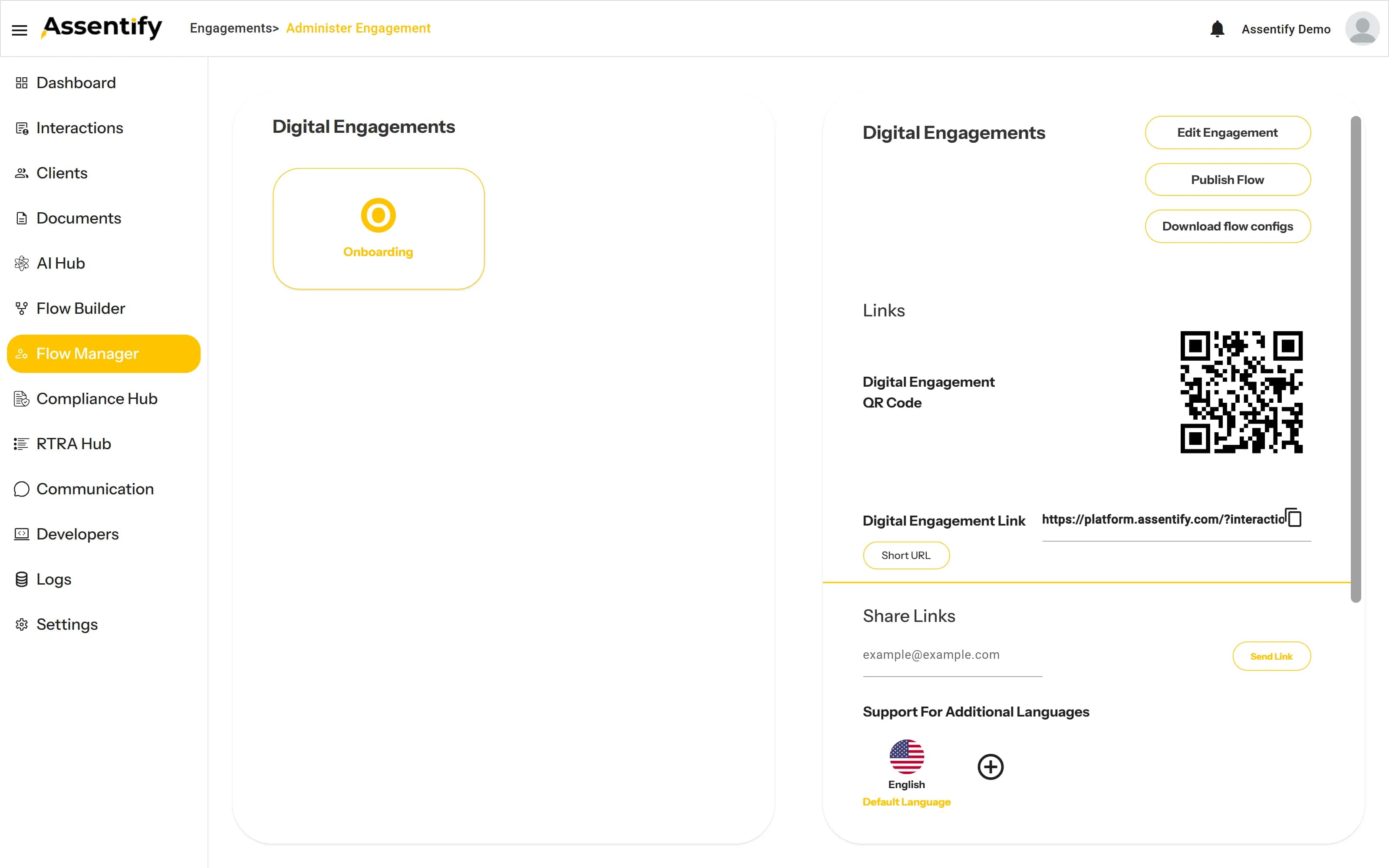
Channels, on screen
Publish once, then share it as a link, a QR code or an email.
Flow Manager publishes the flow and hands you the link and QR code. The same flow runs on the web, inside WhatsApp and in your own app.
- Edit, publish and download from one panel
- A QR code and a link for every published flow
- Share by email from the same place
The difference that decides it
Hosting on request is an offer. Processing in country is a fact.
At an inspection, a supervisor asks where the data is, not where it could be arranged to be. Assentify processes identity data inside Lebanon today, for live subscribers, handling hundreds of thousands of transactions daily. That is the sentence that has to survive the question.

Where Assentify is stronger
Four differences for a Lebanese institution.
14+
uqudo countries in operation across MEA
In country
Assentify, running in Lebanon today
50+
uqudo enterprises across MEA
30+
Assentify subscribers live, counted not projected
UQUDO LEFT · ASSENTIFY RIGHT
Residency as an operating fact
uqudo states that it meets MEA data residency requirements and offers in-country hosting options upon request on AWS and Azure. Read carefully, that is an offer rather than an operating state, and the difference matters to a supervisor. Assentify runs in-country processing in Lebanon today, for live subscribers, with identity data handled inside the jurisdiction. A capability you are already operating and one you are willing to arrange are not the same answer to an inspection question.
Signing finishes the flow
No electronic signature product appears in uqudo’s published product navigation, so an institution that needs a verified identity and a signed agreement is buying two vendors. Advanced, qualified-grade digital signing: an Adobe AATL certificate, keys in a hardware security module and a local certificate authority. In Lebanon, Banque du Liban recognises the one-time password as the client’s electronic signature. Context Aware Signing binds biometrics, OTP signing and tamper proofing to the document.
The onboarding runs inside WhatsApp
uqudo publishes its channels as no-code KYC, mobile SDK, web SDK and API. None of those is a messaging channel. In markets where WhatsApp is the default consumer surface, requiring an app install or a browser session is where completion drops. Assentify ships conversational and WhatsApp flows as a first-class channel, so capture, liveness, screening and signing complete without leaving the conversation.
Lebanese depth written by people in Lebanon
uqudo’s Lebanon page is one of the better ones in the market and names the right instruments. It is also produced at country-page scale, and content produced at that scale carries costs: the same page currently contains a section heading referring to Nigeria’s requirements. Assentify supports every Lebanese identity document rather than three, carries the local Lebanese lists including ISF Leb 24 and SIC 18-26, and operates SICILIA for SIC letter processing as a product rather than describing it as a requirement.
When to choose uqudo instead
Four situations where uqudo is the better buy.
Your footprint is Gulf-wide rather than Levant-deep
uqudo publishes 37 country pages and states 14+ countries in operation with 50+ enterprises across MEA. If your programme spans the GCC and East Africa simultaneously and no single market dominates the volume, that spread of country coverage is a genuine head start. Assentify is deepest in Lebanon and the surrounding markets and does not claim the same breadth of country-level presence.
You want a large systems-integrator partner network
uqudo names Accenture, PwC, Microsoft, Mastercard, Visa, Huawei and Oman Data Park among its partners. In enterprise and public-sector procurement, a delivery partner your organisation already contracts with can matter more than the product underneath. Assentify delivers with its own professional services team, which is a different model: fewer partner logos, and the people who wrote the platform doing the work.
Device intelligence and transaction monitoring are central
uqudo publishes device intelligence and transaction monitoring as first-class products. If your fraud model depends heavily on device fingerprinting and post-onboarding transaction surveillance as a bought capability, that is a mature part of their catalogue. Assentify covers real-time transaction risk assessment through the RTRA Hub, and buyers should compare those two specifically rather than assuming equivalence.
You want a published deployment timetable
Two to three weeks for public cloud and six to eight weeks for private cloud or on-premise, with a 99.9% service level, is a clear and testable commitment. Some procurement processes want exactly that: a number in a document rather than a demonstration. Assentify publishes faster figures for publishing a flow, but any claim about speed should be proved in a session with your own documents rather than taken from either site.
One more difference. uqudo publishes a 99.5% accuracy figure and a 30-second onboarding figure. Assentify publishes neither as a single global number, because both depend entirely on the document mix, the capture conditions and the security bar set on the flow. That means uqudo gives a procurement team something to write in a box and Assentify does not. If your process needs a number in a box, that favours uqudo, and the way to settle it is a parallel run on your own documents.
Sources
Where the uqudo figures come from.
Sources
Competitor facts are taken from each vendor’s own published pages, checked on 16 August 2026. Vendors change their sites, so check the current page before relying on a figure.
- uqudo positioning, product navigation, channels and named partnershttps://uqudo.com/ · checked 16 August 2026
- uqudo scale claims: 50+ enterprises, 20M+ verifications, 14+ countries, 30-second onboarding, 99.5% accuracy, 1.7M+ PEPshttps://uqudo.com/ · checked 16 August 2026
- uqudo deployment timings, 99.9% service level, and in-country hosting options upon request on AWS and Azurehttps://uqudo.com/ · checked 16 August 2026
- uqudo Lebanon page content, document list, Arabic and French OCR claim, and the Nigeria section headinghttps://uqudo.com/lebanon-kyc-aml-services/ · checked 16 August 2026
- Assentify ISO/IEC 27001:2022, InterCert, registration IC-IS-2408273Certificate issued 31 August 2024, recertification due 30 August 2027
Open questions
- uqudo pricing. Nothing is published.
- Whether uqudo has delivered in-country hosting inside Lebanon for any client. The site describes it as an option upon request.
- Whether uqudo carries the local Lebanese screening lists. Its list coverage is published as a global count.
- uqudo’s exact Lebanese document coverage beyond the three types named on its Lebanon page.
- Any accuracy comparison. uqudo publishes 99.5%; Assentify does not publish a comparable single figure, so the two numbers are not comparable.
Both are regionally committed identity platforms, and the differences are narrow and specific rather than sweeping. uqudo is broader across MEA, with 37 published country pages, a large partner network including Accenture, Microsoft, Mastercard and Visa, and published deployment timetables. Assentify is deeper in Lebanon and the Levant, runs in-country processing as an operating fact rather than an option on request, includes digital signing in the same platform, ships conversational and WhatsApp onboarding, and carries the local Lebanese screening lists.
No electronic signature product appears in uqudo’s published product navigation, as of 16 August 2026. Its published products are KYC, authentication, device intelligence, AML screening and transaction monitoring. That means an institution needing both a verified identity and a signed agreement is buying two vendors and reconciling two audit trails. Advanced, qualified-grade digital signing: an Adobe AATL certificate, keys in a hardware security module and a local certificate authority. In Lebanon, Banque du Liban recognises the one-time password as the client’s electronic signature.
uqudo states that it meets MEA data residency requirements and offers in-country hosting options upon request on AWS and Azure, which is an offer rather than a statement of current operation in Lebanon. Assentify runs in-country processing in Lebanon today for live subscribers. For a supervised institution, the question at inspection is what is running now, not what could be arranged.
For an institution supervised by Banque du Liban, Assentify is the stronger fit on four specific grounds. Identity data is processed inside the country today, every Lebanese identity document is supported rather than the three named on uqudo’s Lebanon page, the local Lebanese screening lists including ISF Leb 24 and SIC 18-26 are covered alongside the global vendor data, and signing runs in the same platform with the one-time password Banque du Liban recognises as the client’s electronic signature. Outside Lebanon and outside signing, the comparison narrows considerably.
Yes, and it is the most credible regional competitor Assentify has. uqudo has built a real MEA-native platform, publishes a Lebanon page that names Banque du Liban, the Special Investigation Commission, Law 44 of 2015, Law 81 of 2018 and the relevant circulars, and has partner relationships with Accenture, PwC, Microsoft, Mastercard and Visa. Any comparison page that treats uqudo as an easy win is not describing the market accurately. The differences are narrow, and they concentrate on residency, signing and channel breadth.
uqudo publishes two to three weeks for public cloud and six to eight weeks for private cloud or on-premise, and Assentify publishes flow publication without an engineering cycle. Those two numbers describe different things, so comparing them directly is misleading. uqudo is quoting a platform deployment; Assentify is quoting the time to publish a new flow on a platform already deployed. The reliable way to compare is a session where both build the same flow with your documents in front of you.
Start
Put both in front of the same Lebanese ID.
Bring the documents your branches actually see, including the worn ones and the handwritten ones. Extraction quality on a real Levantine document set settles this comparison faster than any table.
See them live before you decide. The demo call shows the platform working on real screens, and the free month puts a tenant of your own behind every claim in the comparison. One form covers both, and no card is taken at any point.
Still comparing? Every comparison, in one place.