AI Hub
Documents in.
Structured data out.
Custom AI processing pipelines for images and PDFs. Detection, classification, checks, DocScan and extraction, chained in a playground, in Arabic and English.
- Arabic and English
- AR + EN
- Images and PDFs in
- Component families
- 8
- Dedicated, enterprise
- GPU
Pipeline Builder
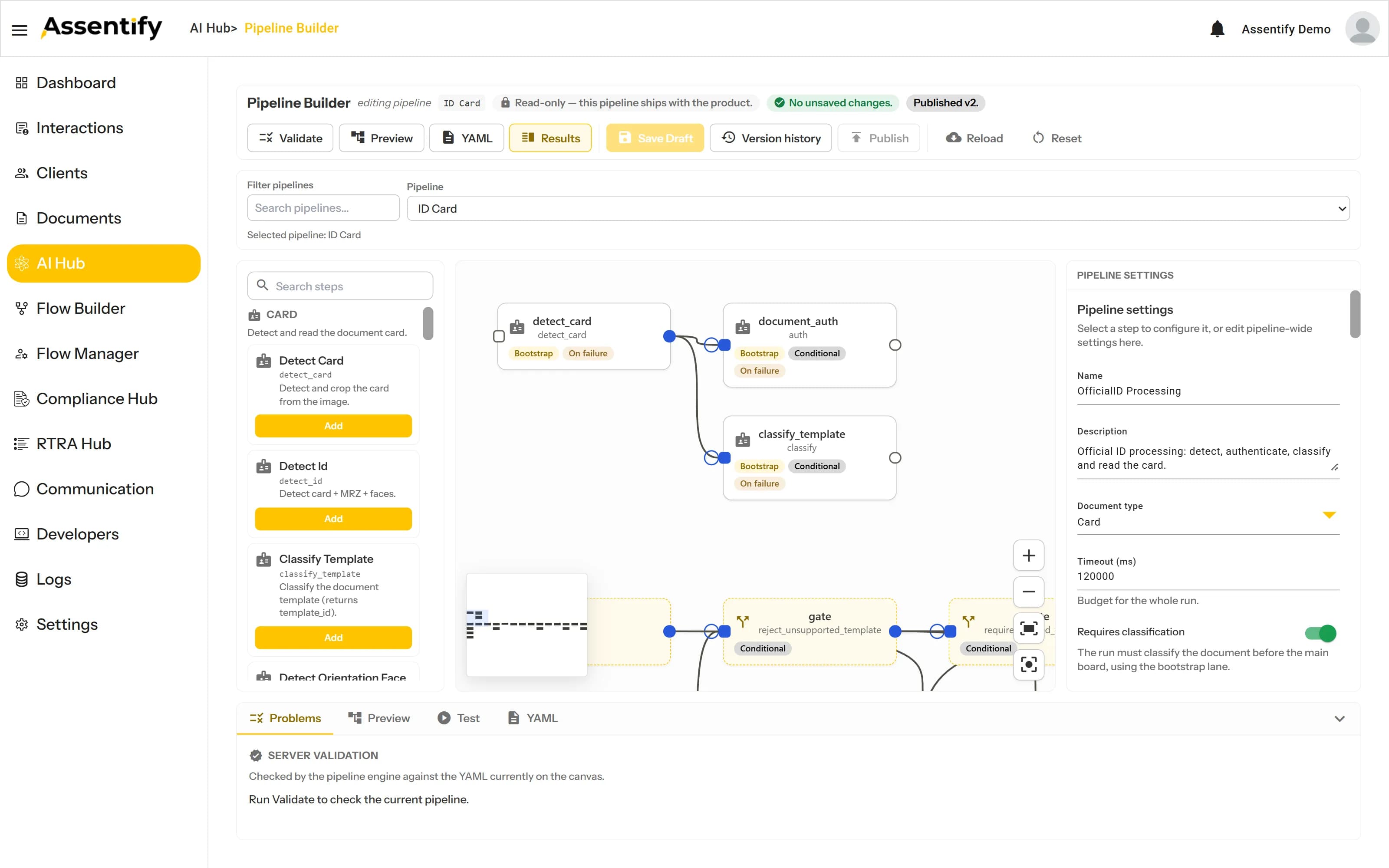
The pipeline, on a canvas you can open.
The ID Card pipeline ships with the product, and every pipeline is validated, previewed and published as a version from one place, so what runs in production is what was tested.
Where the pixels come from
DocScan runs before the template sees anything.
Every card is detected and classified, then DocScan fixes skew and orientation and crops it exactly. Extraction only ever reads a clean, upright card, which is where its accuracy comes from.

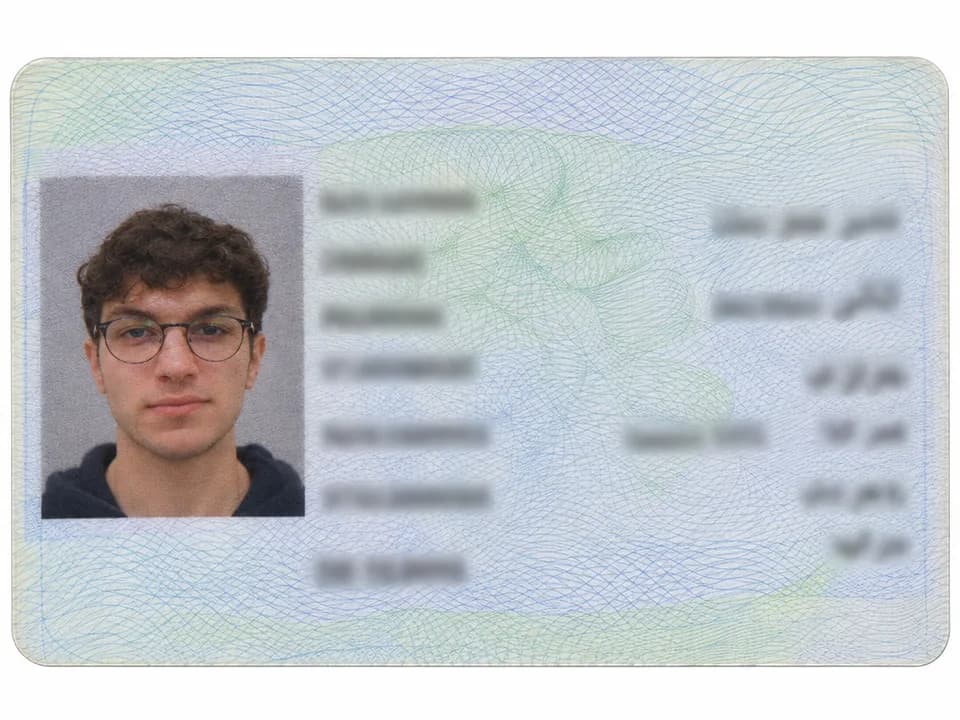
- Skew corrected
- Turned upright
- Cropped to the edge
- Glare removed
The pipeline
Components you chain, and change one at a time.
The AI Hub exposes the pipeline itself. When a field comes back wrong, you can see which component produced the problem and change that component alone.
Detect and classify
Detection finds the ID, the face, the MRZ, the paper, the card or the QR code. Classification names the document with prebuilt models for every ID in Lebanon and Syria and the Lebanon vehicle package, plus a similarity check and a homography approach (LightGlue).
Check
Authenticity checks catch a screen attack, a paper attack and a cropped paper attack. Tampering checks catch a replaced face and replaced data.
Prepare and read
DocScan fixes skew and orientation and crops the ID exactly. Extraction then runs Assentify templated OCR, the fine-tuned key-based approach, or the best effort approach on Assentify’s fine-tuned vLLM model, with transliteration where a name needs it.
Control
Looping, fork and other control components let one pipeline take a five-page PDF, split each page into its cards, and read them one by one.
Three tools
Build the pipeline. Describe the document. Prove it works.
The AI Hub ships with the tooling around the model, which is the part that decides whether a document project succeeds.
Pipeline Builder
Chain components into a named pipeline for a document class, then point a flow at it. Different documents get different treatment without a code change, and a pipeline can be revised without touching the flow that consumes it.
Template Builder
Describe a document once. Where the fields sit, what each one is called, and what shape the value should take. The template is then reusable across every pipeline and every flow that meets that document again.
Playground
Try a template against a real document and see what comes back, before it touches a live flow.
Your worst documents, first
Accuracy is often agreed in a proposal and measured on clean samples, then meets the real intake: a folded card, a flash reflection, a photo of a screen, a scan at an angle. The Playground puts that collision at the start, before a single client is exposed to it.
The model
Fine-tuned by us, for the documents this region uses.
Best effort extraction in the AI Hub runs on Assentify’s fine-tuned vLLM model, in Arabic and English. It is tuned on the documents this region issues, and on the enterprise tier it can be trained on your own document set when your intake changes.
Compute and control
Shared capacity, or a GPU of your own.
Most subscribers run on shared capacity. Enterprise clients can take a dedicated GPU instance instead, which changes three things at once. Throughput becomes predictable under load. Processing is isolated from every other tenant. And the model can be trained on your own document set.
In Lebanon this connects directly to data residency. Assentify runs local GPU servers in country, so eKYC and document processing can happen inside the border where the regulator expects it.
Enterprise options
- Dedicated GPU instance
- Enterprise tier
- Custom model training
- Enterprise tier
- Data persistence
- On cloud or on premise
- In-country processing
- Available in Lebanon
- Languages
- Arabic and English
- Input types
- Images and PDF
Where it plugs in
Extraction is one stage in a bigger flow.
The AI Hub sits inside a platform that already has the capture, the review, the screening and the record.
Identity documents
Templated OCR for regional identity documents, including every Lebanese identity document, plus global documents by market and passports read from the Machine Readable Zone to ICAO 9303.
Supporting documents
Proof of address, payslips, commercial register extracts and the rest of the file that arrives as a photograph and has to become data before anyone can decide anything.
Back-office backlogs
The AI Hub is not only for onboarding. Any image or PDF your operation processes by hand today is a candidate for a pipeline, and the Playground is where you find out in an afternoon.
Into the flow
Extracted values populate the Assisted Data Entry step, where the client confirms what was read. If they change a value, the record is marked Modified and a reviewer sees exactly what was altered.
Into compliance
The name, date of birth, document number and country that come out of extraction are the exact inputs the Compliance Hub screens on, so extraction quality is a compliance control. A misread name is a missed match.
Pricing
Starts at $449/month
Published so you can size a budget before you speak to anyone. The AI Hub is sold in three tiers on an annual commitment. Page volume, document classes, dedicated GPU capacity and custom training shape the final number, so contact sales to complete.
Tiers
- Starter
- The pipeline, the builders and the Playground.
- Business
- Higher volume and more document classes.
- Enterprise
- Dedicated GPU instance and custom model training.
Questions
AI Hub, answered.
The AI Hub is Assentify’s AI processing pipeline for images and PDFs that chains detection, classification, authenticity and tampering checks, DocScan, extraction, transliteration and control components. Its best effort extraction runs on Assentify’s fine-tuned vLLM model, and it works in Arabic and in English. It ships with three tools: a Pipeline Builder for assembling the stages, a Template Builder for describing a document class once, and a Playground for testing a template against a real document before it goes anywhere near a live flow.
Yes, the AI Hub handles Arabic documents natively, because the model behind it is fine-tuned for Arabic and English, which is the whole reason it exists as an in-house model rather than a bought API. Arabic document extraction is where generic OCR fails most visibly, and in the Compliance Hub the same problem returns as transliteration between Arabic and Latin script during name screening. Assentify treats both as first-class rather than as an edge case.
Templated OCR extracts against a description of the document you expect, rather than reading a page and hoping the right values fall out. The template knows the field positions, the field names and the expected shape of each value, so the output is a named, checked field instead of a block of text. It also makes wrong-document detection possible: if the page does not match the template, that is a signal worth acting on, not noise to be smoothed over.
Yes, dedicated GPU compute and custom-trained models are available on the enterprise tier of the AI Hub. Enterprise clients can run on a dedicated GPU instance rather than shared capacity, and can have a model trained on their own document set. That matters where document classes are unusual, volumes are high, or an institution needs its processing isolated for its own risk reasons.
The AI Hub starts at $449/month, on an annual commitment, in three tiers: Starter, Business and Enterprise. Page volume, document classes, dedicated GPU capacity and any custom model training shape the final figure, so contact sales to complete. The AI Hub is subscribed to on its own or alongside the Flows Hub, the Compliance Hub and the RTRA Hub.
A pipeline is pointed at by a flow step, so extraction happens inside the interaction rather than as a separate batch job afterwards. What comes out of post-processing populates the Assisted Data Entry step for the client to confirm, feeds the client record in Clients, and provides the identity fields the Compliance Hub screens. One extraction, one record, one audit trail.
Start
Bring your worst documents.
The fastest way to judge an extraction engine is to hand it the files your team argues about. Take a tenant for a month, build a template, and run them through the Playground.