Lebanon · eKYC
eKYC in Lebanon, from the rule to the running flow.
Banque du Liban rewrote the rules on electronic banking on 9 January 2026. eKYC in Lebanon now has a defined form, defined conditions, a clear line on who may provide it, and in-country processing.
- Circular 69 rewritten
- 2026
- Account ceiling
- USD 10K
- Notice to BDL
- 90 days
- Processing
- In country
The instruments
Basic Decision 7548, as rewritten.
Basic Circular 69 governs electronic banking and financial operations at banks and financial institutions. Its articles were replaced in full on 9 January 2026.
The instrument
Basic Decision No. 7548, Basic Circular No. 69
Electronic Banking and Financial Operations
- Originally issued
- 30 March 2000
- Articles replaced by
- Int. Decision 13791
- Replacement date
- 9 January 2026
- Intermediate Circular
- No. 750
- Applies to
- Banks and FIs at BDL
- Parallel regime
- Decision 13790, EPSPs
The consolidated text is explicit: the articles of Basic Decision 7548 and all its annexes were repealed and replaced. The year 2000 text no longer governs anything.

Definition
What eKYC means under Lebanese regulation
In Lebanon eKYC is a named route, with a named form, a named ceiling and a named approval.
It is a licensed activity for the institution
Under Article 2 First of Basic Decision 7548, a bank or financial institution must obtain prior approval from Banque du Liban before it offers the E-KYC service, and must notify BDL in writing ninety days before it starts or promotes any operation covered by the decision. The same ninety days applies again to any later change in a declared operation. Article 2 Third reserves the right of BDL and the Banking Control Commission to ask for further information or to impose conditions.
Plan for it first. The notification window is fixed by the regulation, and it runs in parallel with your build.
It is delivered through a defined form
Article 4 First creates the E-KYC Form. It opens payment accounts not exceeding USD 10,000, it requires enhanced due diligence, ongoing transaction monitoring and a client risk classification of high, medium or low, and it requires a minimum data set set out in Annex 2. Annex 2 is long: more than thirty fields, including full name, date of birth, address, occupation, beneficial-owner status and a criminal-history declaration.
The design problem is to collect all of it without asking a person on a phone to type all of it. Document extraction, assisted data entry and pre-filled fields solve it.
It requires a Digital ID system, to a named standard
Article 4 First requires Digital ID systems that include the requirements for identity proofing and enrolment, and for identity authentication and lifecycle management, as per FATF Guidance on Digital ID. That clause is the technical specification for the project. Identity proofing is the document and the face. Enrolment is the binding of that evidence to a client record. Authentication is how the same person proves it is them again later. Lifecycle management is expiry, renewal, change and revocation.
Assentify covers all four in one platform. Client profiles carry KYC expiry alerts, KYC renewal alerts and a configurable re-screening cycle, so a file does not silently age out of compliance.
It reaches existing clients, not only new ones
Article 4 Third states that the E-KYC Form may also be used to renew or amend existing KYC. For most Lebanese institutions that is the larger programme. A remote refresh sent by link, short URL or QR code, answered on a phone in a few minutes, costs a fraction of a branch appointment and produces better evidence than the paper file it replaces.
The checklist
What is required of a bank or financial institution
Ten obligations, each tied to the article that creates it. Filter by who acts, and open a row to see the platform’s part.
Decision 7548, Art. 2 First
Prior BDL approval
The institution must obtain prior approval from Banque du Liban before offering the E-KYC and E-Money services covered by the decision. The approval attaches to the licensed institution, never to a technology vendor.
Who acts
The institution. This one sits with you and your regulator, whichever platform you choose.
Payment providers read a parallel text. Basic Decision 13790 of 9 January 2026 carries its own E-KYC article at Article 26, its own seven signature conditions at Article 25, and the identical Local Data Hosting rule at Article 27. Article 26 adds facial recognition systems linked to the photo on the user’s identification document.
The claim
The data stays in Lebanon. So does the machine that reads it.
Article 7 tells you where the record has to live. It does not say where the model that reads the identity document has to run. Assentify runs it in Lebanon too, so nothing crosses the border and Article 8 needs no third-party processing consent.
Capital Outsourcing runs the Security Operation Center and Network Operation Center for Assentify Cloud, 24/7, under a service level agreement.
Pick a step
Where it runs
The client’s phone or browser
Web link, WhatsApp or your app
- This step
Assentify Cloud, in Lebanon
Own cloud and GPU servers, in country
Data persistence
On cloud or on premise, per tenant
Document read. A vision model reads the document on Assentify’s GPU servers inside Lebanon.
Capital Outsourcing runs the Security Operation Center and Network Operation Center for Assentify Cloud, 24/7, under a service level agreement.
The supplier question
Who can provide eKYC in Lebanon
The regulation draws a hard line between the licensed institution and the technology underneath it.
What a vendor supplies
The identity proofing, enrolment, authentication and lifecycle management that FATF Guidance on Digital ID describes, plus the security controls, the technical documentation, the audit trail and a deployment that keeps the data inside Lebanon. That is the file the institution submits.
What stays with the institution
The BDL approval in Article 2 attaches to the bank, the financial institution or the payment provider, never to a vendor. Compliance monitoring cannot be outsourced either. Your analysts clear the hits, your reviewers approve and decline, your rules set the thresholds.
In the wild
What a running eKYC flow looks like in Lebanon
A Lebanese finance client printed a loan campaign with a Scan to Start QR code, put it on the wall, and the code opens an Assentify flow.

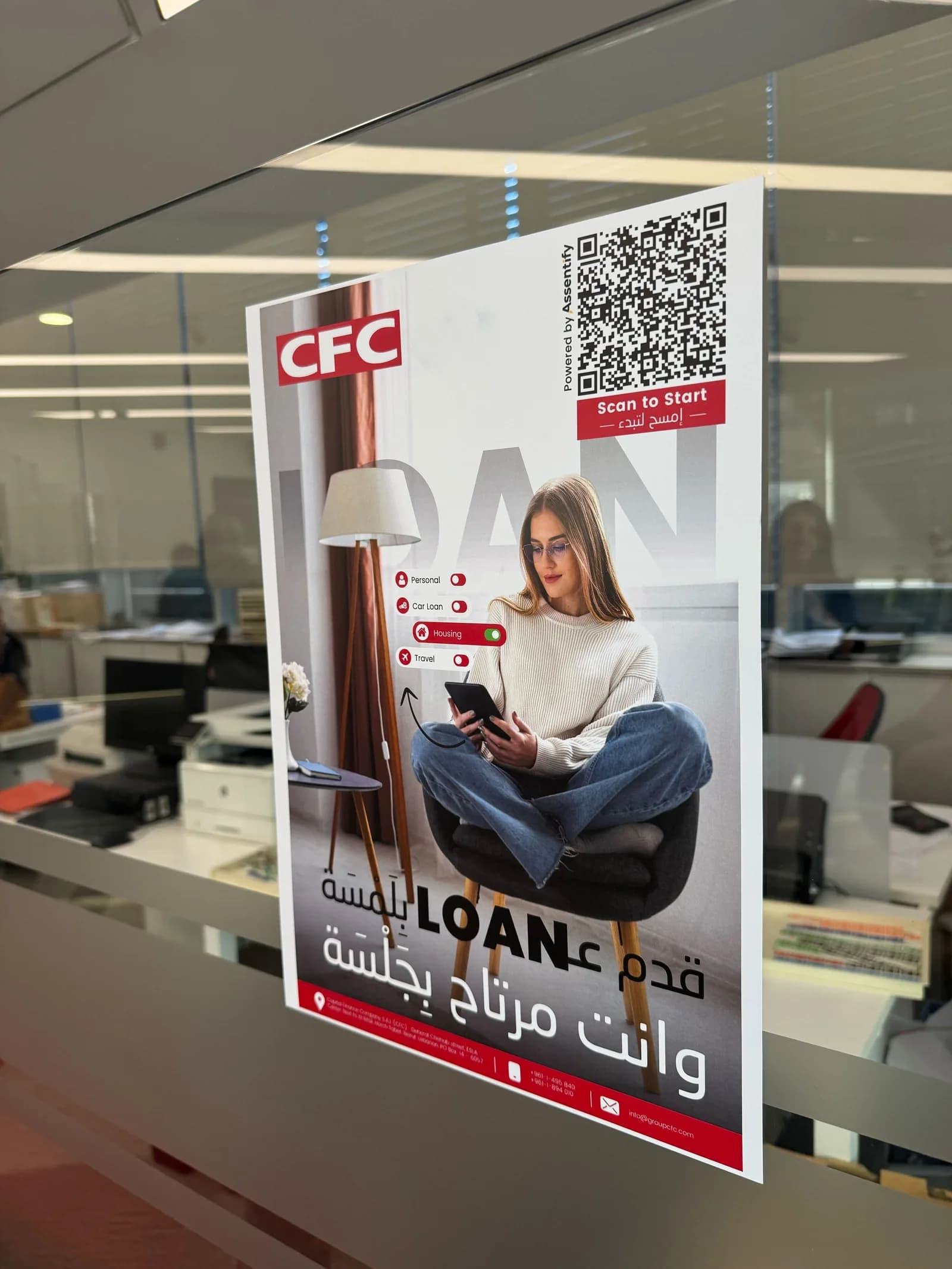

Between the scan and the verified record sit the document capture, the face match, the liveness score and the screening pass, all processed in country. The client sees a scan and a selfie. The supervisor sees the file.
The campaign carries the client’s brand; the only Assentify mark is the Powered by Assentify line beside the code. Flows publish to the web by link, short URL or QR code, into WhatsApp through conversational flows, or inside the institution’s own application through the Mobile Flow SDK, and they carry the institution’s identity end to end.
Go deeper
The rest of the Lebanon cluster
Questions
eKYC in Lebanon, answered.
eKYC in Lebanon is remote client onboarding through the E-KYC Form defined by Banque du Liban in Basic Decision 7548, known as Basic Circular 69. The decision was originally issued on 30 March 2000 and its articles were wholly replaced by Intermediate Decision 13791 of 9 January 2026, Intermediate Circular 750, so the operative text is from 2026. It lets a bank or financial institution open a payment account without a branch visit, using a Digital ID system built to FATF Guidance on Digital ID, enhanced due diligence, ongoing transaction monitoring and client risk classification.
Yes, Article 2 First of Basic Decision 7548 requires the institution to obtain prior approval from Banque du Liban for the E-KYC and E-Money services, and to notify BDL in writing ninety days before starting or promoting any covered operation, or before changing an operation it has already declared. The approval belongs to the licensed institution. It does not transfer to a technology supplier, and no vendor can obtain it on your behalf.
The E-KYC Form opens payment accounts not exceeding USD 10,000 under Article 4 First of Basic Decision 7548. Article 4 Second allows BDL to exceptionally approve a higher ceiling for banks only, on a justified request submitted by the bank concerned. Financial institutions and Electronic Payment Services Providers have no equivalent uplift, so the ten thousand dollar ceiling is the working design constraint for most remote onboarding flows in the market.
Yes, Article 4 Third of Basic Decision 7548 states that the E-KYC Form may be used to renew or amend existing KYC, not only to onboard new clients. That makes remote re-KYC of the existing book a legal route rather than a workaround, which matters in a market where branch visits are expensive and a large share of client files are older than the current standard.
Yes, for banks and financial institutions conducting electronic banking and financial operations. Article 7 of Basic Decision 7548 requires them to store in Lebanon all data and information pertaining to customers and executed operations, a rule the article itself calls Local Data Hosting. Basic Decision 13790, Article 27, of 9 January 2026 imposes the identical obligation on Electronic Payment Services Providers. The requirement comes from banking regulation, not from privacy law: Law 81 of 2018 requires disclosure of a cross-border transfer but does not prohibit one.
Any vendor can supply the technology, but the regulatory obligations stay with the institution, and the architecture has to fit them. Article 8 of Basic Decision 7548 makes the institution the data controller, restricts sharing of personal data to BDL, the Banking Control Commission, the SIC and the judicial authorities, and keeps the institution responsible toward the client whatever a processing contract says. A vendor that ships identity documents and selfies abroad to be read puts the institution in tension with Articles 7 and 8. Assentify runs the whole pipeline inside Lebanon for exactly that reason.
Start
Build the flow, then judge it.
We provision your own subdomain with a sandbox allowance. Build an eKYC flow on the canvas, publish it, send yourself the link, and read the interaction record it produces. That record is what a supervisor will read too.