Compare · Docusign · signing
Assentify vs Docusign.
Docusign is the category. Its agreement platform, integration catalogue and legality library are all best in class. Assentify signs at the end of a verified identity flow, and the legality library stops at Lebanon.
- Dimensions, sourced
- 12
- Docusign legality guides
- 70+
- Cases where Docusign fits better
- 4
- Every source checked
- 16 Aug 2026
The short version
CHOOSE DOCUSIGN IF
Your problem is agreements rather than onboarding: contract lifecycle management, template governance, a thousand integrations, and counterparties who already expect the envelope.
CHOOSE ASSENTIFY IF
The signature has to complete a client process, carry the identity that was just verified, and hold up in a market Docusign’s legality guide does not cover.
Credit where it is due
Docusign built the standard everyone else is measured against.
Docusign describes one billion people using its service and 95% of the Fortune 500 as customers. It publishes per-seat pricing openly, supports 44 signer languages, and lists more than a thousand pre-built integrations. It has moved beyond electronic signature into Intelligent Agreement Management, covering agreement preparation, contract lifecycle management, electronic notarisation and web forms, with an AI layer over the agreement estate. That is a genuinely large product, built over two decades.
Its eSignature Legality Guide is, in our view, the single strongest content asset in the signing half of this market. More than seventy country guides, each with a summary of local law, permitted document types, cautionary categories requiring legal review, case law and links to legislation. Assentify has published nothing of that scale.
The two products answer different questions. Docusign asks how an organisation manages agreements at scale. Assentify asks how a regulated institution takes a stranger, proves who they are, screens them, decides, and gets a binding signature, in one flow, inside a jurisdiction with its own rules about where the data may sit.
That is why many institutions run both. Docusign for commercial and internal agreements, Assentify for the client-facing onboarding flow where the signature has to be attached to a face, a document and a screening result.
Side by side
Twelve dimensions, sourced on both sides.
Docusign entries are taken from docusign.com, its pricing page and its legality guide, checked 16 August 2026.
| Dimension | Assentify | Docusign |
|---|---|---|
| What it is | A Digital Experience Platform where signing is the final step of a verified identity flow, alongside verification, screening, orchestration, transaction risk scoring and custom AI pipelines. | Positioned on its own homepage as AI-powered agreement management, with electronic signature as one product inside the Intelligent Agreement Management platform. |
| What the signature is bound to | The identity that was just verified. Context Aware Signing combines biometrics, OTP signing and tamper proofing, with a pattern overlay carrying document details so alteration or reuse outside the intended context is detectable, including in print. | The signer’s authenticated session and audit certificate. Identity assurance is available through separate identity verification options rather than as first-party biometric capture inside the same record. |
| Legal framing | Assentify signing produces advanced, qualified-grade digital signatures. Signed PDFs carry Assentify’s Adobe Approved Trust List (AATL) certificate, so Adobe Acrobat and Reader show them as trusted. Signing keys are held in a hardware security module, and Assentify runs a local certificate authority in country. In Lebanon, Banque du Liban recognises the one-time password as the client’s electronic signature. | Compliance across many jurisdictions, published through an extensive eSignature Legality Guide covering more than 70 countries. |
| Lebanon | In-country processing in Lebanon, every Lebanese identity document, local Lebanese screening lists, and OTP signing that Banque du Liban recognises as the client’s electronic signature. | The eSignature Legality Guide covers France and the United Arab Emirates among more than 70 countries. It does not cover Lebanon, Qatar or Kuwait. |
| Published pricing | Reference starting points on the pricing page, completed by sales. Priced as a platform rather than per seat. | Fully published and per seat. Personal at $11 per month billed annually, Standard at $30 per user per month, Business Pro at $45 per user per month, Enhanced on request. |
| Identity verification | First party. Document capture, iBeta certified passive liveness with active and configurable modes, face matching, extraction and de-duplication, on the same record as the signature. | Identity verification options exist within the agreement platform. |
| AML screening | Included through the Compliance Hub, with LexisNexis and Refinitiv plugins plus local Lebanese lists including ISF Leb 24 and SIC 18-26. | Not part of the agreement platform. Screening would come from another vendor. |
| Channels | Web link, short URL or QR, conversational and WhatsApp flows, mobile SDK, and Branch Assisted Mode for onboarding at the counter. | Web, email and multi-channel delivery within the agreement platform, plus web forms and a very large application integration catalogue. |
| Contract lifecycle | Document template building and flow-driven document generation. Assentify does not sell a full contract lifecycle management product. | A deep contract lifecycle management estate including agreement preparation, agreement management, electronic notarisation, web forms and an AI layer. |
| Integrations | The Data Sources engine for wiring core banking, ERP and CRM systems into a flow, plus APIs, webhooks and mobile SDKs. | Published as more than 1,000 pre-built integrations. |
| Scale claimed | Over 30 subscribers live, processing hundreds of thousands of transactions daily, across banks, wallets, insurers and national-scale deployments. | Published as 1.7 to 1.8 million customers, 95% of the Fortune 500, and one billion people using Docusign. |
| Security certification | ISO/IEC 27001:2022, certified by InterCert, registration IC-IS-2408273, certified 31 August 2024, recertification due 30 August 2027. | Published as ISO 27001, FedRAMP, APEC PPP, CSA STAR, PCI DSS and SSAE 18. |
Docusign figures are quoted from docusign.com, ecom.docusign.com and the eSignature Legality Guide, checked 16 August 2026. Assentify signing produces advanced, qualified-grade digital signatures with an Adobe AATL certificate, and Banque du Liban recognises the one-time password as the client's electronic signature.
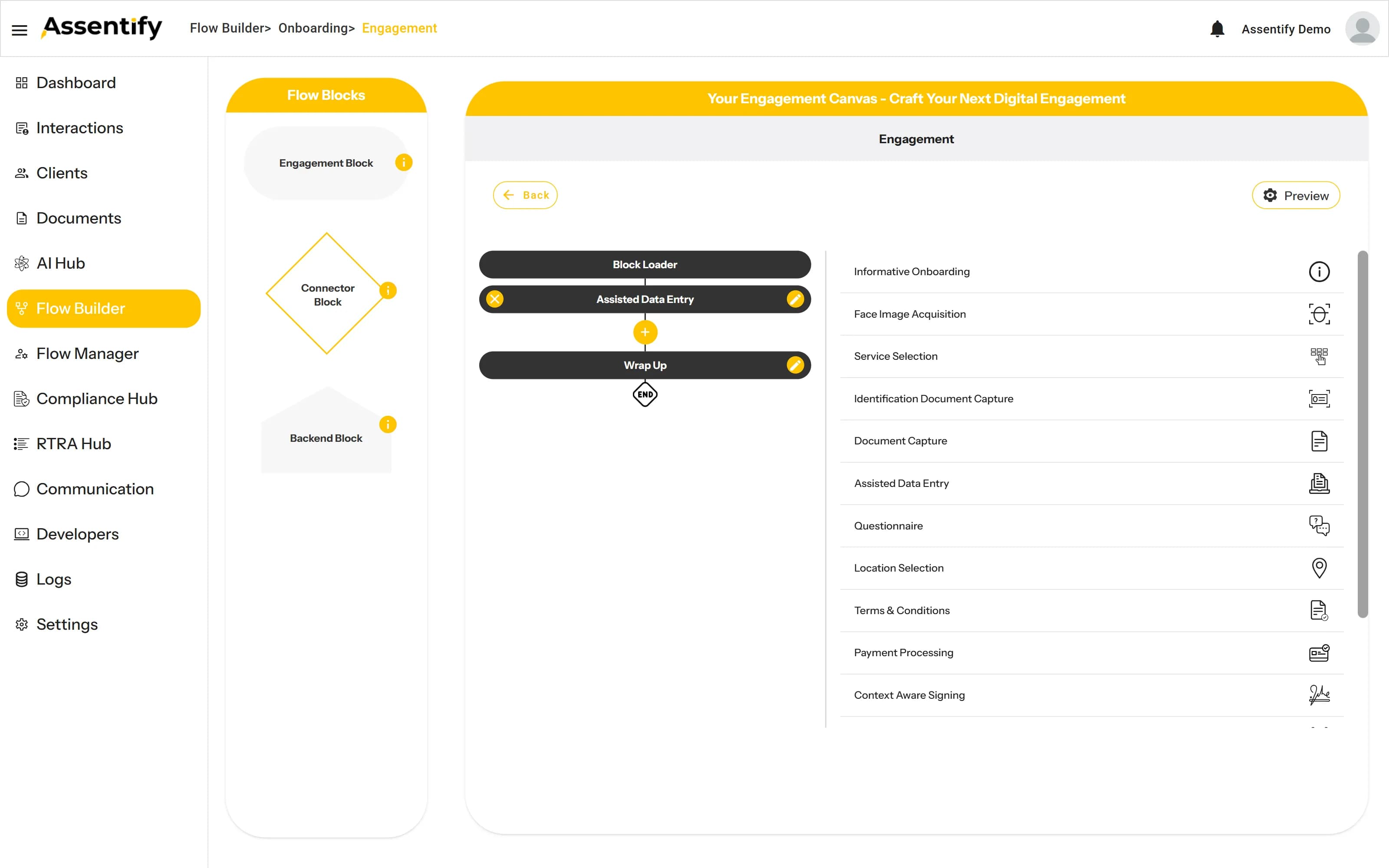
Signing, on screen
Signing is a step in the flow, after the identity is proved.
Context Aware Signing sits in the step library beside Terms and Conditions, so the signature follows the capture, the face match and the screening in the same flow.
- Steps in the Engagement Block
- Terms and Conditions before the signature
- Context Aware Signing, bound to the verified identity
The question a signature has to answer
A signature proves what was agreed. The hard part is proving who agreed.
Assentify Context Aware Signing binds biometric verification and document metadata into a tamper-resistant signature, with a pattern overlay carrying the document details so alteration or reuse outside the intended context is detectable, even in print. The identity is not referenced from another system. It is in the same record.

Where Assentify is stronger
Four differences, all of them about what the signature is attached to.
1B
people described as using Docusign
One
record: identity, evidence and signature
$11
Docusign, per seat per month, entry plan
Platform
Assentify pricing, not per seat
DOCUSIGN LEFT · ASSENTIFY RIGHT
The signature carries the identity check itself
In a typical stack, a client is verified by one vendor and signs with another, and the link between the two is a record identifier passed between systems. Assentify signs on the same record as the verification. Context Aware Signing combines biometric data such as facial verification with document metadata, producing a tamper-resistant signature and embedding a pattern overlay carrying the document name and other critical details, so alteration or reuse outside the intended context is detectable even after printing.
Lebanon, where the legality guide stops
Docusign’s eSignature Legality Guide is the strongest asset in the signing half of this market, covering more than 70 countries including France and the United Arab Emirates. It does not cover Lebanon, Qatar or Kuwait. Assentify processes in country in Lebanon and signs with the one-time password Banque du Liban recognises as the client’s electronic signature. Its signed PDFs carry Assentify’s Adobe AATL certificate, so Adobe Acrobat and Reader show them as trusted.
Signing ends the flow
An account opening that verifies in one system, screens in a second and signs in a third produces three audit trails, three support paths and three places for a client to abandon. Assentify runs capture, liveness, extraction, screening, decisioning and signing as one flow on one record, publishable to web, WhatsApp, mobile SDK or Branch Assisted Mode from the same builder. For an onboarding process, that is a different product category from an agreement platform.
The screening the agreement platform does not do
A signed agreement with a sanctioned counterparty is a compliance failure regardless of how good the signature is. Assentify screens against LexisNexis and Refinitiv coverage plus the local Lebanese lists including ISF Leb 24 and SIC 18-26, before the signature and continuously afterwards. Docusign is an agreement platform and does not sell screening, so that capability comes from a separate vendor and a separate contract.
Assentify signing produces advanced, qualified-grade digital signatures. Signed PDFs carry Assentify’s Adobe Approved Trust List (AATL) certificate, so Adobe Acrobat and Reader show them as trusted. Signing keys are held in a hardware security module, and Assentify runs a local certificate authority in country. If your counsel needs the position documented for a specific transaction type, ask us in writing.
When to choose Docusign instead
Four situations where Docusign is the better buy.
Three of these describe capabilities Assentify does not sell.
You are managing agreements, not onboarding people
Docusign has repositioned around Intelligent Agreement Management, covering agreement preparation, contract lifecycle management, electronic notarisation, web forms and an AI layer over the agreement estate. If your problem is a legal team drowning in contract versions and renewal dates, that is the product built for it. Assentify does not sell contract lifecycle management, and the document template builder is not a substitute for it.
Your counterparties already expect the Docusign envelope
One billion people are described as using Docusign, and 95% of the Fortune 500 are customers. When you send an agreement to a large counterparty, a familiar signing experience removes friction and support calls that a less familiar one creates. Ubiquity is a real feature in a two-sided process, and Assentify does not have it outside its own markets.
You need 1,000 integrations and 44 signer languages
Docusign publishes more than 1,000 pre-built integrations, 44 signer languages and 14 sender languages. If your signing has to appear inside a customer relationship management system, a human resources platform and a procurement tool on the same day, that catalogue is the shortest path. Assentify integrates through the Data Sources engine and APIs, which is powerful for core systems and is not a marketplace of a thousand connectors.
Your procurement requires FedRAMP or a per-seat price
Docusign publishes FedRAMP among its certifications and publishes per-seat pricing from $11 per month. Both are hard requirements in some organisations. Assentify publishes ISO/IEC 27001:2022 with its registration number and prices as a platform rather than per seat. If your checklist has either item as mandatory, that decides it before any capability discussion.
Sources
Where the Docusign figures come from.
Sources
Competitor facts are taken from each vendor’s own published pages, checked on 16 August 2026. Vendors change their sites, so check the current page before relying on a figure.
- Docusign positioning as AI-powered agreement management and the Intelligent Agreement Management platformhttps://www.docusign.com/ · checked 16 August 2026
- Docusign scale claims: 1.7 to 1.8 million customers, one billion people, 95% of the Fortune 500, 44 signer languages, 1,000+ integrationshttps://www.docusign.com/ · checked 16 August 2026
- Docusign pricing: Personal $11 per month annual, Standard $30 per user per month, Business Pro $45 per user per monthhttps://ecom.docusign.com/plans-and-pricing/esignature · checked 16 August 2026
- Docusign eSignature Legality Guide covering more than 70 countries, including France and the UAE and excluding Lebanon, Qatar and Kuwaithttps://www.docusign.com/products/electronic-signature/legality · checked 16 August 2026
- Docusign certifications: ISO 27001, FedRAMP, APEC PPP, CSA STAR, PCI DSS, SSAE 18https://www.docusign.com/ · checked 16 August 2026
- BDL recognition of OTP as the client’s electronic signatureBDL Basic Decision 7548, Article 5(7).
Open questions
- The scope and jurisdictions of the identity verification options available inside the Docusign platform.
- Whether Docusign has added a Lebanon, Qatar or Kuwait legality guide since 16 August 2026. Check the guide directly before relying on its absence.
- The current state of Lebanese accreditation for electronic signature providers. A third-party legality guide published by Zoho describes Law No. 81 of 2018 and identifies COLIBAC as the root certification authority. That is a third-party source, it may be out of date, and it should be re-checked with Lebanese counsel before any legal reliance.
- Any comparison of enterprise contract terms, service levels or discounting between the two vendors.
This comparison is not legal advice. Electronic signature law changes, accreditation registers change, and the enforceability of a given signature depends on the transaction and the forum. Take local counsel before relying on any vendor statement.
For signing that follows an identity check, usually yes; for enterprise contract lifecycle management, usually no. Assentify signs at the end of a verified identity flow, so the signature sits on the same record as the document capture, the liveness check, the face match and the screening result. Docusign is an agreement platform covering preparation, contract lifecycle management, notarisation and a catalogue of more than 1,000 integrations, and that estate is far broader than anything Assentify sells. Many institutions run both, using Assentify for onboarding and Docusign for commercial agreements.
Docusign’s eSignature Legality Guide covers more than 70 countries and does not include Lebanon, Qatar or Kuwait, as of 16 August 2026. France and the United Arab Emirates are covered. That absence is about published legal guidance rather than technical availability, but for a Lebanese institution seeking documented comfort on local enforceability it is a material gap. Assentify processes in country in Lebanon, and Banque du Liban recognises the one-time password as the client’s electronic signature under Circular 69.
Context Aware Signing is Assentify technology that binds a signature to the identity and the document it belongs to. It combines biometric data such as facial verification with document metadata to produce a tamper-resistant signature, and embeds a unique pattern overlay carrying the document name and other critical details. Any attempt to alter the document or reuse the signature outside its intended context becomes detectable, including after the document is printed. It runs alongside OTP signing, so the signer is challenged as well as recognised.
Assentify signing produces advanced, qualified-grade digital signatures. Signed PDFs carry Assentify’s Adobe Approved Trust List (AATL) certificate, so Adobe Acrobat and Reader show them as trusted. Signing keys are held in a hardware security module, and Assentify runs a local certificate authority in country. If your legal team needs a specific assurance level documented for a specific jurisdiction, ask for it in writing.
Docusign publishes per-seat pricing and Assentify prices as a platform. On the Docusign pricing page, checked 16 August 2026, Personal is $11 per month billed annually, Standard is $30 per user per month and Business Pro is $45 per user per month, with Enhanced on request. Assentify publishes reference starting points and completes the number with sales, because the platform covers verification, screening, orchestration and signing together. Per-seat and per-platform models are hard to compare directly, so build both around your actual signer and client volumes.
Usually not. Docusign’s strength in internal and commercial agreement work comes from contract lifecycle management, template governance, negotiation workflow and a very large integration catalogue, none of which Assentify sells. Assentify is built for signing that completes a client process: an account opening, a loan agreement, a policy, a mandate. If your requirement is the legal department rather than the onboarding funnel, buy the agreement platform.
Start
Verify a client, then sign, in the same flow.
One month free. Build an account opening that captures a document, checks liveness, screens the name and ends with a signature bound to the face that was just verified.
See them live before you decide. The demo call shows the platform working on real screens, and the free month puts a tenant of your own behind every claim in the comparison. One form covers both, and no card is taken at any point.
Still comparing? Every comparison, in one place.