Advanced screening algorithm
A name is not a string.
Every screening engine can compare two identical spellings. The work starts when the same person reaches you as Mohamad, Mohammed and Muhammad, from three systems, in two scripts. That is the problem this engine was built for.
- Recommended split, phonetic to AI
- 40 / 60
- Set per client, by risk appetite
- Your split
- Every weight in a profile
- Visible
Threshold and score
Move the threshold. See how the score is built.
Every candidate returns a percentage, and the threshold decides which become cases. The score itself is a blend you can read.
Threshold lab
3 of 6 become cases
- Mohammed Al Rashid96Case
- Fatima Haddad91Case
- Georges Khoury88Case
- Ali Hassan Saleh82Clears
- Nour Chami74Clears
- Rami Aoun63Clears
Illustrative scores from the blended engine at the recommended split, 40 percent traditional and 60 percent AI. Lower the threshold and you buy recall with reviewer hours; raise it and you buy quiet queues with risk. Assentify lets you make that trade per surface, with sliders per algorithm, instead of accepting one global default.
Six candidate matches, one threshold. This is the decision a Screening Profile makes on every name.
Score explainer
Illustrative scores, one name pair
Mohamad Chehade against MUHAMMAD SHEHADEH
Traditional share at 40%
86
AI matching at 60%
93
Composite score
90%
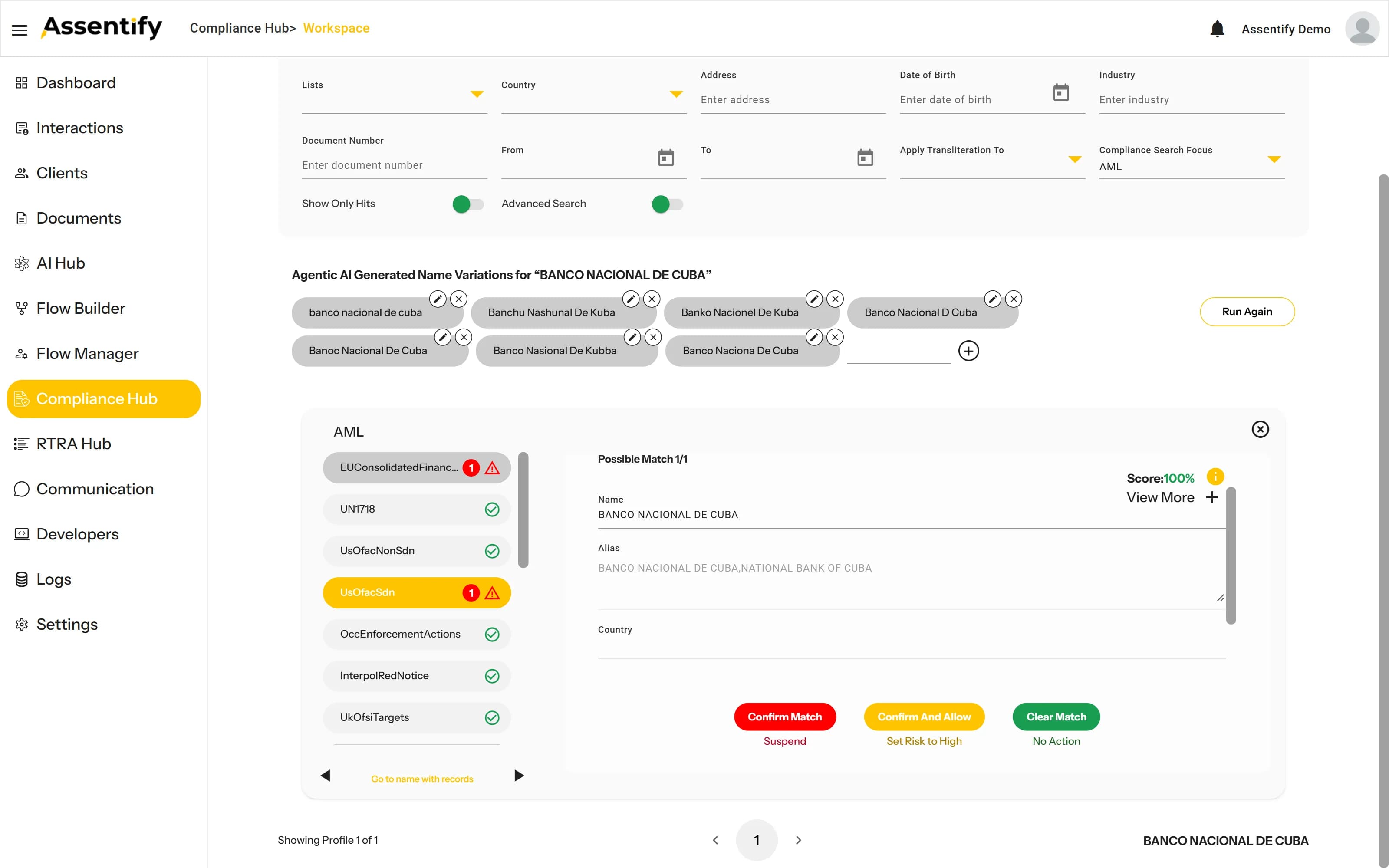
In the Compliance Hub
The score, at work on a real search.
Every candidate carries its percentage and the list that answered, so an analyst can see why a name scored before deciding to confirm or clear it.
The problem
One person. A dozen spellings. All of them correct.
Arabic and Latin script do not map cleanly onto each other. Short vowels are written loosely, several consonants have no exact Latin equivalent, and in Lebanon French orthography adds a second convention on top of the English one.
محمد
One sound key: M530- MohamadM530
- MohammadM530
- MuhammadM530
- MohammedM530
- MohamedM530
- MuhammedM530
Six common renderings, all correct, all in circulation in the same market.
حسين
One sound key: H250- HusseinH250
- HussainH250
- HuseinH250
- HusaynH250
- HocineH250
The final consonant and the internal vowel both float.
شحادة
Sound code splits it: AI and transliteration join it- ChehadeC300
- ShehadehS300
- ChehadehC300
- ShhadeS300
French orthography writes sh as ch, so one sound has two families of spelling.
خليل
Sound code splits it: AI and transliteration join it- KhalilK440
- KhaleelK440
- HalilH440
- KalilK440
Aspiration is written four ways depending on who filled in the form.
عبد الرحمن
One sound key: A134- Abdul RahmanA134
- Abdel RahmanA134
- Abd Al-RahmanA134
- AbdulrahmanA134
A compound given name splits, joins and hyphenates unpredictably.
None of these spellings is a mistake. The codes beside them are Soundex, one of the phonetic codes in the engine: it gathers most spellings of a name under one key, and splits a few, which is exactly where the AI variations and transliteration take over.
The failure is silent. The screen shows no match, the case closes clean, and the miss is found later by an examiner or a correspondent bank, as a finding.
The engine
Phonetics alone floods you. A model alone cannot be explained.
Assentify blends the two, lets each client set the ratio, and shows every weight inside it.
Traditional algorithms, 40 percent recommended
Double Metaphone encodes a name by how it sounds, so spellings a speaker would pronounce alike share a key. Soundex is a coarser, older encoding that catches different errors. Skeleton compares characters only. Each code has its own weight slider a compliance officer can point at.
AI-driven matching, 60 percent recommended
This half starts before the search does. An AI agent generates candidate name variations, then the engine searches them together with the transliterated names and the phonetic codes, comparing by edit distance. The four steps are set out below.
Transliteration across the search
A name captured in Arabic is screened against Latin-script sources, and the reverse. In the Compliance Hub Workspace this is Apply Transliteration To, set on the search itself. Script is a common reason a regional screening engine misses a real match.
Profiles, applied independently
A Screening Profile is named, weighted and applied to Interactions, Client Clear and Workspace on its own terms, so onboarding can run tighter than an investigation from the same engine. Every profile change leaves an audit entry.
Inside the AI half, step by step
Generate the variations. Search all of them at once.
- 01
Generate
An AI agent writes candidate variations of the name the way a compliance officer would: plausible spelling variations, the typo patterns people actually produce, and the geographic or language equivalent of the same name. George and Jorge is the obvious pair.
- 02
Search
The engine matches across three things at once: those AI generated variations, the transliterated query names, and the phonetic codes themselves. The codes are Double Metaphone, Soundex and Skeleton, which compares characters only.
- 03
Compare
Matching runs on edit distance. One and two character modifications are allowed between a candidate and the entries in the index, so a doubled letter or a slipped vowel does not end the search.
- 04
Return
The most relevant names come back from that combined search, each scored as a percentage. The match floor drops the weak ones before they reach a queue.
The agent covers the spellings a person would have used, transliteration covers the script, the phonetic codes cover the sound, and edit distance absorbs the last stray character.
- AI matching, recommended
- 60%
- traditional phonetics, recommended
- 40%
Why we recommend 40 and 60
The two halves fail in opposite directions. Phonetic algorithms are precise about sound and blind to structure: they match Khalil to Khaleel and miss a record where the family name was entered first. The AI half widens the query, but on its own it gives an examiner nothing to inspect.
At 40 and 60, recall comes mostly from the side that generalises, while an inspectable core still carries real weight in every score.
The split is a configuration and a risk appetite decision. Some clients run 10 and 90, others 50 and 50, each to its own scoring requirements.
The principle
A profile you cannot explain is a profile you cannot defend.
When an examiner asks why a name scored 71 percent and cleared, the answer has to be a configuration. Assentify exposes the algorithms by name, the weight on each one, the blend between the traditional and AI halves, and the floor below which nothing reaches a human. Every one of those is recorded when it changes.
Questions
The matching engine, answered
An AI agent generates candidate name variations, and the engine then matches across those variations, the transliterated query names and the phonetic codes at once. The agent works the way a compliance officer would, producing plausible spelling variations, common typo patterns and the geographic or language equivalent of the same name, George and Jorge being the obvious example. The phonetic codes are Double Metaphone, Soundex and Skeleton, which compares characters only. Matching itself runs on edit distance, allowing one and two character modifications between a candidate and the indexed entries, and the most relevant names come back scored as percentages. Each client sets the split between traditional algorithms and AI matching in its Screening Profile, with 40 percent traditional and 60 percent AI recommended, and every weight is visible and adjustable.
Because a single Arabic name reaches your systems in many different Latin spellings, and exact string matching treats each one as a different person. Arabic writes short vowels loosely, several consonants have no exact Latin equivalent, and in Lebanon French orthography adds a second convention on top, so the same sound is written ch by one clerk and sh by another. Phonetic algorithms compare how a name sounds instead of how it is typed, which is what allows Mohamad, Mohammed and Muhammad to reach the same list record.
Yes, and that is the reason the engine is built as a blend rather than as a single model. The traditional share is made of named, published codes, Double Metaphone, Soundex and Skeleton, with weights an examiner can read, so a match score can be traced back to a specific configuration decision. The AI share adds the recall that phonetics alone cannot reach, and it is describable too: an agent generates candidate name variations, and the engine searches them alongside the transliterated names and the phonetic codes, comparing by edit distance. Every change to a profile is recorded in the audit trail with the user, the timestamp and the event type, so the profile in force on any past date can be reconstructed.
Yes, Screening Profiles apply to Interactions, Client Clear and Workspace independently, so each surface runs at the sensitivity that suits it. Live onboarding usually runs a tighter profile, because every extra candidate becomes a manual review while a client is waiting. Client Clear and Workspace usually run wider, because an analyst is already working the case and recall matters more than volume. All three read from the same lists and write to the same audit trail.
Three controls do most of the work: the match floor, the algorithm weights and the filters. The match floor drops low-scoring candidates automatically, so they never enter a queue. The weights let you dial back an algorithm that is generating noise on your particular book of names. Filters such as country and date of birth narrow the query before matching runs, which is cheaper than filtering afterwards.
The matching engine is Assentify intellectual property, built in house, and it is separate from the lists it screens against. The lists are published by others. The matching, the transliteration, the weighting and the profile model are the part Assentify built.
Start
Bring the name your current engine missed.
Take a case your team worked last quarter, build a profile yourself, and compare both the result and the size of the queue it produces.