Capabilities
Fifteen capabilities.
One record.
A verification judges a face, a document, a depth signal, a template, a name in two scripts, a rule and a signature, in the seconds a client is willing to give you.
- Capabilities on one platform
- 15
- Identity, compliance, build
- 3 groups
- Audit trail behind all of them
- 1
One capture
Eight checks, two screens, one record.
The order of operations, in one capture
Screen one, the document
- 1Document presented to the camera
- 2Document liveness and depth check
- 3Template match and security features
- 4MRZ and templated OCR extraction
Screen two, the face
- 5Face captured, liveness assessed
- 6Face encoded and matched to the document
- 7Uniqueness checked across the client base
Behind both screens
- 8Name screened against every configured list
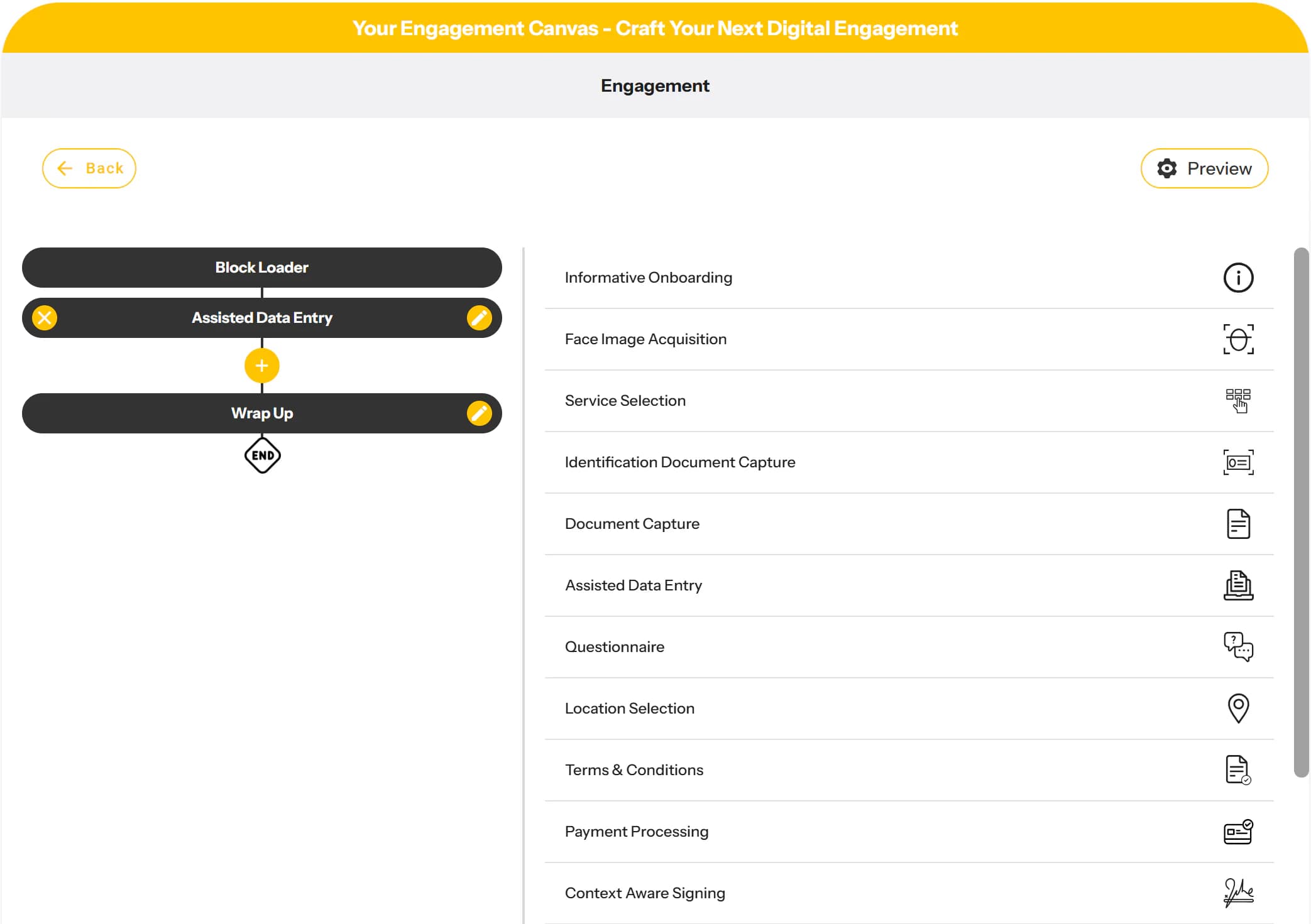
Every check is a step, or a setting on a step, so the institution decides which run and how strictly, flow by flow.
Identity
What the platform decides about a person.
Five capabilities answer the same question from five directions: is this a real human, present now, holding a real document, who is not already in your book under another name.
Compliance
What the platform proves afterwards.
What a regulator, a correspondent bank and a fraud team ask about: can you show what you verified, and would it survive the way names are actually written here.
Why one platform
Six vendors produce six answers. Somebody still has to decide.
When identity, screening, signing, orchestration, transaction risk scoring and document AI come from different suppliers, the integration is yours, the reconciliation is yours, and the gap between their answers is yours to explain to an examiner. Assentify runs every check in one pass and writes a single record that carries the evidence for all of them.
Build and automate
What your team changes without an engineering release.
A control your compliance officer can change on a Tuesday is worth more than a better one that needs a quarter of engineering time.
The record
Evidence is the product.
Any vendor can return a pass or a fail. The question a CISO asks is what the file looks like eighteen months later, when the person who approved it has left and a regulator is reading the row.
Every interaction in Assentify expands into a full case. The reviewer opens no second system to see which lists ran or what the face match scored. One row holds everything the platform observed at the moment of capture.
- row holds the whole case
- 1
- timestamps, start and end
- 2
On an expanded interaction
- Captured selfie and reference face
- Side by side, with a compare view
- Match Percentage
- Live face against the face read off the document
- Device name and user agent
- Captured, not asserted
- Time started and time ended
- Per interaction, to the second
- Captured document image
- Stored when the step is set to store it
- Inline Compliance Hub
- Every list searched, with a pass or match marker
- Decision buttons
- Generated from the Backend Block configuration
All fifteen
Every capability, one link away.
15 of 15 shown
- IdentityBiometricsFace capture, encoding and matching.
- IdentityLiveness detectionPassive, active and configurable.
- IdentityDe-duplicationOne human, one client record.
- IdentityDocument authenticityVision models on the card itself.
- IdentityFraud detectionDepth, read from one camera.
- ComplianceAML and sanctions screeningLoaded from source, daily. Local lists included.
- ComplianceScreening algorithmPhonetic and AI matching, blended.
- ComplianceTransliteration engineArabic and Latin, both directions.
- ComplianceReal-time risk scoringRisk assessed in real time.
- ComplianceDigital signingElectronic, digital, and verifiable on paper.
- Build and automateEngagement buildingCompose it once, publish it everywhere.
- Build and automateFlow automationAutomate the clean case, escalate the rest.
- Build and automateOCR and extractionTemplated OCR, MRZ, Arabic and English.
- Build and automateAI pipeline processingDetection to extraction, chained.
- Build and automateCustom AI modelsTrained on your own document set.
Questions
Capabilities, answered
Assentify provides fifteen capabilities across three groups. Identity covers biometrics, liveness detection, de-duplication, document authenticity and fraud detection. Compliance covers AML and sanctions screening, the screening algorithm, the Arabic and Latin transliteration engine, real-time risk scoring and digital signing. Build and automate covers engagement building, flow automation, OCR and extraction, AI pipeline processing and custom AI models. They are capabilities of one platform, so a verification produces a single record with a single audit trail.
No, they are capabilities of one platform, turned on per step inside a flow, not separate products with separate contracts. A flow designer decides whether a given step performs liveness, whether it stores the capture, whether it enrolls a biometric profile, and which screening lists the Backend Block runs against. That is why the whole verification produces a single record instead of six vendor responses that somebody has to reconcile.
The matching engine and the transliteration engine are Assentify intellectual property, and they are the two that decide whether a regional name is matched or quietly missed. The screening lists are published by others, and Assentify loads the international ones from source into the platform daily, alongside the local Lebanese lists it carries directly. Clients who need a wider catalogue can add a LexisNexis or Refinitiv plugin. Document AI runs on Assentify’s own fine-tuned vision language model. Biometrics run on an internationally recognised biometric engine with iBeta certified passive liveness, plus active and configurable liveness.
The operator sees one expandable record holding the captured selfie beside the reference face, the Match Percentage, the captured document image, the device name, the user agent, the start and end time, the full list of screening lists searched with pass or match markers, and the decision buttons configured for that flow. Rows carry three flags: KYC in red for document expiry, AML in orange for a possible watchlist match, and Modified in yellow when an extracted value was edited, a face match was low, or tampering was detected.
Data Persistence is set per tenant to on cloud or on premise. Lebanon is the proven instance: an Assentify local cloud and in-country GPU servers run document AI, face matching and liveness inside the country. In the UAE, Kuwait, Qatar, Bahrain and Syria, Assentify processes in its own cloud and keeps zero trace there. The data is stored on premise at the client.
For most regulated buyers the answer is liveness and document authenticity, because those two decide whether the rest of the record can be trusted at all. A perfect OCR read of a screen replay produces clean data that is entirely false. Assentify recommends starting with liveness, authenticity and face matching switched on, then adding de-duplication and continuous screening once the first cohort of real clients is through.
Start
Run your own documents through it.
We provision a real tenant, switch on the capabilities you care about, and let your team capture their own cards and faces. Test the attacks you are actually worried about.