Industries
One obligation.
Nine different flows.
Know the client. Screen the name. Keep the record. Answer for the decision. That duty barely changes from a bank to a gold shop. Everything around it does.
- subscribers live
- 30+
- transactions daily
- 100K+
- Sectors, one platform
- 9
- Certified
- ISO 27001
One platform, configured
Every sector draws its flow on the same canvas.
An Engagement Block for what the client does, a Connector Block for the systems it reaches, a Backend Block for the decision. The Flow Builder arranges them into the flow your sector runs.
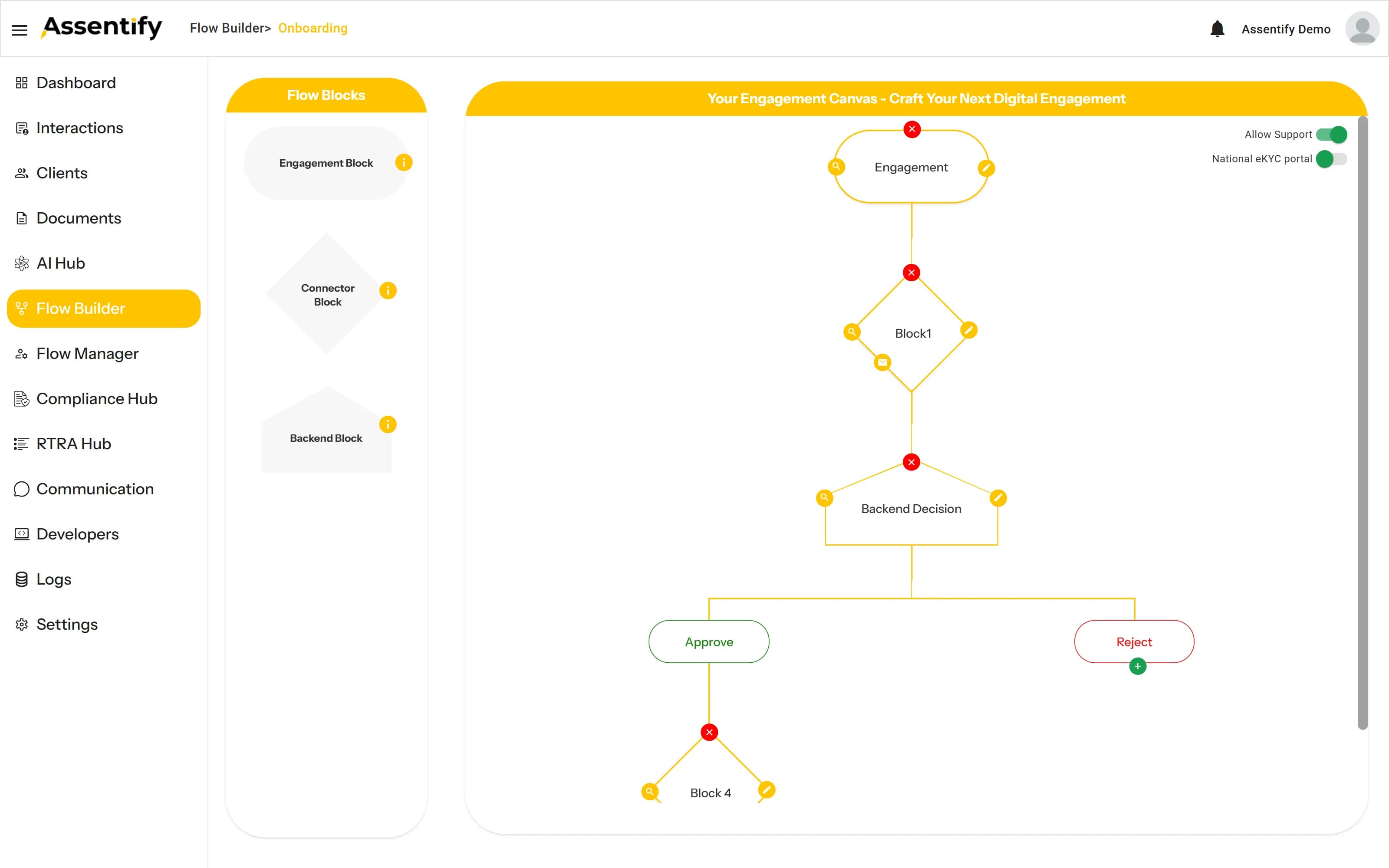
One duty, many shapes
Every one of those entities has to identify the client, screen the name, keep the record and answer for the decision. What differs from one entity to the next is the surface. A bank onboards at a branch counter and on a phone. A gold trader onboards at a shop counter. An NGO onboards in a queue at a distribution point.
One platform, configured
The same Flow Builder, the same Compliance Hub and the same audit trail, arranged into the flow each sector actually runs.
Three flows, three sectors
Pick a sector and step through its flow.
eKYC onboarding with signing for a bank, a loan application for a lender, a quote, payment and issuance for an insurer. Same blocks, same hubs, different flows.
Step 1 of 9 · Engagement Block
Service selection
The client picks the account they want to open.
Runs in Flows Hub
Engagement
- Service selection
- IDV
- Read the ID
- Data collection
- Contract signing
Connector
- Web Hook
Backend
- Screening
- Decision rule
Profile
- Client Profile
Nine sectors
Pick the one you run.









The spine
The industry list is set by statute.
Lebanon Law 44 of 2015 names the entities that must report to the financial intelligence unit. The obliged-entity lists across the region read much the same.
Article 4 entities
Law 44 of 2015 names banks, financial institutions, leasing companies, card issuers, electronic money transfer institutions, exchange institutions, financial intermediaries and collective investment schemes as reporting entities. They report to the same financial intelligence unit, the Special Investigation Commission, and they answer the same correspondence.
Article 5 entities
The same law extends the duty beyond finance: insurance companies, casinos, real-estate dealers and agents, and merchants of valuables including jewellery, precious stones, gold, works of art and antiques. Accountants, notaries and lawyers join them in defined situations.
The pressure behind that statute went up in October 2024, when Lebanon was placed under increased FATF monitoring, and it had not come off at the plenary of 19 June 2026. The published action plan asks for better beneficial-ownership data, better financial intelligence reaching the FIU, and targeted financial sanctions reaching designated non-financial businesses and non-bank institutions. The sectors that used to run on paper are now the ones being looked at.
The argument
Nine industries. Six vendors each. Or one platform.
A regulated business usually buys from six vendors. They cover identity verification, AML screening, digital signing, workflow engines, real-time transaction risk assessment and risk based approach scoring, and custom AI processing pipelines. Assentify replaces all six with one contract, one integration and one audit trail.
A group with a bank, a leasing arm and a wallet runs one contract, one integration and one audit trail across every entity it owns.
Average interactions per client, per month
- TelecomOCR and eKYC onboarding
- 300,000
- Payment providerVIP lane, onboarding, due diligence, scoring
- 150,000
- Banks and Banking-as-a-ServiceOnboarding and customer due diligence
- 100,000
- Loan providerseKYC onboarding
- 25,000
- NGOsDonation disbursement
- 5,000
- Mobile walleteKYC onboarding
- 3,000
- InsuranceeKYC, policy request and issuance
- 1,500
What every sector shares
Six capabilities under every flow.
Volume is half the sizing question. The other half is what happens after onboarding: a wallet’s transactions, an insurer’s signed and templated policies. These six carry all of it.
Questions
Industries, answered.
Assentify serves banks, digital wallets and electronic payment providers, financial institutions and lenders, exchange offices, gold and precious-stone traders, insurers, telecom operators, rental agencies and NGOs. These map closely onto the reporting entities named in Articles 4 and 5 of Lebanon Law 44 of 2015, and onto the equivalent obliged-entity lists across the wider MENA region. Assentify is registered in Cyprus, with research and development in Canada and Lebanon, and clients across MENA.
One platform beats a specialist product per industry because the underlying obligation is the same in every sector and only the flow around it changes. Identify the client, screen the name, record the decision, keep the evidence. A specialist product per industry means a separate integration, a separate contract and a separate audit trail for each line of business you run. Assentify keeps one platform and reshapes the flow, so a bank running retail onboarding, corporate onboarding and a leasing subsidiary uses one system with three flows.
Average monthly interactions per client run from about 1,500 for insurance to about 300,000 for telecom. Banks and Banking-as-a-Service average around 100,000 a month, payment providers around 150,000, loan providers around 25,000, NGOs around 5,000 and mobile wallets around 3,000. Across the whole subscriber base, Assentify processes hundreds of thousands of transactions daily with over 30 subscribers live.
Yes, Assentify is registered in Cyprus and serves clients across MENA, including the United Arab Emirates, Qatar and Kuwait, as well as France. Identity document support covers global documents by market and passports read to ICAO 9303. Lebanon is the deepest specialism, because in-country processing and the local screening lists demand it, and the platform serves the wider region the same way.
No, Assentify does not take over your compliance function. Lebanese regulation prohibits banks and financial institutions from outsourcing compliance monitoring, and the electronic payment provider regime prohibits outsourcing risk management, compliance and internal audit. Assentify is technology your own compliance department operates. The platform runs the screening, presents the matches, records the decisions and produces the evidence. Your officers decide.
A web flow or a WhatsApp conversational flow can be built and published in minutes, then shared as a link, a short URL or a QR code. Embedding the same flow in your own iOS or Android app through the Mobile Flow SDK takes hours. Connecting your core system through the data sources engine is done from the admin interface with no development and no customisation, so your team stays in control of the timing.
Start
Build your sector’s flow in a real tenant.
We provision a tenant on your own subdomain with a sandbox allowance, load the lists you screen against, and let your team build the flow they run every day.